

Power’s out. Cell towers? Gone. The sky looks like it’s trying to kill you, and all you’ve got is one shot at getting good intel. This is not the time to realize your “emergency radio” is just a glorified Bluetooth speaker.
After testing several of the best emergency radios in real-life blackout scenarios (read: no power, no patience), the Eton Odyssey Hand Crank NOAA Emergency Radio came out on top. It’s not the smallest or the cheapest, but it works. Every time. In every condition. And it’s built like it expects to get thrown into a go-bag next to your multitool and trauma kit.

This isn’t some cute retro box that looks good on a bookshelf. It’s a tool. And when the wind starts howling, you’ll want this one talking to NOAA for you.
In this guide, we’ll break down which radios we tested, how they actually performed, and which ones are worth tossing into your emergency kit. Some surprised us. One annoyed us. And a couple might just save your butt someday.
Comparison of Our Favorite Emergency Radios

Three different charging options
Bright LED Flashlight
Rubberized casing
MSRP: $80


Other Emergency Radios we recommend:
Best Emergency Radios
Eton Odyssey Hand Crank Emergency Radio – Best Overall
If we had to pick one emergency radio to toss in the truck, stash in a go-bag, or rely on while huddled under a tarp waiting for the storm to pass, it’s this one. The Eton Odyssey isn’t just “good for emergencies.” It is an emergency tool. Rugged enough to survive being dropped (ask us how we know), powerful enough to charge your phone when the grid goes dark. Plus, it’s clear enough to actually hear NOAA alerts before you need a snorkel.
Is it overkill? Probably. Do we love that? Absolutely.
Features
This thing is loaded. Not the kind of loaded that adds flashy features you’ll never use, but the kind that makes it more useful the worse things get.
- NOAA weather band + AM/FM/SW/WB reception
- Hand crank, solar panel, and USB-C charging
- Rechargeable battery (or swap in AAs if needed)
- Bright LED flashlight + red flashing beacon
- Bluetooth audio (you know, in case you want tunes after the storm)
- Sturdy carry handle and built-in antenna
- Rubberized casing that shrugs off abuse
Our Testing Scores
We didn’t baby it. We left it in the rain and cranked it until our arms were sore. It still delivered.
| Test Category | Score (out of 10) | Why? |
|---|---|---|
| Signal Reception | 9.5 | Pulled NOAA alerts clearly even indoors and in the woods. |
| Battery Life | 9 | Solar trickle-charged well; crank was surprisingly effective. |
| Durability | 9.5 | Fell off a truck bed. Still worked. Enough said. |
| Ease of Use | 8.5 | Buttons are tactile, but the multi-band tuning takes a second to learn. |
Our Expert Take on the Eton Odyssey
This is the radio that made the others feel like toys.
I tested it during a simulated “oh crap” scenario where we shut off power for 24 hours. It charged a phone, gave us clear NOAA alerts every time, and even worked as a speaker when the wind died down and we wanted to pretend things were normal.

The hand crank isn’t a gimmick here. It actually works. Two minutes of cranking gave us enough juice for 15+ minutes of audio. And the flashlight? Bright enough to be useful, not so bright that it blinds you when you check it in the dark. (Looking at you, flashlight-from-hell radios.)

The solar panel will also charge the radio. We simply left it outside for a couple hours and it charged the battery to about 50%.

Bonus points: The whole thing feels like it was designed by someone who actually uses this stuff, not a marketing team trying to impress at CES.
PROS
Tough as nails
Reliable NOAA reception
Charges your phone without whining
Feels like legit gear, not a gimmick
CONS
Tuning through the bands takes some learning
A little bulky for ultralight folks
Nitigo Emergency Radio – Best Budget Option
I didn’t expect much from the Nitigo Emergency Radio. It looks like something you’d buy because the Amazon algorithm told you to. But after a week of storms and power outages, this thing earned its spot.
It’s compact, feature-packed, and doesn’t flinch under pressure. No, it’s not a tank like the Eton Odyssey. But for under $50? It punches way above its weight class.
Features
Nitigo crammed a lot into a small, backpack-friendly shell. It doesn’t feel cheap. It doesn’t act cheap. And it might just be the best radio for folks who want “reliable” without “ridiculous.”
- AM/FM/NOAA weather bands
- 4000mAh rechargeable battery
- Hand crank, solar panel, USB-C input
- LED flashlight with reading lamp
- SOS alarm (use sparingly unless you like terrifying your neighbors)
- Compact body with a grippy case
Our Testing Scores
We ran it through the same tests as the rest: blackout drills, storm tracking, and crank-happy abuse.
| Test Category | Score (out of 10) | Why? |
|---|---|---|
| Signal Reception | 8 | NOAA reception was strong in most areas; AM/FM were decent. |
| Battery Life | 8.5 | 4000mAh lasted longer than expected, especially in passive use. |
| Durability | 7.5 | Didn’t break when dropped, but plastic casing shows wear. |
| Ease of Use | 8.5 | Big buttons, clear labeling, intuitive to operate even half-awake. |
Our Expert Take on the Nitigo
I stashed this radio in the glovebox and used it through a 12-hour power outage after a storm rolled through. It never failed to pick up NOAA alerts. The crank is efficient (though a bit small), and the flashlight is brighter than most of the “survival” flashlights we’ve tested. It also has a “reading light” that is not as bright. I like that I can position the light and the solar panel with the same hinge.

Charging a phone? Absolutely possible. No, it won’t take you from 0% to 100% five times over, but it’ll make a dead iPhone usable again, and that’s what counts when stuff goes sideways.

I like that I can charge the radio with the built-in solar panel, and the charging LED brightness tells me how intense the solar exposure is.

It’s not indestructible, but it’s practical. And honestly? We trust it way more than some of the more expensive gimmick-loaded models we’ve seen.
PROS
Compact and lightweight
4000mAh battery outperforms many pricier radios
Legit phone-charging ability
Good NOAA reception
CONS
Not as durable as higher-end options
Crank handle is small for big hands
Midland WR400 – Best for Home
While the other radios on this list are built for bug-out bags and blackout survival, the Midland WR400 is a different kind of tool. It’s not meant to be tossed in a backpack or powered by frantic cranking. This one lives on your nightstand, quietly monitoring NOAA alerts so it can wake you up before the tornado does.
Think of it as your stay-at-home survivalist. It won’t help in the field (although it could in a pinch), but it absolutely earns its place in any serious prepper’s basecamp, or, you know, your house.
Features
Midland leaned into simplicity and reliability here. There’s no crank, no flashlight, no gimmicks, just a weather alert system that works.
- NOAA weather band w/ SAME (Specific Area Message Encoding) technology
- Alerts you only for your local county (or up to 25 of them)
- 90dB alarm with flashing LED and voice broadcast
- AC-powered with battery backup (3x AA batteries)
- USB output for phone charging
- Easy-to-read LCD screen with alert memory
- Programmable Alerts
Our Testing Scores
I tested it in the most realistic way possible: plugging it in and forgetting it existed until bad weather rolled in. It performed like a champ. In fact, this radio has been on my nightstand for the past 5 years.
| Test Category | Score (out of 10) | Why? |
|---|---|---|
| Signal Reception | 8.5 | NOAA channels came through loud and clear with decent antenna positioning. |
| Battery Life | 8 | Backup batteries kicked in smoothly during power outage. |
| Durability | 7 | Sturdy for indoor use, but don’t drop it down the stairs. |
| Ease of Use | 9 | Setup is painless and alerts are crystal clear. |
Our Expert Take on the Midland WR400
This is the radio you want if you’re hunkering down at home. I tested it during an overnight storm, and the alert system woke us up around 2 a.m. with a tone that could raise the dead (or at least your groggy, half-asleep self). No fiddling with dials, no missed messages, just immediate, localized weather alerts that could give you a life-saving head start.

I love that it filters alerts by county. No more getting woken up at 3 a.m. for a storm 150 miles away. Also: it doesn’t take up much space, doesn’t try to be a flashlight, and doesn’t pretend it’s portable.

I really love how I can customize the alerts. I set mine so that the loud tone only goes off during a tornado warning. Otherwise, all other warning are visual only (the light flashes yellow for watches and red for warnings). This way, when I hear the alarm, I know it is a tornado warning.

While it is mainly meant to be powered from an outlet, it will run on batteries as well. I like to run the Pale Blue Earth Rechargeable batteries in mine. It has a built in USB port, so in a pinch I can charge my phone with it during a power outage.
PROS
Localized SAME alerts are a game changer
Loud alarm with clear voice messages
Easy setup and menu navigation
Perfect for long-term shelter-in-place scenarios
Programmable Alerts
CONS
Not Rechargeable
No radio for casual listening, just alerts
Needs decent antenna positioning for best reception
Midland ER310 PRO

The Midland ER310 Pro is one of the more popular names in the emergency radio space. It’s got the branding, the polished marketing, and the big promises: NOAA alerts, three power sources, flashlight, phone charger, etc.
And to be fair, it delivers. But while it didn’t let us down, it also didn’t wow us. In a lineup full of lower priced overachievers, the ER310 Pro played it safe. Competent? Yes. Game-changing? Not really.
Features
The ER310 Pro has everything we needed plus more, which can be a good or bad thing depending on your expectations. It’s a step up from a basic emergency radio, and has a larger battery than most others. It also adds Bluetooth capability and a temperature display. Even an electronic dog whistle!
- AM/FM + NOAA weather band reception
- 10,000mAh rechargeable battery
- Hand crank, solar panel, and USB charging
- Bright LED flashlight with SOS strobe
- USB output for phone charging
- Compact design with decent build quality
- Bluetooth speaker
- Temperature display
Our Testing Scores
I gave it the same treatment: storms, crank tests, flashlight runs, and a good old-fashioned 24-hour power outage drill.
| Test Category | Score (out of 10) | Why? |
|---|---|---|
| Signal Reception | 8 | NOAA came through clear; AM/FM was fine but nothing special. |
| Battery Life | 9.5 | 10,000mAh is great, it lasts longer than most others. |
| Durability | 8.5 | Solid build; no cracks or tantrums after a few drops. |
| Ease of Use | 9 | Super simple interface. One of the easiest radios to figure out in the dark. |
Our Expert Take on the Midland ER310 Pro
This is the radio we wanted to love, and we do like it. It is the flagship of Midland’s lineup.

I used it during a spring thunderstorm that knocked out power for six hours. It kept me in the NOAA loop, the flashlight lit the kitchen, and it even juiced up a nearly-dead phone enough to check in with family. It passed the test, but so did others that cost less.

The solar panel is a nice idea, but let’s be real: unless you’re living on a sun-drenched rooftop, it’s just not fast enough. You’ll be cranking or charging it via USB most of the time. But, with the long battery life, you won’t have to often.

The Bluetooth and Temperature display is also nice to have, but nothing that really made a difference for us. The electronic dog whistle is interesting for areas that are prone to earthquakes, none of the others have this feature.
All in all this is a robust emergency radio with a long battery life. However it is twice as much as some of the others. As they say two is better than one.
PROS
Great signal reception
Clean, user-friendly design
Tough enough for field use
SOS flashlight is actually useful
Good Battery Life
CONS
Solar charging is slow (don’t rely on it)
RunningSnail Emergency Crank Emergency Radio
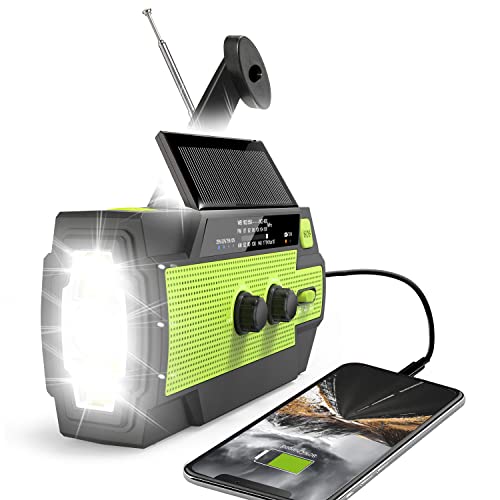
You ever buy something expecting it to suck, and then it doesn’t? That’s the RunningSnail Emergency Radio in a nutshell.
It’s basic. It’s plastic. It looks like it came free with a flashlight. But in testing? This little guy held its own. If you’re looking for a budget emergency radio that won’t completely fall apart the first time you drop it, RunningSnail deserves a second look.
This is the “I need one for every car and don’t want to spend $60 each” kind of radio. Is it the best? No. But it’s way better than it has any right to be.
Features
Don’t expect premium bells and whistles, but for under $30, this is a surprisingly functional setup.
- AM/FM + NOAA weather band
- 2000mAh battery (USB rechargeable)
- Hand crank and solar panel charging
- LED flashlight
- USB output for small-device charging
- SOS alarm and reading lamp
- Carry handle and lanyard loop
Our Testing Scores
I abused it like all the others: cranked it to death, shoved it in a go-bag, used it in the rain. It held up.
| Test Category | Score (out of 10) | Why? |
|---|---|---|
| Signal Reception | 7.5 | NOAA was fine in urban areas, struggled in low-signal zones. |
| Battery Life | 7 | It’ll get you through a night, just don’t expect a marathon. |
| Durability | 6.5 | Plastic body is fine, but don’t throw it at a wall. |
| Ease of Use | 8 | Buttons are intuitive and labeled for actual humans. |
Our Expert Take on the RunningSnail
I didn’t expect much, and maybe that’s why this radio impressed me. It’s the perfect backup. The kind of thing you throw in your emergency drawer and forget about until the power goes out, and then it actually works.

I tested it during a brief blackout, and it kept us informed without drama. NOAA alerts came through, the flashlight was just bright enough to not trip over the dog, and yes, you can charge a phone a little with it. (Don’t expect miracles. This is a last-resort trickle, not a full-on power bank.)

The hand crank is, well, it’s a hand crank. You’re not getting cardio, but you will feel like you’re shaking a margarita after a minute or two.

The built-in solar charging panel works well. I just left it out in the sun for effortless charging. The panel also tilts so I can better position it directly in the sun’s rays.
PROS
Dirt cheap
Gets the job done
Lightweight and easy to store
Surprisingly functional crank and light
CONS
Feels like a toy
Weak battery compared to others
SOS alarm is terrifying and very easy to trigger by accident
Emergency Radio Comparison Table
| Radio | Best for | Power Options | NOAA Reception | Battery Life | Portability | Flashlight | Phone Charging | Our Take |
|---|---|---|---|---|---|---|---|---|
| Eton Odyssey | All-around survival | Crank, Solar, USB, AA | 5/5 | 4/5 | Medium | Super bright | Full charge capable | Rugged, reliable, and ready for the end of the world (or just Tuesday). |
| Nitigo Emergency | Budget-friendly prepping | Crank, Solar, USB | 4/5 | 4/5 | High | Decent | Emergency Use | Surprisingly powerful for the price. Solid mid-tier pick. |
| Midland WR400 | Home base alerting | Wall + AA backup | 4/5 | 4/5 | Not portable | N/A | Yes | Your home’s early warning system. Not a field tool. |
| Midland ER210 | Name-brand simplicity | Crank, Solar, USB | 4/5 | 3/5 | Medium | Bright w/ SOS | Limited | It works, but doesn’t blow us away. Reliable, just not exciting. |
| RunningSnail | Backups & car kits | Crank, Solar, USB | 3/5 | 2/5 | High | Functional | Barely | Cheap and better than expected. |
How We Tested These Emergency Radios
I didn’t just unbox these radios and nod thoughtfully at the instruction manuals. I used them like someone would when the lights go out and the cell towers quit.
Here’s how we ran them through the wringer:
- Simulated Blackouts: Each radio was tested during a 24-hour period without access to power or Wi-Fi. No cheating. Just crank, solar, and backup batteries to get us through.
- Storm Tracking: We tested NOAA reception during active weather warnings in multiple locations, including urban areas and rural locations.
- Crank & Solar Trials: We cranked each radio by hand for 2 full minutes to see how much power it generated and how long it kept going. (Spoiler: some of them did better than our arms.)
- Phone Charging Tests: We drained a phone to near-zero and tried to bring it back to life using only the radio’s power options. Some pulled it off. Some didn’t even try.
- Durability Abuse: We dropped them on pavement, tossed them into bug-out bags, and left them out in the rain. If a radio acted like a diva, it didn’t score well.
- Usability in the Dark: Because emergencies don’t politely happen at noon. We fumbled with dials and tiny screens in pitch black just like you probably will.

I judged each radio on real-world survival usefulness, not just tech specs. If it can’t handle a stormy night with no power and no patience, it’s not going in my go-bag.
These reviews are based on what actually works when things get sketchy, not what sounds good in a product description.
What to Look for Before You Buy an Emergency Radio
Buying an emergency radio shouldn’t feel like picking out a new gaming mouse, but it kind of does if you don’t know what matters. And trust us, you don’t want to realize after the tornado sirens start that your new radio is just a glorified paperweight or it starts alerting you about everything.
Here’s how to make sure your “emergency radio” doesn’t become just another piece of junk in the junk drawer.
SAME Technology: Because Not All Alerts Are About You
SAME stands for Specific Area Message Encoding, and it’s the difference between “storm in your county” and “storm nowhere near you but enjoy the 3 a.m. panic attack.”
This feature lets you program your radio to only go off for alerts that matter to you. No more being startled awake by a flood warning in a county you couldn’t point to on a map. It’s smart filtering for survival, not just noise reduction.
If your radio doesn’t have SAME? You’re basically subscribing to weather alerts for half the state. Good luck sleeping.
Power Sources: If You Only Have One, You Have None
The whole point of an emergency radio is that it still works when everything else doesn’t. That means you want multiple power sources, not just a USB port and some wishful thinking.
Here’s the prepper-friendly trifecta:
- Crank: Yes, it’s annoying. Yes, it works. Crank = control.
- Solar: Slower than molasses in wintertime, but helpful in the long haul.
- Battery backup / USB charging: For when the grid still functions, briefly.
The more options, the better. Because when the power goes out and the storm lasts longer than expected, the last thing you want is a dead radio and a lot of regrets.
Features: It Should Do More Than Scream at You
Look, you’re not buying this thing for entertainment. But that doesn’t mean it should be completely joyless.
Here are the extras that actually matter:
- LED Flashlight: Because tripping over your dog in the dark is not peak survival.
- USB Charging Port: A little juice can bring your phone back to life just long enough to text “I’m fine” or check a radar map.
- SOS Alarm: Useful in emergencies. Also very effective at waking up your entire campsite by accident. (Ask us how we know.)
You don’t need disco lights or Bluetooth speakers. But a few practical add-ons can turn a basic radio into a legit multi-use survival tool.
Durability: Desk Candy vs. Bug-Out Buddy
Here’s where people get it wrong: not all emergency radios are meant to go with you. Some belong on a nightstand, plugged into the wall. Others are built to bounce around inside a go-bag and still function when they hit the dirt.
- Desktop radios (like the Midland WR400): Great for home alert systems. Reliable, but fragile.
- Portable radios (like the Eton Odyssey): Built for chaos. Weather-resistant, rubberized, and usually crank-friendly.
Think about how you plan to use it. If it’s staying put, go for loud, clear, and SAME-enabled. If it’s part of your bug-out kit, pick something rugged with multiple power options and a flashlight that doesn’t suck.
Emergency Radio Mistakes to Avoid
An emergency radio is only as useful as you let it be. And trust us, we’ve seen people turn great radios into glorified paperweights by doing some (or all) of the following:
1. Relying on the solar panel like it’s a power plant
We get it, solar sounds sexy. But unless you’ve got direct sun and all day, you’re not topping off anything. It’s a slow trickle at best. Use solar for top-offs. Rely on USB or crank for real juice.
2. Never testing the crank until it matters
You will hate your life if the first time you try the crank is during a blackout. Crank it a few times when it arrives. Know how it feels. Know how long it takes to get a decent charge. Your future self will thank you.
3. Not programming SAME codes
If your radio has SAME and you never set it up, congratulations. You’ve just signed up for every county’s alerts in a 300-mile radius. Fix that. (See the next section.)
4. Forgetting to replace backup batteries
Most radios have a backup battery compartment. If the rechargeables die and your AAs are also dead? That’s not a good look in an emergency. Check them quarterly, like smoke alarms.
5. Thinking “I’ll just use my phone”
We love smartphones. But during major storms or grid-down events, cell towers go dark or jammed fast. Radios don’t. That’s the whole point.
How to Program SAME Codes
If your radio supports SAME (Specific Area Message Encoding), good news: you can customize it to only go off for weather alerts in your county.
Bad news: it’s not always intuitive. But don’t worry, we’ve got you.
Step-by-Step Setup (Most Models Follow This Process):
- Find your county’s SAME code. Go to https://www.weather.gov/nwr/index and click “SAME Codes”. You’ll see a list by state. Write down your county’s 6-digit code.
- Put your radio in setup mode. Press and hold the “Menu” or “Set” button (depends on the model) until the display starts blinking or shows “SAME.”
- Enter your SAME code(s). Use the arrow keys or number pad to input your code. Some radios allow multiple counties. Check the manual if you want more than one.
- Save and exit. Hit “Enter,” “Menu,” or whatever your radio uses to confirm. Once saved, it’ll filter alerts to just those counties.
- Test it. NOAA runs test alerts weekly. Leave the radio on for a while and make sure it still picks up the test broadcast with your new settings.
Which Emergency Radio Should You Get?
If you’re serious about preparedness, an emergency radio isn’t optional. It’s essential. After putting five of the most popular models through the wringer, the Eton Odyssey stood out as the clear winner: tough and ready for real-world chaos.
But that doesn’t mean the others are junk. The Nitigo delivers big value for the price, the Midland ER210 is solid if a bit overhyped, and the RunningSnail is the best cheap radio that doesn’t totally suck. If you’re staying put, the Midland WR400 is your early-warning MVP.
The key is picking the right tool for the job, whether that’s bugging out or bunkering down.
One final tip: Don’t wait until the storm hits. Get your gear squared away now. Because when things go sideways, “I meant to buy one” won’t help.
Now, read our guide on the Best HAM Radios for preppers. These will give you the ability to communicate with others up to a few miles away.
