

Most people don’t get lost all at once. It usually starts small: a missed turn, a trail that looks different on the way back, or a GPS route that suddenly stops updating. You assume you’ll correct in a minute. Then daylight fades and every direction starts to look the same.
Search-and-rescue teams report the same pattern again and again: people rarely run into trouble because conditions are extreme. They get into trouble because they lose track of where they are and make a few rushed decisions that send them farther from safety.
Navigation failure is dangerous because it multiplies every other survival problem. When you don’t know where you are, you waste energy, lose time, and often move in the wrong direction.

Modern technology helps, but it also creates overconfidence. Phones die and GPS signals fail. When those tools stop working, skill matters.
This guide serves as Survival Stoic’s navigation hub. Inside, you’ll learn:
- The navigation skills that keep you oriented
- The gear that supports good decisions
- Practical methods to avoid getting lost in the first place
From here, you can dive deeper into compasses, GPS tools, backtracking, urban navigation, and training drills that build real-world competence.
Because the goal isn’t just carrying navigation gear.
The goal is knowing how to get home.
Why Navigation Skills Matter
Getting lost doesn’t usually happen because someone makes one catastrophic mistake. It happens because of small, normal decisions that slowly stack up.
You take a side trail without thinking much about it. Terrain looks familiar enough, so you don’t check direction. You assume you’ll remember the way back. Then conditions change: weather rolls in, darkness falls faster than expected, or landmarks look different from the opposite direction.
By the time uncertainty sets in, people often keep moving instead of stopping to reassess. Panic pushes them to hurry. And hurrying usually makes things worse.
Search-and-rescue teams see this pattern constantly. Most lost hikers and travelers weren’t unprepared or reckless. They simply didn’t maintain awareness of where they were relative to safety.
Navigation skills matter because they prevent small problems from becoming emergencies.
When you understand navigation, you:
- Notice when you drift off course
- Track your movement automatically
- Recognize landmarks and route changes
- Retrace your steps when needed
- Make calm, rational decisions under stress
Without those skills, every survival priority becomes harder. You burn extra calories. You waste daylight. Water sources and shelter become harder to find. And rescue becomes less likely because your location becomes unpredictable.
Technology helps, but it can’t replace awareness. GPS devices fail. Phones die. Batteries run out in cold weather. Signals disappear in canyons, dense forests, or remote terrain.
Navigation skill is what keeps you safe when tools stop working.
At Survival Stoic, we treat navigation as a core preparedness skill, not just an outdoor hobby. The same awareness that keeps you oriented on a trail also helps in urban emergencies, evacuations, and everyday travel disruptions.
Before diving into gear, it helps to understand the different navigation methods available and when each works best. In the next section, we’ll break down the main navigation systems people rely on and how they fit together.
Survival Navigation Methods
There isn’t one single way to navigate safely. Experienced outdoorsmen and rescue professionals use multiple navigation methods, switching between them depending on terrain, conditions, and available tools.
Each method has strengths and limitations. The safest approach is learning how they work together so that when one system fails, another takes over.
Here’s a quick overview of the primary navigation methods you’ll encounter throughout Survival Stoic’s guides.
Map & Compass Navigation
Map and compass navigation remains the most reliable method because it doesn’t rely on batteries, signals, or software. When used correctly, it works anywhere on earth.
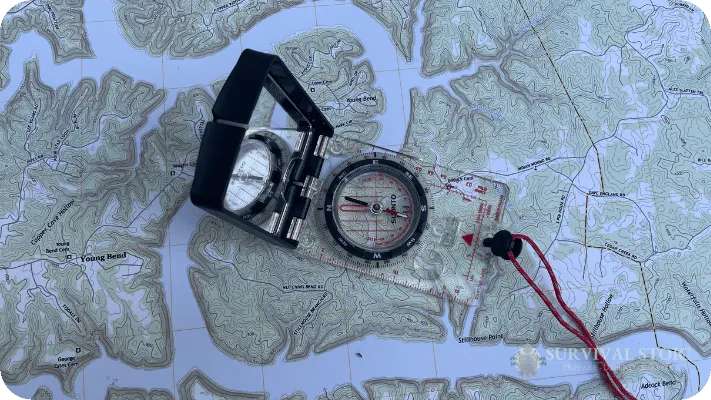
This method allows you to:
- Determine direction of travel
- Plot routes across terrain
- Track your position relative to landmarks
- Correct drift before you wander off course
The downside? It requires practice. Many people carry compasses but never learn how to use them properly.
GPS Navigation
GPS devices make navigation faster and easier. Modern watches, handheld units, and phones can track movement and guide you back using breadcrumb trails.
GPS excels at:
- Fast route tracking
- Location precision
- Recording movement paths
- Backtracking along recorded routes
However, GPS systems rely on power and signal availability. Batteries die, devices fail, and certain terrain or weather conditions interfere with reception.
Natural Navigation
Natural navigation uses environmental awareness instead of equipment.
Examples include:
- Sun position and shadow movement
- Terrain features and water flow
- Wind patterns and vegetation clues
- Recognizing landscape orientation
Natural navigation works best as a support skill, helping confirm direction when tools aren’t available or when visibility is limited.
It also builds awareness, reducing reliance on technology.
This skill also overlaps with other survival skills like Mantracking and Foraging.
Urban Navigation
Navigation challenges aren’t limited to wilderness settings. Urban environments create different problems:
- Confusing road networks
- Crowds and obstacles
- Rapid route changes
- Limited visibility or blocked paths
Urban navigation blends route awareness with situational awareness and personal safety considerations.
You can learn more from our experts here:
→ Urban Tracking Introduction
→ Urban Tracking Part 2
→ Situational Awareness Training
Why Multiple Methods Matter
The key takeaway: good navigators don’t rely on one system.
They combine tools and awareness:
- GPS for speed
- Compass for reliability
- Terrain awareness for confirmation
- Backtracking techniques for safety
In the next section, we’ll look at the gear that supports navigation, and how to choose tools that actually help instead of adding false confidence.
Best Survival Navigation Gear (And What Actually Matters in the Field)
Navigation gear isn’t magic. It doesn’t replace awareness or skill. What it does is make good decisions easier and mistakes easier to catch before they become problems.
The goal isn’t carrying more equipment. The goal is carrying reliable tools that support your awareness and give you backups when things go wrong. All navigation gear we recommend is field-tested during hiking, hunting, and emergency-preparedness training rather than evaluated only from specs.
A solid navigation setup usually layers three things:
- A primary navigation tool
- A reliable backup
- A way to recover if you get turned around
Let’s walk through what that looks like in practice.
Survival Watches: Navigation on Your Wrist
Modern survival watches have become incredibly capable tools. Many combine GPS tracking, digital compasses, altimeters, route recording, and breadcrumb navigation into something you wear every day.

Their biggest advantage?
They’re always on you.
If you’re hiking or responding to an emergency, your watch is already there tracking movement. That makes backtracking far easier if plans change or visibility drops.
Strengths include:
- GPS route tracking
- Breadcrumb navigation back to start or a point of interest
- Altitude and weather awareness
- Long battery life compared to phones
But watches still run on batteries. They’re excellent tools, not standalone solutions.
If you’re choosing one, start here:
Compasses: The Tool That Never Needs Batteries
A good compass weighs almost nothing, never needs charging, and works anywhere on earth.
That’s why experienced outdoorsmen still carry one, even when using GPS.
A compass allows you to:
• Maintain a direction of travel
• Confirm bearings
• Reorient yourself when confused
• Navigate when electronics fail
The problem is many people carry compasses they don’t know how to use. A compass without training becomes dead weight.
If you’re choosing or learning to use one:
→ Best Survival Compasses
→ How to Backtrack When Lost
GPS Units: Dedicated Navigation Tools
Handheld GPS units sit between watches and phones. They’re built specifically for navigation and usually offer:
- Longer battery life
- Better durability
- Stronger signal reception
- Larger map displays
Hunters, search-and-rescue teams, and serious backcountry travelers often prefer dedicated GPS units because they’re built for rough conditions.
We’ll expand Survival Stoic’s GPS coverage as we complete more long-term testing.
Offline Maps & Navigation Apps
Smartphones are powerful navigation tools, as long as you prepare them correctly.
With offline maps downloaded, your phone can:
- Show position without signal
- Record routes
- Help with urban navigation
- Provide satellite imagery
The problem is battery life. Cold weather, constant GPS use, and emergencies drain phones quickly.
Phones work best when paired with:
- Power banks
- Vehicle charging
- Backup navigation tools
Your phone should help navigation, not be your only plan.
We recommend investing in printed typography maps that you can use offline. Have one of your surrounding area and any planned bug out routes. Keep these in your bug out bag for offline navigation. They only weigh a few grams, but they can do a lot of good.
The #1 Rule: Always Carry a Backup
Here’s the practical field rule:
One navigation tool is convenience. Two is safety.
A typical reliable setup looks like:
- GPS watch or GPS device as primary
- Compass as backup
- Offline maps or printed map as support
That combination covers almost every real-world scenario.
In the next section, we’ll step away from gear and break down how compass navigation actually works, so your backup tool is something you can confidently use if technology quits on you.
Compass Navigation Basics (The Skill That Never Fails)
Ask anyone who spends serious time outdoors what navigation skill matters most, and you’ll hear the same answer:
Know how to use a compass.
A compass works in dense forests, mountains, deserts, cities, and storms. It doesn’t lose signal, crash, or run out of battery. When everything else fails, it still points the same direction.
But, a compass only works if you know what to do with it.
Blake likes to joke that most compasses people carry are basically expensive keychains, because they never learned how to use them beyond “north is that way.”
In reality, compass navigation isn’t complicated. You don’t need advanced land navigation training to get real value from it. A few basic skills dramatically reduce your chances of getting lost.
What a Compass Actually Helps You Do
A compass isn’t just for finding north. It helps you:
- Maintain a consistent direction of travel
- Navigate around obstacles without drifting off course
- Align your map with terrain
- Return along the same direction you traveled in
- Correct mistakes before they become major problems
One of the biggest causes of getting lost is gradual drift. People naturally veer off course without realizing it. Over distance, a small error becomes a huge deviation.
A compass stops that drift.
The Most Important Beginner Skills
If you only learn a few compass skills, focus on these:
Following a bearing
Pick a direction and maintain it consistently.
Turning around correctly
Know how to reverse your direction when backtracking.
Orienting your map
Match your map to the terrain around you.
Checking direction regularly
Small course corrections prevent big mistakes later.
These basics alone prevent most navigation problems.
Compass Skills Make Every Tool Better
Even if you normally rely on GPS or watches, compass knowledge still matters.
When GPS routes look wrong or devices fail, a compass lets you confirm direction and avoid panic-driven decisions.
It also works as a confidence check. If your GPS says you’re heading one way and your compass says another, something needs correcting.
Blake is working on an in-depth guide on using a compass. In the meantime, work on picking a direction and sticking to it. That alone will keep you traveling in a straight line.
Next, we’ll look at the strengths and limitations of GPS navigation, and why smart navigators treat electronics as support tools rather than guarantees.
GPS Navigation: Strengths & Weaknesses in Real Survival Situations
GPS navigation changed how people move outdoors. What used to require careful map study and compass work can now happen with a quick glance at your wrist or phone.
And to be clear, GPS is an incredible tool. Blake uses it constantly when testing gear, scouting routes, or running unfamiliar terrain.

But here’s the Survival Stoic reality:
GPS is a tool. Not a guarantee.
People get into trouble when they forget that difference.
Where GPS Excels
GPS navigation shines when speed and accuracy matter.
Modern GPS devices and watches can:
- Show your exact position
- Record your route automatically
- Create breadcrumb trails back to safety
- Mark camps, vehicles, or water sources
- Help navigate complex trail networks
If you hike out, hunt deep terrain, or explore unfamiliar areas, GPS makes route recovery dramatically easier.
Instead of guessing your way back, you can simply follow your recorded path.
That convenience is why GPS tools have become standard gear for serious outdoorsmen.
Where GPS Can Fail You
The danger isn’t GPS itself. It’s relying on it as your only navigation plan.
Common failure points include:
Battery life
Cold weather, constant tracking, or emergencies drain batteries fast.
Signal issues
Canyons, heavy forest cover, storms, and remote terrain can interfere with reception.
Device damage
Drops, water exposure, or simple hardware failure can end your navigation instantly.
User error
Wrong settings or poor preparation cause more problems than people admit.
Search-and-rescue teams routinely encounter lost hikers carrying dead phones with no backup plan.
Technology worked, until it didn’t.
GPS Should Support Awareness, Not Replace It
The safest navigators still watch terrain and direction while using GPS.
They know:
- Where they started
- Which direction safety lies
- How terrain is changing around them
So if GPS fails, they already understand their situation.
Blake puts it simply:
“If your only navigation plan is a battery, you don’t have a plan.”
The Smart Approach: Combine Tools
The most reliable field setup looks like this:
- GPS device or watch for convenience
- Compass for reliability
- Awareness to tie everything together
When those three work together, navigation becomes far safer and less stressful.
In the next section, we’ll look at one of the most practical skills every outdoorsman should know:
Backtracking Techniques
One of the biggest navigation mistakes people make is pushing forward when they’re unsure instead of going back to the last place they knew where they were.
Backtracking sounds simple, but in real situations it’s easy to mess up. Stress builds, daylight fades, and people convince themselves the next ridge or trail will fix everything. Instead, they move farther from safety.

Experienced outdoorsmen handle uncertainty differently. When something feels off, they stop and retrace their steps. Backtracking is one of the smartest navigation decisions you can make.
Why Backtracking Works
When you retrace your path, you return to known terrain. Known water sources, known trails, known routes, or known exit points.
That eliminates guesswork.
Instead of gambling on unknown directions, you move toward information you already confirmed earlier. In survival situations, certainty is safety.
GPS Breadcrumb Navigation
Modern GPS devices and survival watches make backtracking easier than ever.
As you travel, most devices automatically record your movement path. If you get disoriented, you can simply follow that breadcrumb trail back to where you started or to your last known point.
This works extremely well, as long as your battery still has power.
That’s why GPS is helpful, but not your only solution.
Marking Routes as You Travel
Another smart habit is marking your path as you move.
This can include:
- Noticing distinct landmarks
- Mentally noting turns and terrain changes
- Watching trail features carefully
- Leaving subtle markers when appropriate
Experienced hikers and hunters constantly check behind them as they travel, memorizing how the return route looks.
Trails often look completely different going the opposite direction. Turning around periodically helps prevent confusion later.
The Most Important Rule: Stop Early
Backtracking only works if you realize something is wrong early.
Common warning signs include:
- Landmarks don’t match your memory
- Terrain looks unfamiliar
- Travel is taking longer than expected
- Direction feels uncertain
When those signs appear, stop and reassess before continuing. The farther you go in the wrong direction, the harder recovery becomes.
Learn Backtracking Step-by-Step
If you want a full breakdown of practical techniques, including GPS, compass, and awareness-based methods, this guide walks through the process in detail:
→ How to Backtrack When Lost – Steps to Find Your Way Home
Next, we’ll look at navigation in environments most people actually encounter every day, and how awareness and route planning change in urban emergencies.
Urban Navigation & Tracking: Moving Safely in Cities and Suburbs
Most people picture navigation as a wilderness survival problem. But in real emergencies, many navigation challenges happen in towns and cities.
Evacuations, natural disasters, civil unrest, major traffic shutdowns, or infrastructure failures can quickly make familiar areas confusing or difficult to move through.
Roads close. Traffic stops. Landmarks disappear behind crowds or smoke. GPS routing becomes unreliable as conditions change faster than maps update.
Urban navigation isn’t about finding north in the woods; it’s about moving safely and efficiently through unpredictable environments.
And awareness matters even more here.

Why Urban Navigation Is Different
In wilderness settings, the biggest threat is usually environment and exposure. In cities, the threats are often:
- Congestion and blocked routes
- Crowds and panic movement
- Vehicle gridlock
- Unsafe areas or routes
- Limited visibility around buildings
The fastest route isn’t always the safest one. And the route you planned earlier in the day might be unusable later.
Urban navigation requires constant reassessment.
Awareness Matters More Than Direction
In cities, navigation becomes less about compass direction and more about situational awareness.
Good urban navigators constantly ask:
- Is this route getting more or less crowded?
- Are conditions improving or getting worse ahead?
- Where are alternate routes?
- Where can we stop safely if needed?
The goal is to avoid problems along the way, not just reach a destination.
This awareness mindset overlaps heavily with personal safety training.
Tracking Movement in Urban Environments
Urban tracking focuses on observing movement patterns, identifying disturbances, and reading environmental clues.
Skills include:
- Recognizing recent movement through an area
- Spotting route changes or bottlenecks ahead
- Reading crowd flow and congestion
- Identifying safer movement paths
These skills become valuable in emergencies, evacuations, and even everyday travel disruptions.
Urban Navigation Is a Preparedness Skill
Preparedness isn’t just about surviving in the woods. Most real emergencies happen close to home.
Understanding alternate routes, evacuation options, and safe movement through familiar areas can prevent panic and poor decisions when things go wrong.
In the next section, we’ll look at the most common navigation mistakes people make, and how avoiding a few predictable errors dramatically lowers your chances of getting lost in the first place.
Common Navigation Mistakes (That Get People Lost Every Year)
Navigation problems happen most often when conditions worsen or when gear fails at the worst moment. They happen because of very normal mistakes people don’t realize they’re making until it’s too late.
We see this quite a bit when talking with hunters and hikers after trips go sideways. Almost every story starts the same: “We thought we knew where we were.”
Here are the mistakes that show up again and again.
1. Trusting technology too much
GPS and phone navigation are incredible tools, until the battery dies, the signal drops, or the device breaks.
Many people stop paying attention to their surroundings because the screen is doing the thinking for them. They spend more time looking down than looking up.
Then when the tool fails, they have no idea where they are or which direction leads back to safety.
Good navigators use technology, but they still watch the terrain and direction the whole time.
2. Not carrying a backup navigation tool
This one is simple: people assume one device is enough.
But phones get dropped. Watches run out of power. GPS units get left in vehicles or packs. The more tricks a gadget does, the more likely it is to fail.
A lightweight compass and map weigh almost nothing and can solve a huge problem if electronics fail.
Yet many people still leave them behind or don’t know how to use them. While leaning old school navigation does take a second to learn, it can be a lifesaving tool.
3. Failing to track the return route
People naturally focus on getting somewhere, not on getting back. They follow trails or curiosity forward without noticing turns, landmarks, or route changes.
Then when it’s time to return, everything looks different. Traveling backwards isn’t always as straightforward as it might appear.
Experienced outdoorsmen regularly look behind them as they travel, mentally storing how the return path will appear.
That small habit prevents huge confusion later.
4. Moving too fast when unsure
Uncertainty triggers urgency. People walk faster, hoping clarity appears ahead. Instead, they drift farther off course.
The smartest move when confused is often the opposite: stop, slow down, check direction, and reassess. A short pause can prevent hours of wandering.
5. Ignoring situational awareness
Sometimes people technically know where they are, but they ignore warning signs around them. Storms move in. Darkness approaches. Terrain becomes harder than expected. Fatigue sets in.
Good navigation involves knowing when to turn back or change plans, and a large chunk of this is paying attention to your surroundings.
Awareness prevents navigation problems before they begin.
6. Small mistakes become big problems
None of these mistakes feel serious at first. That’s why they’re dangerous.
Navigation errors build slowly until suddenly everything feels uncertain at once.
Avoiding these mistakes doesn’t require expensive gear, though, just better habits and awareness. And those habits get stronger with practice. Practice is free, but it does require setting aside time to really practice them.
In the next section, we’ll look at simple navigation training drills you can use to build skill and confidence long before you ever need it in a real emergency.
Navigation Training Drills
Here’s something that makes sense but easily gets forgotten:
You don’t build navigation skill by reading about navigation.
You build it by practicing, preferably somewhere low-risk, before you actually need it. Don’t wait until you’re lost to figure out how your gear works.
The good news is navigation skill builds quickly. A few simple exercises make a huge difference, and you don’t need wilderness expeditions to practice them.
You can build real competence in local parks, familiar trails, or even around your neighborhood. Don’t forget to practice them in cities, too.
1. Take No-GPS Walks
One of the easiest drills is simply leaving GPS off for a while.
Go for a hike or walk without relying on your phone or watch for direction. Instead, pay attention to:
- Direction changes
- Landmarks you pass
- Terrain features
- How the return route looks
Notice how often you naturally drift or stop paying attention. Awareness improves fast once you start practicing it intentionally.
2. Practice Compass-Only Navigation
Pick a direction and walk a bearing using only your compass.
You don’t need complicated terrain. A park or trail works fine.
Practice:
- Holding direction over distance
- Navigating around obstacles without losing bearing
- Turning around and returning along the same line
This teaches how easily small directional errors add up, and how useful a compass becomes when visibility drops.
3. Train your return awareness
A simple but powerful habit: occasionally turn around while traveling. Look at the route behind you.
Trails often look completely different when reversed. Practicing this builds mental route memory, making backtracking much easier later.
4. Try night or low-visibility navigation
Practicing short routes near home at dusk or night teaches:
- How easily landmarks disappear
- How direction becomes harder to judge
- Why slow, deliberate movement matters
You quickly learn how much more attention navigation requires without daylight.
5. Make navigation practice normal
You don’t need elaborate training plans. Just add awareness to trips you already take.
Check direction occasionally. Track landmarks. Confirm bearings. Notice terrain.
Skill grows through repetition.
And when something eventually goes wrong (weather shifts, trails disappear, plans change), those habits quietly keep you oriented.
In the next section, we’ll break down a simple navigation kit checklist so you know exactly what tools belong in your pack, vehicle, or bug-out bag.
Navigation Kit Checklist for Survival & Emergency Kits
Navigation gear doesn’t need to be complicated. In fact, the best setups are usually simple, lightweight, and reliable.
A good navigation kit isn’t about carrying every gadget available. It’s about having enough redundancy that one failure doesn’t leave you guessing which direction safety lies.
Whether you’re building a hiking kit, vehicle emergency setup, or bug out bag, these are the core navigation tools worth carrying.

Where navigation gear fits into preparedness
Navigation tools shouldn’t live in isolation. They belong in broader preparedness kits as well.
If you’re building or updating your gear setups, these guides show how navigation fits into larger systems:
→ Survival Gear List
→ How to Start Prepping
→ Prepper Checklist
In the next section, we’ll answer some of the most common navigation questions readers ask, including whether phones can replace GPS units and how beginners should start building navigation skills.
FAQ About Survival Navigation
These are some of the most common questions readers ask when they start improving their navigation skills. Most come down to one concern:
How much do I really need to know before this becomes useful?
The good news is you don’t need expert-level land navigation to dramatically reduce your chances of getting lost.
Can a phone replace a GPS device?
Sometimes, but it shouldn’t be your only navigation tool.
Phones work very well if you download offline maps ahead of time and manage battery life carefully. The problem is that phones drain power quickly, especially in cold weather or when running GPS constantly.
They’re also easier to break or lose than dedicated gear.
A phone works best as part of a layered system, not your only plan. Make sure to keep a map and compass in your get home bag in case your phone fails.
What type of compass should beginners buy?
A simple sighting compass is usually the best starting point.
They’re lightweight, affordable, and work well with maps. More complex compasses add features most people don’t need at first.
What matters most isn’t the compass itself. It’s learning how to use it confidently.
If you’re choosing one, this guide helps:
How should beginners start learning navigation?
Start small and local.
Practice in places where getting lost isn’t dangerous:
- Local parks
- Familiar trails
- Neighborhood walks
- Day hikes
Turn off GPS occasionally and pay attention to direction, landmarks, and route awareness. Skill builds faster than most people expect once you start paying attention.
Do survival watches work without cell signal?
Yes. GPS watches don’t rely on cell service to track movement.
They communicate with GPS satellites directly, allowing them to:
- Track routes
- Record travel paths
- Guide you back along breadcrumb trails
However, they still depend on battery life, so they work best alongside a compass and good awareness habits.
What’s the biggest navigation skill to learn first?
Simply learning to notice where you are while moving solves most navigation problems.
Pay attention to:
- Direction of travel
- Major landmarks
- Terrain changes
- Time and distance traveled
Most people get lost because they stop noticing these things, not because navigation is complicated.
Final thoughts
Navigation isn’t really about compasses or GPS units. Those are just tools.
At its core, navigation is about awareness: knowing where you are, where you came from, and how to move toward safety when plans change.
The people who stay out of trouble aren’t always the ones carrying the most gear. They’re the ones who notice when something feels off, slow down, and correct small mistakes before they grow into big problems.
Good navigation feels boring when you’re doing it right. You’re simply paying attention, checking direction occasionally, and making small corrections along the way.
But when things go wrong (storms roll in, trails disappear, roads close, or emergencies force quick decisions), those quiet habits suddenly matter a lot.
If you’re building a preparedness plan, navigation is one of the core skills worth developing early. It supports everything else: reaching shelter, finding water, evacuating safely, or simply getting back to your vehicle or home.
Because in almost every survival situation, the goal is the same:
Make good decisions, move safely, and get home.
And if you’d like practical preparedness guides, gear insights, and field-tested skills delivered occasionally without the noise, you can join the Survival Stoic newsletter and stay sharp between trips.
