

After testing several of the best fuel stabilizers for long term emergency storage, we chose PRI-G fuel stabilizer as the best option for most situations.
Stocking up on fuel is a key part of our Practical Prepping Guide. But you can’t store fuel for very long without adding a fuel stabilizer to it.

Originally, I had always just grabbed whatever was on the shelf, but after some fuel went bad prematurely when I used a budget full stabilizer, I decided that it was probably a good idea to test what options were out there.
So, that’s exactly what we did. Below, you’ll find our hands-on testing data from several popular fuel stabilizers and a short review of each.
Comparison of Our Favorite Fuel Stabilizers

Others we reviewed:
- Sea Foam Motor Treatment – Jump to Review
- Sta-Bil Marine Formula – Jump to Review
- Star Tron Enzyme Fuel Treatment – Jump to Review
The Best Fuel Stabilizers for Prepping
While I do recommend PRI-G for most uses, I understand that everyone has a different emergency preparedness checklist and storage situation. So, I’ve included a few of my favorite options based on my testing that should work for just about any situation.
Fuel is a bit of an advanced prepping technique. So, if you haven’t stocked up on first-aid or water yet, read our guide on how to start prepping to take care of these basics. Also see our favorite gas cans that we store our fuel in.
PRI-G – Best Overall

- Cost per gallon treated: 14 cents
- Shelf life: Indefinite
- Works with ethanol fuel? Compatible with E10/E15
While I originally used Sta-bil for most of my fuel storage needs, I’ve recently switched to PRI-G. Why? It simply works better and for longer. PRI-G can keep gas fresh for several years, though it’s recommended to treat your fuel annually. If you do this, your fuel can theoretically last indefinitely.
PRI-G is also cheaper than much of the competition. It’s very concentrated, and it costs around 14 cents to treat a gallon. It does have a higher upfront cost, though, and smaller containers aren’t available. I found I could also bundle several bottles together to save money.
The thing I love most about PRI-G is that it has an indefinite shelf life when sealed. It’s something I can stock up on and treat my fuel with for years. Practically all other fuel stabilizers have a shelf life of a couple of years, which limits their usability in a long term emergency situation.

However, it only lasts for two years after opening. Because it doesn’t come in smaller containers, those without a larger fuel supply will likely end up pouring quite a bit out.
PRI-G can restore old, stale gasoline when used at double-strength. This is a complete game changer in a SHTF situation since most fuel will start going bad in a year. You can store PRI-G and use it to treat any old fuel you come across.
For this reason I keep some unopened for just this scenario.
Recommended for:
If you’re planning on storing gas for an extended time, you’ll probably want to use PRI-G fuel stabilizer. I’d recommend buying a larger bundle of bottles to save money, especially since PRI-G lasts indefinitely before opening. Keep a few unopened for future emergencies.
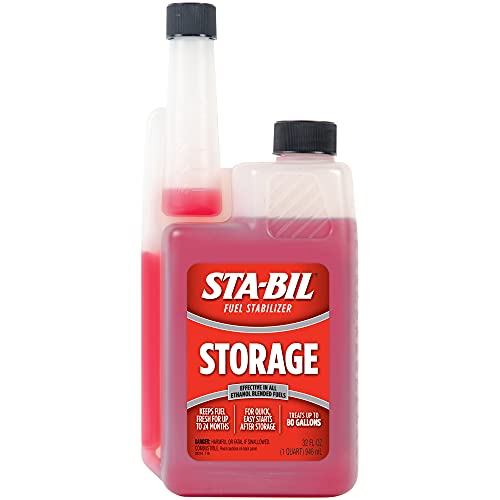
Sta-bil – Best for Small Supplies
- Cost per gallon treated: 17 cents
- Shelf life: 5 years when unopened
- Works with ethanol fuel? Compatible with E10 and E85
Sta-bil is an easy go-to fuel stabilizer that you can find just about anywhere. Over the years, it’s what I’ve come to use for my own storage needs. Sometimes, it is tempting to buy cheaper, off-brand stabilizers, but I’ve found the reliability of Sta-bil to be worth the extra cost.
Sta-bil keeps fuel fresh for 24 months. After that, you can use the fuel or treat it again. Theoretically, as long as you keep adding more stabilizer every two years, you can keep it fresh indefinitely.
This fuel stabilizer itself can last up to two years opened and five years unopened. This means you could not reliably store a bunch of Sta-bil up in the hopes of keeping your fuel fresh for a decade. You’re going to have to re-buy this every two years, assuming you open and use it everytime you buy it.

It only takes an ounce of Sta-bil to treat 2.5 gallons. Therefore, this is not a situation where I’d recommend buying the biggest container possible. It makes far more sense to buy small containers so you aren’t pouring a bunch of stabilizer out every two years.
Luckily, Sta-bil is available in very small containers, which is one reason I recommend this brand for those who don’t plan on storing much fuel. It is slightly more expensive than PRI-G per gallon, but you won’t waste as much! You can even get it in tiny four oz. containers.
How well does Sta-bil work? I’ve been using it for years, and it’s always worked just fine. I’ve never had problems with fuel going bad, even when it sat there for several years. It’s one of the most widely available and popular fuel stabilizers for a reason, and I think it works just fine for most medium-term preparedness (up to five years).
Recommended for:
Sta-bil Fuel Stabilizer works best for those who plan to store only a small amount of fuel and, therefore, want a smaller container of fuel stabilizer.
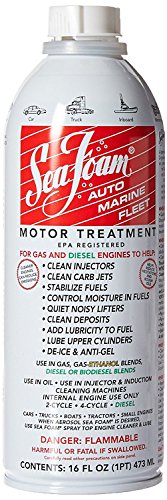
Sea Foam Motor Treatment
- Cost per gallon treated: $1.87
- Shelf life: Indefinite when unopened
- Works with ethanol fuel? Yes, though the exact kind isn’t stated
Sea Foam Motor Treatment was originally designed to remove harmful residues and deposits when added to the fuel in an engine. However, it can also stabilize fuel, preventing evaporation and preserving ignition vapors.
Sea Foam does work. It’s been around for years, and many people today continue to use it largely because they’ve always used it. It does last indefinitely on a shelf when unopened, which is always a nice boon. You can easily stock up thanks to their huge bundles, too.
That said, this fuel stabilizer only comes in one size: 16 fl. oz. It takes one ounce to treat a gallon of fuel, which means you can treat 16 gallons with one container. It’s a lot less concentrated than other options on the market, which makes it a lot more expensive, too.
Sea Foam works best when the fuel is still fresh, and it cannot restore old fuel. It does keep fuel fresh for up to two years on a single treatment, though, which is longer than most other fuel stabilizers.
Recommended for:
Sea Foam Fuel Treatment does its purpose and will work just fine if that’s all you have. But if you’re looking to stock up on the best fuel stabilizer, I’d recommend either PRI-G or Sta-bil, depending on the amount of fuel you plan to store.
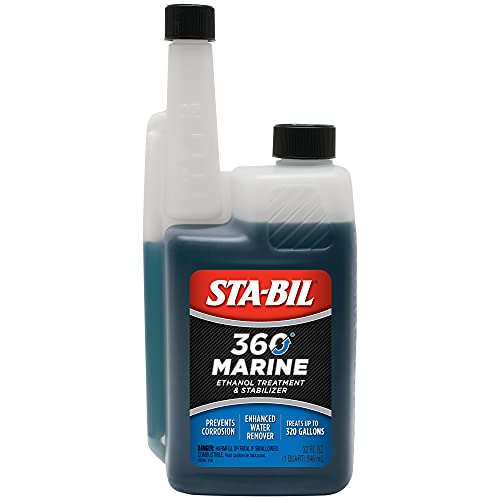
Sta-bil Marine Formula
- Cost per gallon treated: 14 cents
- Shelf life: 5 years when unopened
- Works with ethanol fuel? Yes
I’ve seen Sta-bil marine formula recommended a lot across the internet for prepping situations. The marine formula contains additives that help absorb water, which is important for protecting engines in boats and similar crafts.
It also includes some corrosion inhibitors, which provide a stronger layer of protection against rust than Sta-bil’s original formula.
Many argue that these added benefits make Sta-bil marine formula a better option for storing fuel for emergencies. However, this is not necessarily the case.
The marine formula is much more concentrated, making it harder to use for smaller supplies. You have to treat far more fuel at a time for it to be practical. After all, it’s formulated to put into a whole boat fuel tank!
The regular formula also stabilizes fuel for two years, while the marine option only works for one year. This alone makes me prefer the regular formula to the marine one.
The added benefits, like protection from moisture, won’t matter much when you’re storing fuel in sealed containers in a garage or shed. If you’re storing your fuel correctly, you aren’t going to have an issue with moisture!
All that said, the marine formula does work just fine! It does its job and will absolutely work if that’s all you have. However, the regular formula just makes more sense for emergency fuel storage.
Recommended for:
Use Sta-bil Marine for the task it was designed to do – to winterize your boat. If you aren’t storing fuel for a boat engine, use the regular Sta-bil formula.
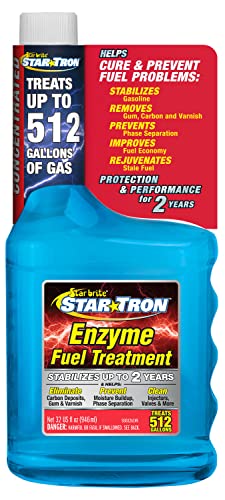
Star Tron Enzyme Fuel Treatment
- Cost per gallon treated: 11 cents
- Shelf life: Indefinite when unopened
- Works with ethanol fuel? Yes
Star Tron Enzyme Fuel Treatment is newer than many of the other brands I’ve mentioned on this list. But it is a cheaper option that’s becoming more popular. I’ve talked to several preppers who have started using it to store fuel due to the cost alone.
Based on my research and testing, Star Tron works perfectly fine for most purposes. However, this brand is largely designed to be used in a car engine, not on fuel that’s sitting around. It’s advertised as preventing the problems commonly associated with ethanol-mixed fuel.
For instance, it prevents rough idling and decreases fuel economy. It can also reduce emissions when it’s caused by poor combustion. All of these things are great if you’re using them directly in your car or lawn mower.
It does work with all types of engines and all fuel types, including generators.
While Star Tron can be used to stabilize fuel, PRI-G and Sta-bil are specifically designed for long-term fuel stabilization. Star Tron doesn’t place the same emphasis on extended storage, though it is advertised to stabilize fuel for up to two years.
I don’t think there is any problem with using Star Tron as a daily fuel enhancement. However, Sta-bil and PRI-G have been around for a long time and have developed a history of reliable performance. I’m not quite ready to trade that in for an ethanol treatment.
Recommended for:
If you’re using a “first in, first out” method for storing fuel that involves switching out your fuel supplies every six months or less, Star Tron Fuel Treatment could be a good option, especially if you live in a state with high concentrations of ethanol-containing fuel.
How We Tested Fuel Stabilizers
I focused on practical, real-world testing to determine which fuel stabilizer was the best for emergency preparedness. While I don’t have access to professional lab equipment, my hands-on approach allowed me to look at each stabilizer’s performance in everyday situations.
Here are some things I used in my ranking process:
- Ease of use: I looked at how simple each stabilizer was to measure, pour, and mix into gasoline. Products with clear instructions, convenient packaging, and minimal mess earned higher marks. This is also where I learned that more concentrated wasn’t always better!
- Longevity: Since storing fuel for an emergency means leaving it there for at least several months, I paid close attention to how long each stabilizer actually worked. Some work for several years or more, while others are designed to be used for less than a year.
- Ethanol protection: I considered how well each stabilizer health with the challenges of ethanol-blended gasoline, as that’s what most people have access to these days. I used data like product specifications and user feedback to gauge effectiveness.
- Versatility: Products that worked with multiple fuel types (e.g., ethanol blends, non-ethanol gas, and diesel) were rated higher for their flexibility. Preppers cannot always be picky about what fuel they have on hand!
- Cost-effectiveness: For preppers storing large quantities of fuel, affordability matters. I calculated the cost per gallon treated for each product and factored in how much coverage a single bottle could provide.
- Sizes available: If you have a small supply, you aren’t going to use much stabilizer. In this situations, being able to purchase smaller bottles of a product can help you save money.
My goal was to recommend which fuel stabilizer works best for regular people storing fuel for emergencies.
Winter-Blend vs. Summer-Blend Gas
In the United States, the EPA requires gas stations to sell both winter gas and summer gas, switching them out seasonally. These seasonal blends can have a big impact on your fuel storage plans, so it’s important to understand what you’re getting at the pump.
What’s the difference between these two blends?
- Winter-Blend Gas: Winter gas is formulated with a higher Reid Vapor Pressure (RVP). This increased volatility helps engines start better in colder temperatures, but it makes the gas more prone to degradation in warmer weather.
- Summer-Blend Gas: This blend has a lower RVP to prevent evaporation (and prevent smog). It is more stable in hot temperatures and may be better for long-term storage in warmer climates.
This has several implications for fuel storage. Winter-blend gas often degrades faster when stored in the heat. Threfore, unless you’re in a consistently cold environment, it might not be the best option for storage.
That said, both blends perform best in their specific season. Trying to start a generator in below-freezing temperatures with summer-blend gas can be challenging! If your generator sputters in the winter, it may be because you’re using summer-blend fuel, not because the fuel stabilizer didn’t work.
For this reason, I typically recommend storing both types of gas. Label each container with the season you purchased it in. Then, whenever an emergency comes around, use the fuel that makes the most sense for the season you’re in.
The EPA requires gas stations to continue selling summer gas until September 15. However, most gas stations will run through their summer gas stores before switching to winter gas. Summer gas typically starts after April 15.
I recommend purchasing each type of gas well into the season so you can know what you’re getting. Purchasing around the crossover dates won’t guarantee you’ll get the type of gas you want.
What Fuel Stabilizer Should You Buy?
For most uses, I recommend PRI-G Fuel Stabilizer. If you only plan on storing a few gallons of fuel, a small bottle of Sta-bil Fuel Stabilizer might work better, though.
Also, make sure to keep some unopened for future use. In a long term emergency, you may come across some old gas that needs to be treated.
Now, read my Power Outage Preparedness List for more things you should store alongside your fuel.
If you don’t have a generator yet, you should read through my guide on what size generator you need, which has a helpful calculator and several generator recommendations.
While you’re here, consider signing up for our newsletter! Jason, our founder, sends out updates about the site regularly, as well as coupons and discounts.
