

Water is one of the few preparedness supplies you cannot afford to get wrong.
Most emergencies become water emergencies surprisingly fast. Whether it’s a winter storm knocking out power, a tornado damaging local infrastructure, or a hurricane contaminating municipal water, even a short-term outage can leave families scrambling for safe drinking water within days.
Many preparedness guides reduce the topic to a single product recommendation. Buy a filter. Store some bottles. Pick up a water barrel. Real-world preparedness is more complicated than that.
Safe water depends on several overlapping systems working together. You need a four-part strategy: a reliable way to store water ahead of time, a method to collect more if the crisis drags on, the right tools to filter out dirt, and the knowledge to disinfect what remains.
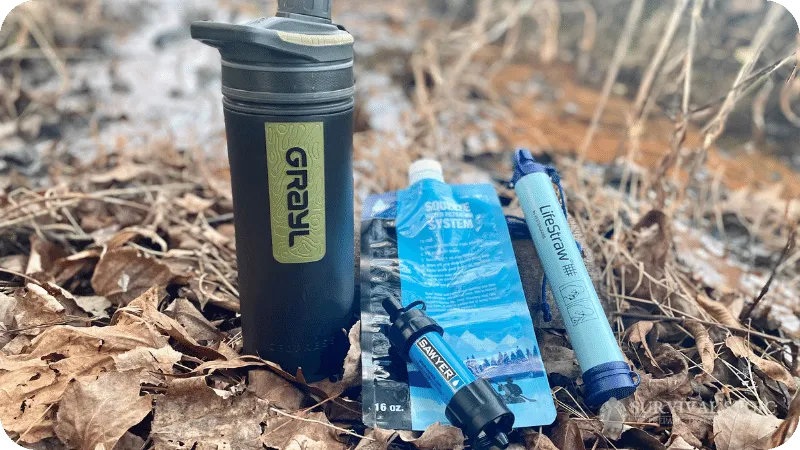
Over the years, we’ve tested water filters, water containers, purification tablets, and storage solutions in the field. We’ve also lived through extended power outages and severe weather events where water became a serious concern much sooner than most people expect.
One lesson stands out above all others: the people who fare best are rarely the ones with the most gear. They are the ones who built a complete system before they needed it.
This guide will show you how to do exactly that.
The 4-Layer Emergency Water System

Most water preparedness advice focuses on a single solution. Someone buys a water filter and considers the problem solved. Another person stores a few cases of bottled water and assumes they are covered.
In reality, reliable access to water comes from layers. If one layer fails, another takes its place. This approach is far more resilient than depending on a single piece of equipment or a single source of water.
Layer 1: Store Water

Stored water is your first line of defense.
This includes bottled water, water jugs, water bricks, barrels, and other containers filled before an emergency occurs. Stored water requires no treatment, no fuel, and no setup. It is immediately available when you need it.
For most families, stored water will carry them through the first several days of an emergency.
Related: Best Water Storage Containers for Emergency Preparedness
Layer 2: Collect Water
Every stored supply eventually runs out.
Longer emergencies require access to additional water sources. Depending on where you live, this may include rainwater collection, private wells, nearby streams, ponds, lakes, or even emergency sources inside your home, such as a water heater.
The goal is simple: identify where your next gallon of water will come from before you need it.
Layer 3: Filter Water
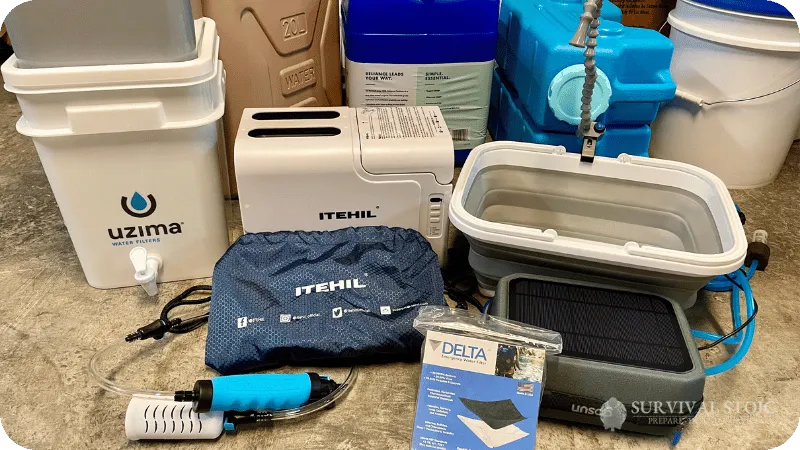
Collected water is rarely ready to drink. Water filters use physical barriers to strain out sediment, bacteria, and parasites (like Giardia and Cryptosporidium). They turn cloudy, questionable water into clear, usable water. For most localized emergencies, a high-quality filter is your workhorse.
A good filter can dramatically expand the amount of water available to your family during an emergency.
Related: Best Emergency Water Filters (for home use)
Related: Best Survival Water Filter (for on-the-go)
Layer 4: Purify Water

Filtering and purifying are not always the same thing.
Most standard filters cannot remove viruses, which are small enough to pass right through the filter elements. If your backup water source is contaminated by floodwaters or sewage, you must purify it. Boiling, unscented household bleach, or purification tablets use heat or chemicals to kill the microscopic pathogens that filters miss.
Related: Best Water Purification Tablets
Why the Layers Matter
Imagine a family that owns a high-quality water filter but stores no water. If a storm hits and local water service fails, they must immediately begin searching for a water source.
Now imagine a family with two weeks of stored water, a reliable filter, purification tablets, and several identified backup sources. They have time to assess the situation, make informed decisions, and adapt if conditions change.
That is the real purpose of preparedness. It is not about owning more gear. It is about reducing problems before they become emergencies.
How Much Emergency Water Do You Need?
The standard recommendation from emergency management agencies is simple: store at least one gallon of water per person per day.
That guideline is a useful starting point, but it is exactly that: a starting point.
A gallon per day covers drinking water and a small amount of cooking. It does not leave much room for washing dishes, basic hygiene, hot weather, illness, pets, or physically demanding work. Families often discover that their actual water use is much higher than expected.
Why Most Families Need More Than the Minimum
Water serves far more purposes than drinking alone.
You may need water for:
- Cooking meals
- Mixing powdered foods
- Making coffee or tea
- Washing hands
- Cleaning dishes
- Brushing teeth
- Taking medication
- Caring for pets
- Basic sanitation
Even a short disruption can increase water consumption if temperatures are high or family members are sick.
For that reason, many experienced preppers view one gallon per person per day as the bare minimum rather than the ideal target.
Stored Food Requires Water Too
This is one of the most commonly overlooked parts of emergency planning.
Many preparedness foods depend on water for preparation. Rice, beans, pasta, oatmeal, powdered milk, powdered eggs, and freeze-dried meals all require water before they can be eaten. Standard freeze-dried meals (the kind from Mountain House or Patriot Supply) require roughly 1 to 2 cups of boiling water.
A family that has carefully built a three-month food supply may discover that a significant portion of that food becomes difficult to use without adequate water reserves.
Before investing heavily in emergency food, make sure your water plan can support it.
Related: Emergency Food Storage Hub

Water Storage Goals by Household Size
Every situation is different, but these numbers provide a reasonable planning baseline.
| Household Size | Minimum Goal | Better Goal |
|---|---|---|
| 1 person | 14 gallons | 30+ gallons |
| 2 people | 28 gallons | 60+ gallons |
| Family of 4 | 56 gallons | 120+ gallons |
| Family of 6 | 84 gallons | 180+ gallons |
These targets are intended for short- to medium-term emergencies. Families preparing for extended disruptions often store significantly more water or pair moderate storage with a reliable filtration system.
Families with pets also need to consider their water needs. A good rule of thumb is that dogs and cats need about 1 ounce of water per pound of body weight per day. A 60-pound retriever will drink roughly a half-gallon of water a day on its own.
Focus on the First Two Weeks
Many preparedness plans fail because they try to solve every possible problem at once.
A more practical approach is to focus on the first fourteen days.
Two weeks of water storage will cover the vast majority of weather-related emergencies and utility disruptions that most families are likely to experience. Once that foundation is in place, you can expand your storage, improve your filtration capabilities, and develop additional backup sources over time.
A modest water supply that actually exists is far more valuable than a perfect plan that never gets implemented.
Water Storage vs. Water Filtration: Which Matters More
Many preparedness discussions turn into an argument between water storage and water filtration.
Should you spend your money on barrels and containers? Or should you buy a high-quality filter and plan to obtain water when you need it?
The truth is that both approaches solve different problems.
Stored Water Buys Time
Stored water is the simplest and most reliable emergency water solution available.
When a tornado knocks out power, a winter storm closes roads, or local water service becomes unreliable, stored water is immediately available. There is no treatment required, no equipment to assemble, and no need to leave the safety of your home to find additional supplies.
This is why stored water should form the foundation of every emergency water plan.
The downside is obvious: every stored supply has a limit. Once the containers are empty, you need another source.
Water Filtration Extends Survival
A water filter solves a different problem. Instead of storing every gallon you might need, a filter allows you to turn questionable water into usable water. A nearby creek, pond, rain barrel, or collected rainwater can become a viable resource when paired with the right filtration system.
For longer emergencies, filtration dramatically increases your options.
The limitation is that a filter cannot create water where none exists. You still need access to a water source, and some contaminants may require additional purification methods.
Keep in mind that standard biological filters do not remove chemical contaminants, heavy metals, or fuel runoff. When identifying backup sources in your neighborhood, prioritize clean rainwater or moving streams over stagnant urban runoff.
Why Most Families Need Both
Imagine a severe storm knocks out utilities for several days.
A family with stored water can immediately begin using their reserves. They are not forced to search for water while roads are blocked and conditions remain uncertain. If the outage continues longer than expected, a filtration system allows them to supplement those reserves with water from alternative sources.
The two approaches work together.
Stored water helps you through the first days of an emergency. Filtration helps you adapt if the situation lasts longer than planned.
That is why experienced preppers rarely choose one or the other. They build both into their preparedness plan.
| Stored Water (Containers/Barrels) | Water Filtration (Filters/Purifiers) | |
| Primary Benefit | Instant access; zero effort required in a crisis. | Infinite supply potential; highly portable. |
| Best Used For | Short-term grid failures (1–14 days), sheltering in place. | Long-term grid failures (14+ days), evacuations. |
| The Main Risk | Heavy to store; space-consuming; finite supply. | Requires a nearby physical water source to process. |
| Effort Level | High upfront (filling/rotating), zero in crisis. | Zero upfront, high in crisis (pumping/carrying). |
A Practical Starting Point
If you’re building your water preparedness system from scratch, focus on storage first.
Store at least two weeks of water for your household. Once that foundation is in place, add a reliable water filter and learn how to use it before an emergency occurs.
Most families will benefit more from a modest amount of water storage and a quality filter than from investing heavily in either one alone.
Best Ways to Store Emergency Water
Once you know how much water your family needs, the next question is where to keep it.
There is no single “best” water storage solution. The right choice depends on your available space, budget, household size, and preparedness goals.
For most families, the ideal setup combines several different storage methods rather than relying on a single container.
Bottled Water
Bottled water is where many emergency water plans begin. It is inexpensive, widely available, and requires no preparation. Cases can be stored immediately and rotated as needed.
For many households, bottled water is an excellent starting point while building a larger storage system.
PROS
Ready to drink
Easy to find locally
No filling or treatment required
Easy to transport
CONS
Less efficient for long-term storage
Creates significant plastic waste
Takes up more space per gallon than larger containers
5-Gallon Water Containers
Five-gallon containers offer a good balance between capacity and portability.
A full container weighs about 42 pounds. Most adults can move one without specialized equipment, while still storing significantly more water than individual bottles. These are often one of the most practical options for everyday preparedness.
PROS
Portable
Reusable
Easy to fill and rotate
Suitable for apartments and homes
CONS
Require periodic cleaning
Heavier than many people expect
The Specter Water Container
When moving away from flimsy store-bought bottles, heavy-duty 5-gallon containers are the true workhorses of home preparedness.
Scepter Water Containers are built to rugged military specifications using high-density, BPA-free food-grade plastic. Their tall, slim profile allows you to maximize tight closet space while remaining tough enough to withstand impact without leaking.
Water Bricks and Stackable Containers

Stackable containers are designed to maximize storage space.
They fit neatly into closets, under beds, and along walls where traditional containers may not work well. For apartment dwellers and suburban families with limited storage space, stackable systems can be an excellent solution.
PROS
Excellent use of limited space
Easy to stack
Durable and reusable
CONS
More expensive per gallon
Smaller capacity than barrels
Takes up more space per gallon than larger containers
55-Gallon Water Barrels
Water barrels provide a large amount of storage at a relatively low cost per gallon. A single barrel can hold nearly two months of drinking water for one person.
Pro Tip: If you invest in a 55-gallon barrel, you must buy a food-grade siphon pump and a bung wrench at the same time. Without a bung wrench, you won’t be able to open the tightly sealed caps in a dark, power-free house, and without a siphon pump, the water inside is completely inaccessible.
PROS
Large storage capacity
Cost-effective
Suitable for long-term preparedness
CONS
Difficult to rotate
Require pumps or siphons
Essentially permanent once filled
The Water Reality Check
Water weighs approximately 8.34 pounds per gallon.
| Container Volume | Approximate Weight (When Full) | Mobility Level |
| 5 Gallons | ~42 lbs | Highly Portable (Single adult can carry) |
| 15 Gallons | ~125 lbs | Semi-Portable (Requires two people or a cart) |
| 55 Gallons | ~459 lbs | Stationary (Exceeds structural floor limits if concentrated) |
| 275-Gallon IBC Tote | ~2,294 lbs | Permanent (Requires a forklift/heavy machinery) |
Many first-time preppers fill a large barrel and later decide they would prefer it somewhere else. Unfortunately, that decision usually comes after the barrel weighs nearly half a ton. Always place large containers exactly where they will remain before filling them.
WaterBOBs and Bathtub Storage
Some emergencies provide advance warning. Hurricanes, winter storms, and severe weather events often give families time to prepare.
A WaterBOB is a large food-grade bladder designed to fit inside a bathtub and hold emergency water before a disruption occurs. For many families, this can be a useful backup layer rather than a primary storage method.
PROS
Stores a large amount of water quickly
Excellent for short-notice emergencies
Relatively inexpensive
CONS
Requires advance warning
Not suitable for permanent storage
The WaterBOB
For scenarios where an incoming storm or hurricane provides 24 to 48 hours of advance warning, deploying a temporary large-scale bladder inside a standard household fixture is incredibly efficient.
The WaterBOB is a heavy-duty, 10-mil food-grade LLDPE bladder designed to lay flat inside any standard bathtub. It allows you to rapidly secure up to 100 gallons of fresh tap water before municipal systems potentially lose pressure or face contamination.
Our Recommendation
Most families do not need to choose a single storage solution.
A practical system might include:
- Bottled water for immediate use
- Several portable 5-gallon containers
- A larger barrel for long-term reserves
- A WaterBOB for approaching storms
This layered approach provides flexibility while reducing the weaknesses of any single storage method.
Related: Best Water Storage Containers for Emergency Preparedness
Related: Scepter Water Container Review
Hidden Water Sources Inside Your Home
Most people think about emergency water as something they need to buy and store ahead of time.
While long-term storage is important, many homes already contain dozens of gallons of usable water. Knowing where to find these hidden reserves can provide valuable breathing room during a power outage, natural disaster, or temporary water service interruption.
These sources should not replace a proper water storage plan. However, they can serve as an important backup when circumstances become more serious than expected.
Your Water Heater
For many households, the water heater is the largest emergency water reserve in the house.
A typical residential water heater contains between 40 and 80 gallons of water. Even after accounting for sediment and unusable water near the bottom of the tank, this can provide a significant amount of emergency drinking water.
Important Safety Warning
Before draining a water heater, turn off the electricity at the breaker panel or shut off the gas supply.
Operating a water heater with little or no water inside can damage the unit and create safety hazards.
How to Access Water From a Water Heater
- Turn off power or gas to the unit.
- Shut off the incoming water supply.
- Allow the water to cool if necessary.
- Connect a hose to the drain valve.
- Open a nearby hot water faucet to allow air into the system.
- Drain water into clean containers.
If local water contamination is suspected, only use water that was already inside the tank before the contamination occurred.
Water Inside Household Pipes
Your plumbing system contains more water than many people realize.
After shutting off the main water valve, you may be able to access additional water by opening the highest faucet in the home and then collecting water from the lowest faucet.
The exact amount varies depending on the size of the house, but even a few gallons can be valuable during an emergency.
Toilet Tanks
The tank behind the toilet often contains several gallons of relatively clean water.
This water is generally safe for emergency use if:
- The tank has not been treated with cleaning chemicals
- The water supply itself has not been contaminated
Use water from the tank only. Never use water from the toilet bowl. If the water in your tank is blue or smells strongly of chemicals, it is completely non-potable. It cannot be filtered or boiled clean. Save it strictly for flushing the toilet bowl manually.
If there is any doubt about water quality, filter and purify it before drinking.
Ice Cubes and Freezer Ice
A full freezer can contain several gallons of usable water.
Ice cubes, frozen water bottles, and ice packs can all be melted and used for drinking, cooking, or hygiene.
During power outages, these supplies are often overlooked despite being immediately available.
Bottled and Canned Beverages
Many homes contain emergency hydration supplies without realizing it.
Examples include:
- Bottled water
- Sparkling water
- Sports drinks
- Juice
- Soda
- Canned fruits packed in juice
While these beverages are not ideal long-term water replacements, they can help supplement stored water supplies during short-term emergencies.
Waterbeds and Other Non-Potable Sources
Some older preparedness guides mention waterbeds, swimming pools, and decorative water features. Swimming pool water contains concentrated chlorine and cyanuric acid (stabilizer), while waterbeds are treated with highly toxic algaecides. Standard survival filters and boiling cannot remove these dissolved chemical compounds. Consuming this water will cause severe kidney stress and dehydration.
While these sources may have uses for flushing toilets, cleaning, or other non-drinking purposes, they should generally be considered last-resort options for human consumption.
Pool water, in particular, contains chemicals and contaminants that require additional treatment before becoming safe to drink.
Know Your Backup Sources Before You Need Them
One of the simplest preparedness exercises is walking through your home and identifying every potential water source.
You may discover that your house already contains far more emergency water than you realized.
That knowledge can provide valuable flexibility while you transition to stored supplies, filtration systems, or alternative water sources during a crisis.
How to Collect More Water During an Emergency
Every stored water supply has a limit.
A family with two weeks of water storage is in a far better position than most households. However, longer emergencies require a plan for obtaining additional water once stored reserves begin to run low.
The good news is that water is often available even when municipal supplies fail. The challenge is identifying safe sources and understanding how to make that water suitable for drinking.
Rainwater Collection
Rain is one of the easiest emergency water sources to collect. Even a brief storm can provide a surprising amount of water when collected from a roof, tarp, or other clean surface.
Simple collection methods include:
- Rain barrels
- Buckets
- Tarp catchment systems
- Trash cans lined with food-grade bags
Rainwater should still be filtered and purified before drinking, especially if it has flowed across roofing materials or collection surfaces. The first 5–10 minutes of a rainstorm wash away accumulated bird droppings, dust, pollen, and chemical residue from your roof. For safety, divert this ‘first flush’ away from your collection barrels. Collect the water that falls after the roof has been thoroughly rinsed.
Even a modest rainstorm can produce far more water than most people expect. As a rough estimate, every inch of rain on 1,000 square feet of roof can produce about 623 gallons of water before losses from overflow, splash, gutter inefficiency, and first-flush waste.
Rainwater Harvesting Estimator
See how much water your roof could collect from a single storm.
Formula: roof square footage × inches of rain × 0.623 × collection efficiency. This estimates collection potential only. Roof runoff should still be filtered and purified before drinking.
Important note: This is collection potential, not automatically drinkable water. Roof runoff should still be filtered and purified before drinking.
Private Wells
Many people assume a well guarantees water during an emergency.
Unfortunately, most modern wells depend on electricity to operate the pump. During a power outage, the water may stop flowing even though the well itself remains functional.
If your home relies on a well, consider:
- A backup generator
- Battery backup systems
- Manual well pumps
- Stored emergency water
Homes with wells often have an excellent long-term water source, but only if there is a way to access it during a grid failure.
Streams and Rivers

Flowing water is generally preferable to stagnant water. Moving water often contains less sediment and fewer contaminants than ponds or standing pools. Even so, streams and rivers can contain bacteria, parasites, agricultural runoff, and other hazards.
Always treat surface water before drinking.
When collecting from a stream, look for:
- Clear flowing water
- Upstream areas away from livestock
- Locations away from industrial activity
- Water with minimal visible contamination
No natural water source should be assumed safe without treatment.
Lakes and Ponds
Lakes and ponds can provide large quantities of water when other sources are unavailable. However, stagnant water often contains more algae, sediment, bacteria, and organic material than flowing water.
When collecting from lakes or ponds:
- Avoid areas with visible algae blooms
- Collect from the clearest water available
- Allow sediment to settle before filtering
- Use both filtration and purification whenever possible
These sources are often usable, but they typically require more treatment than flowing water.
Snow and Ice
In cold climates, snow can serve as an emergency water source. The biggest mistake people make is assuming snow provides a large amount of water.
It doesn't.
Fresh snow contains a significant amount of air. Depending on conditions, it may take ten inches or more of snow to produce a single inch of water.
Melting snow also requires a massive amount of thermal energy. If you are using a portable camping stove or relying on stored propane during a power outage, you will burn through your fuel reserves incredibly fast trying to melt snow for daily drinking water. Prioritize liquid water sources whenever possible to preserve your cooking fuel.
Whenever possible:
- Melt ice before snow
- Use clean, fresh snow
- Avoid roadside snow
- Filter and purify melted water before drinking
Snow can be an important backup resource, but collecting meaningful amounts takes more effort than many people expect.
Not All Water Sources Are Equal
If multiple options are available, prioritize them in roughly this order:
| Priority | Water Source | Primary Risk / Challenge | Required Action |
| 1 | Stored Water | Finite capacity. | None (Immediate consumption) |
| 2 | Household Plumbing | Limited to 40–80 gallons. | Isolate tank, drain gravity lines |
| 3 | Clean Rainwater | Requires roof/tarp surface. | Filter out sediment, disinfect |
| 4 | Private Well | Fails instantly without grid power. | Deploy generator or manual pump |
| 5 | Flowing Surface Streams | Biological pathogens, runoff. | Fine filtration + heavy disinfection |
| 6 | Stargnant Ponds / Lakes | Concentrated algae, high organic sediment. | Settle sediment + filtration + disinfection |
| 7 | Urban Runoff / Floodwater | Extreme chemical & industrial toxicity. | Avoid. Last resort for sanitation only. |
That is why experienced preppers focus on identifying several potential water sources before an emergency occurs. When one source becomes unavailable, another can take its place.
Best Emergency Water Filters

One of the biggest mistakes new preppers make is buying a water filter and assuming the water problem is solved.
A filter is important. In many situations, it can be the difference between having a usable water source and having none at all. But a filter is only as useful as your understanding of what it can and cannot do.
I've seen people buy a LifeStraw, throw it in a drawer, and feel completely prepared. Then, a few questions later, they realize they have no way to filter water for cooking, no way to provide water for their family, and no idea whether their filter can handle the contamination they're likely to encounter.
Before choosing a filter, it helps to understand what you're actually trying to remove.
Most Emergency Water Threats Are Invisible
A muddy stream looks dangerous because you can see the problem.
The threats that cause most waterborne illnesses are much harder to spot.
Bacteria, protozoa, and parasites are common in untreated water throughout North America. A clear mountain stream may be safer than a stagnant pond, but neither should be trusted without treatment.
This is where a quality water filter earns its keep. It removes contaminants that would otherwise be impossible to identify with the naked eye.
Different Filters Solve Different Problems
There is no universal water filter.
A filter that works well in a bug out bag may be frustrating to use at home. A system that keeps a family supplied with water during a week-long power outage may be too large to carry on a hiking trip.
The best filter is the one that matches the situation.
A solo hiker can get by with equipment that would be miserable for a family of five. Likewise, a large gravity-fed filter that works beautifully in a kitchen would be completely impractical in a backpack.
If a hollow-fiber filter contains water and is exposed to freezing temperatures, the water inside will expand and crack the microscopic internal tubes. This ruins the filter completely while leaving no visible damage on the outside. During a winter power outage, always keep your portable filters inside a pocket close to your body heat so they do not freeze.
Understanding the Main Types of Water Filters
Walk down the water filter aisle, and you'll quickly discover that "water filter" can mean very different things.
Some filters are designed for a single person drinking directly from a stream. Others are built to provide water for an entire family during a week-long power outage.
Knowing the difference can save you money and help you avoid buying equipment that doesn't match your needs.
Straw Filters

Straw filters became popular because they're inexpensive, lightweight, and easy to carry.
The tradeoff is convenience. Drinking directly from a water source works fine on a hiking trail. It's much less appealing when you're trying to make dinner or provide water for several people.
They're best viewed as a backup tool rather than a complete family water solution.
We review several straw filters in our best survival filter article, even if they aren't necessarily our favorite option.
PROS
Extremely lightweight
Inexpensive
Easy to store in emergency kits
No setup required
CONS
Water must usually be consumed directly from the source
Slow for families and groups
Not practical for cooking or water storage
Limited versatility compared to other filter types
Squeeze Filters

Squeeze filters use a soft pouch or bottle to force water through a filter.
Many preppers consider them a major step up from straw filters because they allow you to collect and store filtered water instead of drinking directly from the source.
For individual use, they strike a nice balance between portability and practicality.
PROS
Lightweight and compact
Allows filtered water to be stored and transported
Faster than most straw filters
Excellent for bug out bags and vehicle kits
CONS
Can become tedious when filtering large volumes
Filter bags eventually wear out
Less convenient for families
Requires some effort with every gallon filtered
The Grayl GeoPress
Most portable water filters remove bacteria and parasites. The Grayl GeoPress goes a step further by functioning as a true purifier, reducing viruses in addition to many of the contaminants handled by traditional filters. During our testing, it consistently produced clean water faster than competing portable systems.
The process is simple: fill the outer container, press the inner cartridge down, and drink directly from the bottle.
For bug out bags, vehicle kits, international travel, and situations where water quality is uncertain, it remains our favorite portable option.
Countertop Gravity Filters

Countertop gravity filters are where many families eventually end up.
Instead of squeezing bottles or pumping handles, you simply fill a container and allow gravity to move water through the filter element. The two-chamber stacked configuration pulls dirty water from the top tank through dense ceramic or carbon elements into the lower clean tank.
If your most likely emergency involves staying home during a storm or power outage, this is often the most practical option.
See our guide to the best emergency water filters for our favorite options for families.
PROS
Produces large amounts of water with minimal effort
Ideal for families
No electricity required
Easy to use during extended outages
CONS
More expensive than portable filters
Takes up storage space
Not practical for evacuation or travel
Slower to set up than grabbing stored water
Which Filter Should You Buy?
For most readers, I would skip the portable straw filter as a primary purchase and start with either:
- A gravity filter for home preparedness
- A squeeze filter for bug out bags and vehicles
Both have proven useful in real-world emergencies and cover the situations most people are likely to encounter.
| If Your Primary Goal Is... | ...Your Best Choice Is: | Examples to Look For |
| Sheltering at home with a family | Countertop Gravity Filter | ProOne, Alexapure, Doulton |
| Mobility, Bug-Out Bags, or Vehicles | Heavy-Duty Squeeze Filter | Sawyer Squeeze, Katadyn BeFree |
| Ultralight Emergency Backup | Straw Filter | LifeStraw, Sawyer Mini |
Water Filtration vs. Water Purification
One of the easiest mistakes to make in preparedness is assuming that clear water is safe water. A mountain stream can look crystal clear and still make you sick. Floodwater can be loaded with contaminants that aren't visible at all. Even rainwater collected from a roof may contain things you don't want to drink.
This is where the discussion usually turns to filtration and purification. The terms are often used interchangeably, but they aren't always the same thing. More importantly, understanding the difference helps you decide how much treatment a particular water source actually needs.
A Filter Is Not Magic
Water filters are one of the most useful preparedness tools you can own. A good filter can remove sediment, bacteria, protozoa, and parasites that would otherwise turn a minor inconvenience into a serious problem.
At the same time, filters have limits. Every filter is designed to address specific threats, not every possible threat. Think of it less like a magic solution and more like a specialized tool. The better you understand what it was designed to do, the more effectively you'll be able to use it.
When Filtration Is Usually Enough

Many of the water sources preppers plan around are freshwater sources such as streams, creeks, ponds, lakes, and collected rainwater. In those situations, a quality filter often handles the biggest concerns. That's one reason filters like the Sawyer and Grayl have become so popular among hikers, hunters, and preparedness-minded families.
In fact, the Grayl is actually a purifier and a filter. Unlike standard backpack filters, the GeoPress removes 99.99% of viruses (e.g., Rotavirus, Norovirus, Hepatitis A), alongside bacteria, protozoan cysts, microplastics, chemicals, and heavy metals. So, it's a bit of a one-and-done method.
If you're collecting water from a remote stream in the mountains, filtration may be all the treatment you need. The risk profile is very different from water flowing through a flooded city street.
When Purification Becomes More Important

Imagine a hurricane pushing floodwater through a neighborhood. Storm drains back up. Sewage systems overflow. Water moves through streets, yards, and buildings before pooling in low areas.
The water may not look particularly dangerous, but appearances don't mean much. This is where purification methods such as boiling, purification tablets, bleach, or UV treatment become far more valuable.
The goal is to address microscopic threats that standard filtration completely misses: viruses. While common filters easily strain out large pathogens like Giardia or E. coli, human viruses (like Norovirus or Hepatitis A) are small enough to slip right through the filter's pores. Because these viruses primarily spread through human waste, they become a massive threat the moment municipal sewage lines back up into local floodwaters.
As uncertainty increases, so should the amount of treatment you're willing to give the water.
The Practical Rule
Most preparedness decisions become easier when you stop chasing perfect answers and focus on managing risk.
If the water source is relatively clean and predictable, filtration may be enough. If the source is questionable, add purification. If you're unsure what you're dealing with, treat the water more aggressively than you think necessary.
A few extra minutes spent boiling water is a minor inconvenience. Spending an emergency battling dehydration from contaminated water is a much larger problem.
The dirtier and less predictable the source becomes, the more treatment it deserves. That simple rule will serve you better than memorizing a dozen technical definitions.
How to Make Water Safe to Drink
Most emergency water sources share the same problem: you can't tell whether they're safe just by looking at them.
A clear mountain stream can contain Giardia. Rainwater may pick up contaminants from a roof. Floodwater can carry everything from sewage to industrial runoff. Even water that looks perfectly clean deserves a healthy amount of skepticism.
That's why experienced preppers don't ask whether water looks safe. They ask what might be in it and how much treatment it needs.
Choose Your Water Source Carefully

One habit worth developing now is evaluating water sources before you collect them.
A surprising amount of work can be avoided simply by starting with better water. Rainwater collected from a clean surface is usually easier to deal with than pond water. Pond water is usually easier to deal with than floodwater. Water flowing through a remote forest is generally preferable to water flowing through a parking lot.
Every step toward a cleaner source reduces the burden on your filters and purification methods later.
Most people spend more time researching water filters than they spend identifying nearby water sources. That's backwards. A premium filter doesn't help much if you have no realistic plan for where the next gallon is coming from.
Boiling Water

If there is one treatment method that has stood the test of time, it's boiling.
The reason is simple: confidence.
Filters wear out. Batteries die. Chemical treatments expire. When water reaches a rolling boil, there is very little ambiguity about whether the process worked. According to the CDC, bringing water to a rolling boil for one full minute is completely sufficient to kill all bacteria, protozoa, and viruses. If you live at an elevation above 6,500 feet (2,000 meters), you must maintain that rolling boil for three full minutes because water boils at a lower temperature at high altitudes.
That reliability comes at a cost. Boiling requires fuel, time, and a way to heat the water. During a prolonged emergency, those resources may become just as valuable as the water itself.
For many families, boiling works best as part of a larger system rather than the only treatment method available.
Related: How to Boil Water Without Electricity
Related: Best Emergency Stove
Water Purification Tablets

Purification tablets solve a different problem.
They're small enough to disappear into a backpack, glove box, or emergency kit, which makes them an excellent backup option. Many people carry them for years without noticing they're there.
The downside becomes obvious the first time you actually use them. Treated water often requires a waiting period before it's ready to drink, and some products leave behind a taste that people either tolerate or complain about endlessly.
That said, tablets remain one of the easiest ways to add redundancy to a water plan.
Related: Best Water Purification Tablets
Aquatabs Purification Tablets
The Aquatabs Purification Tablets utilize NaDCC (Sodium Dichloroisocyanurate), which is vastly superior to old-school iodine tablets. They dissolve rapidly, do not discolor the water, and leave behind almost no chemical aftertaste.
A single tiny tablet treats up to 2 quarts (2 liters) of clear water or 1 quart of dirty water, completely eliminating viruses, bacteria, and Giardia cysts within 30 minutes. They have a rock-solid 5-year shelf life.
Household Bleach
For decades, emergency preparedness guides have recommended unscented household bleach as a way to disinfect water.
It works, but it also requires attention to detail.
The concentration matters. The dosage matters. The type of bleach matters. Grab the wrong bottle from under the sink, and you may find yourself holding a product that was never intended for water treatment in the first place. You cannot use scented bleaches, splashless formulas, or bleaches with added fabric conditioners, as these contain toxic surfactants.
You must use regular, unscented liquid household bleach (usually between 5% and 9% sodium hypochlorite). Here's how to do it:
- Strain out heavy sediment: Chemical disinfectants lose efficacy if the water is cloudy, as pathogens can "hide" behind dirt particles. Filter the water through a cloth, coffee filter, or your squeeze filter first until it is visually clear.
- Measure the correct dosage: Using a clean medicine dropper, add the following amounts of unscented bleach per gallon of water. If water is clear: Add 8 drops (approx. 1/8 teaspoon) per gallon. If water is cloudy/colored: Add 16 drops (approx. 1/4 teaspoon) per gallon.
- Mix and let it sit: Stir or shake the water container thoroughly. Turn the container upside down slightly to let a little chlorinated water rinse the threads of the cap. Let the water sit undisturbed for at least 30 minutes.
- Perform the scent test: After 30 minutes, remove the cap and smell the water. It should have a very slight chlorine odor. If it does not, repeat the dose, mix, and let it sit for another 15 minutes. If it smells faintly of bleach, it is safe to drink.
If you plan to use bleach as part of your emergency water strategy, keep a printed dosage chart with your supplies. Trying to remember the correct ratio during an emergency is rarely a winning strategy.
UV Treatment
Ultraviolet purification devices have become increasingly popular over the last decade.
Many work well under the right conditions. The catch is that they perform best when the water is already fairly clear. Murky water, dead batteries, and damaged electronics can all create problems at the worst possible time.
For that reason, many preppers view UV treatment as a useful supplement rather than the foundation of a water plan.
The System We Prefer

Preparedness tends to work best when multiple layers support one another.
Stored water covers the first phase of an emergency. Filters allow you to process additional water when supplies begin to run low. Purification methods provide an extra layer of protection when the source is questionable or the consequences of getting sick are particularly severe.
No single method is perfect. That's why relying on a single method is rarely the goal.
A family with stored water, a reliable filter, and at least one backup purification method is in a much stronger position than someone betting everything on a single piece of equipment.
The objective isn't to build the most complicated water system possible. It's to create enough overlap that a single failure doesn't become a crisis.
Water During a Power Outage

Most people think about water storage as something that happens before an emergency.
In reality, some of your most important water decisions happen after the power goes out.
A major outage creates a short window where you can still take advantage of residual water pressure, protect existing supplies, and prepare for a disruption that may last far longer than expected. Once that window closes, some opportunities disappear with it.
The good news is that the first hour is usually enough.
The First Hour After the Power Goes Out
Think of the first hour as a race against uncertainty.
You don't know whether power will return in twenty minutes or three days. You don't know whether municipal water pressure will remain stable or whether crews will discover damage hours later.
What you do know is that taking a few simple steps now can dramatically improve your situation if the outage continues.
1. Secure Remaining Water Pressure
Within 10 Minutes
If severe weather was expected, your emergency containers should already be full.
If the outage catches you by surprise, start filling containers immediately. Use water bottles, stock pots, pitchers, bathtubs, and anything else that is clean and capable of holding water.
Many municipal systems continue operating on residual pressure for a short period after electricity is lost. Once that pressure disappears from the system, the opportunity to collect additional water often disappears with it.
2. Isolate Your Home's Water Supply
Within 30 Minutes
If the outage is connected to a major disaster such as flooding, a hurricane, or an earthquake, consider shutting off your home's main water valve.
Doing so helps protect the clean water already inside your plumbing system and reduces the risk of contamination if damaged water mains allow polluted water to enter the system.
Most homeowners know where their electrical panel is located. Far fewer know where their main water shutoff valve is. Finding it now is considerably easier than searching for it during an emergency.
3. Protect Your Water Heater
Within 1 Hour
If it appears the outage may last for a while, switch off the breaker feeding your electric water heater or follow the manufacturer's instructions for safely shutting down a gas unit.
This protects the system if you later decide to drain the tank and prevents damage if power returns unexpectedly while the heater is partially empty.
Many families spend years storing emergency water without realizing that their water heater may contain forty, fifty, or even eighty gallons sitting quietly in the utility room.
4. Switch Into Water Conservation Mode
Ongoing
One of the most common mistakes during outages is continuing to use water as though more is readily available. Treat your stored water as a finite resource from the beginning.
Separate drinking water from utility water. Establish simple household rules. Decide which water sources are reserved for cooking and which can be used for sanitation.
Water tends to disappear much faster when nobody is paying attention to where it's going.
The Flushing Trap
A surprising amount of emergency water disappears down the toilet. Modern toilets use roughly 1.6 gallons per flush. Older models can use three to five gallons or more.
That may not sound significant until you run the numbers. A family of four flushing a modern toilet just four times per day each can easily use more than 25 gallons of water every day on sanitation alone. That's enough drinking water to support the same family for nearly a week.
Whenever possible, reserve stored potable water for drinking and cooking. Rainwater, bathwater, and other gray water sources can often handle flushing duties just fine. Many preppers follow an old rule during short-term emergencies: "If it's yellow, let it mellow. If it's brown, flush it down."
When flushing is necessary, pouring a bucket of water directly into the bowl will often trigger a gravity flush without wasting water refilling the tank.

How to Properly Gravity Flush a Toilet: Do not waste your collected gray water (rainwater, bathwater, etc.) by pouring it into the toilet's upper ceramic tank.
Instead, keep the toilet lid open, grab a 2-gallon bucket of utility water, and pour it quickly and directly into the toilet bowl. The rapid influx of water creates an immediate siphon effect, forcing the waste down the drain automatically while using up to 50% less water than a standard tank flush.
Plan for a Longer Outage Than You Expect
After every major storm, people assume service will return tomorrow. Sometimes they're right. Sometimes utility crews discover damaged substations, broken water mains, flooded roads, or infrastructure failures that take days to repair.
Preparedness becomes much easier when you assume the outage will last longer than expected. If power returns in a few hours, great. If it doesn't, you'll be glad you filled those containers when everyone else was still wondering whether the outage was serious.
Common Emergency Water Mistakes
Most water emergencies are not caused by a complete lack of water. They are caused by bad assumptions, poor planning, or small mistakes that compound over time.
The good news is that many of these mistakes are easy to avoid once you know what to look for.
1. Relying on a Single Water Source
A surprising number of preparedness plans depend on one solution.
Some people store water but have no way to obtain more if supplies run out. Others buy a filter but never store any water at all. Well owners sometimes assume they are covered until a power outage leaves their pump useless.
Strong water plans have layers. Stored water, backup sources, filtration, and purification all support one another. If one layer fails, another can take its place.
2. Forgetting How Heavy Water Is

Water weighs more than most people expect.
A five-gallon container weighs more than forty pounds. A fifty-five-gallon barrel weighs nearly five hundred pounds when full. Once large containers are filled, moving them becomes difficult or impossible without draining them first.
Many people discover this after filling a barrel in the wrong location. Decide where large containers will live before adding a single gallon of water.
3. Storing Water in Unsafe Containers
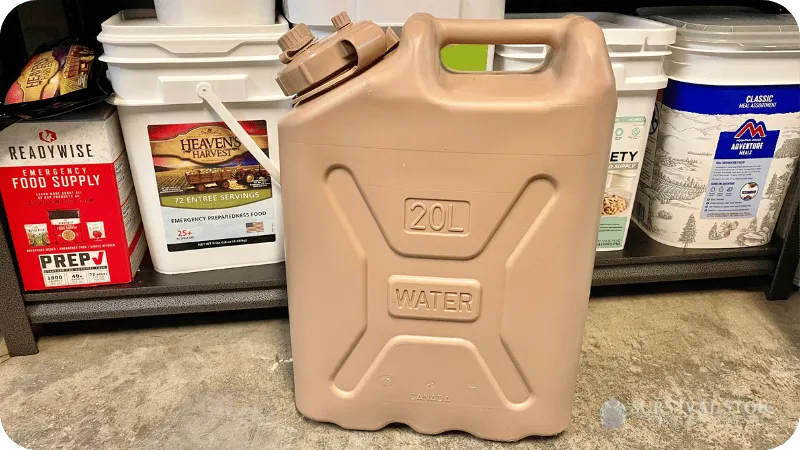
Not every container is suitable for long-term water storage.
Old milk jugs, chemical containers, and non-food-grade plastics can create problems ranging from leaks to contamination. Water may sit in these containers for months or years. It is worth using containers designed for the job.
A proper storage container costs more up front, but it is usually cheaper than replacing spoiled water or damaged supplies later.
4. Confusing Filtration With Purification
A quality filter is one of the most useful preparedness tools you can own. That does not mean it solves every water problem.
The type of treatment required depends on the source. Water from a remote stream presents different concerns than floodwater moving through a neighborhood. Understanding those differences helps you choose the appropriate level of treatment instead of assuming every situation requires the same approach.
Here's exactly what a standard filter can handle versus what requires purification:
| Threat | Examples | Removed by Standard Filter? (e.g., Sawyer, Lifestraw) | Removed by Full Purification? (Boiling, Bleach, UV) |
| Protozoa & Cysts | Giardia, Cryptosporidium | YES (Filters trap these easily due to their larger micron size) | YES (Though Crypto is highly resistant to bleach alone) |
| Bacteria | E. coli, Salmonella, Cholera | YES (Most quality hollow-fiber membrane filters capture bacteria) | YES (Heat or chemicals destroy their cellular walls) |
| Viruses | Norovirus, Rotavirus, Hepatitis A | NO (Viruses are too small; they slip right through standard filters) | YES (Absolute requirement for backcountry water near human waste or global travel) |
| Chemicals & Heavy Metals | Pesticides, Lead, Fuel | NO (Requires specialized activated carbon or reverse osmosis) | NO (Boiling actually concentrates chemicals; purification does not fix industrial runoff) |
5. Waiting Until an Emergency to Test Equipment
Preparedness gear has a way of revealing problems at inconvenient times.
Filters clog. Pumps break. Missing parts somehow disappear. Instructions that seemed obvious six months ago suddenly become much less obvious when the lights are out, and the weather is getting worse.
Run your equipment before you need it. Filter a few gallons of water. Practice draining your water heater. Test your backup plans while the consequences of failure are low.
6. Ignoring Water Conservation
Many families focus entirely on obtaining water and spend very little time thinking about how quickly they use it.
A few extra toilet flushes, unnecessary dishwashing, or careless use of stored water can dramatically shorten the life of your reserves. Conservation becomes increasingly important as an outage stretches from days into weeks.
The easiest gallon of water to replace is the one you never needed to use.
7. Assuming Help Will Arrive Quickly
Most disruptions are short. Some are not.
Storm damage, flooding, infrastructure failures, and other large-scale events have a habit of lasting longer than expected. People often build plans around the best-case scenario and then struggle when reality takes a different path.
Water preparedness becomes much simpler when you plan for a disruption that lasts a little longer than you think it will.
Focus on Progress, Not Perfection
Many people delay preparedness because they cannot build the perfect system immediately.
A family with two weeks of stored water is in a much better position than a family with no plan at all. A household with a basic filter is better prepared than one still researching which filter to buy.
Preparedness is rarely built all at once. Most people improve their systems gradually over time. Start with what you can do today. Then build from there.
Water Plans by Household Type
A family living in a rural farmhouse faces different water challenges than someone in a second-floor apartment. The principles remain the same, but the details change.
Apartment Dwellers

Apartments rarely have room for large barrels or permanent storage systems, so efficiency matters. A practical apartment water plan might include:
- Two weeks of bottled water
- Several stackable water containers or WaterBricks
- A bathtub water bladder for storms
- A gravity filter
- Knowledge of nearby water sources
Storage space is the primary challenge. Compact containers and careful organization solve most of the problem.
Standard residential apartment floors are typically engineered to support a uniform dead weight of 30 to 40 pounds per square foot.
A single 55-gallon water barrel weighs roughly 460 pounds and concentrates all of that immense weight onto a tiny 4-square-foot patch of floor (over 110 lbs per square foot). To avoid structural damage or catastrophic floor failure, apartment dwellers should never store large industrial water barrels. Stick strictly to low-profile, modular options like WaterBricks or standard 1-gallon jugs distributed evenly along load-bearing walls or inside sturdy closets.
WaterBrink Stackable Emergency Water Container
The WaterBrick Stackable Emergency Water Container is an ultra-rugged, 3.5-gallon food-grade HDPE container designed specifically for tight spaces. They notch together securely like giant building blocks, allowing you to stack them up vertically inside a closet or under a bed.
The Math: Stacking four WaterBricks takes up less than 2 square feet of floor space but holds 14 gallons of water, enough to cross the critical two-week drinking threshold for an individual. At 30 pounds per brick when full, they are also light enough for anyone to carry down a flight of stairs if an apartment building requires evacuation.
Suburban Families

Suburban homes often have the advantage of extra storage space and multiple water sources. A practical suburban water plan might include:
- Two to four weeks of stored water
- A WaterBOB for approaching storms
- A gravity filter
- Rainwater collection capability
- Water stored in the water heater as a backup
For most readers, this is the preparedness sweet spot. Moderate storage combined with filtration covers the vast majority of likely emergencies.
Rural Homes

Rural properties frequently have access to creeks, ponds, springs, or wells. The challenge is usually treatment rather than supply. A practical rural water plan might include:
- Stored water for immediate needs
- Multiple filtration methods
- Backup purification methods
- A plan for accessing well water during outages
Many rural households have abundant water available. The question is whether they can safely use it when the power goes out.
Homes With Private Wells
Well owners often assume they are prepared because water is available on their property. Then the power fails. Without electricity, many modern wells stop functioning entirely.
A well-water preparedness plan should include:
- Stored water
- A generator or battery backup
- A manual well pump, if practical
- A method for treating collected water
Owning a well is a tremendous advantage, but only if you can access it when you need it.
Large Families

Water planning becomes much less forgiving as household size increases. A family of six can consume water at an alarming rate compared to a single person or couple.
Large families benefit from:
- Larger storage reserves
- Dedicated sanitation water
- Multiple filtration methods
- Clear household water rules
The larger the household, the more important conservation becomes.
Start Here: A Simple Emergency Water Plan
After reading a guide like this, it's easy to feel like you need dozens of products and hundreds of gallons of water before you're truly prepared.
You don't.
Most families can dramatically improve their preparedness with a few simple steps.
Start by storing two weeks of water for your household. This foundation alone puts you ahead of most Americans and covers many of the disruptions people are most likely to encounter.
Once that baseline is established, add a reliable water filter. A gravity filter is often the most practical option for families, while a portable filter provides a useful backup for vehicles and emergency kits.
Next, identify at least three backup water sources near your home. These might include rainwater collection, a private well, a nearby creek, or even the water stored in your water heater. The goal is not to rely on these sources immediately. The goal is to know where your next gallon will come from if your stored supplies begin running low.
Finally, practice your plan.
Filter a few gallons of water. Locate your main water shutoff valve. Learn how to access your water heater in an emergency. Fill a WaterBOB before the next major storm. Small exercises today build confidence that cannot be purchased later.
Preparedness is not about creating a perfect system overnight. It is about reducing uncertainty one step at a time. Every gallon stored, every skill learned, and every backup option identified makes your family more resilient when the unexpected happens.
To map out your family's customized baseline, use the interactive planner below. Adjust the parameters to fit your household's size, pet needs, and living situation to generate your exact storage requirements and step-by-step checklist.
By now, you should have a good understanding of how emergency water systems work. The next step is turning that knowledge into a plan. Enter your household information below, and we'll help you build a realistic water strategy tailored to your situation.
Emergency Water Planner
Enter your household details and choose your housing situation. This tool will estimate your water targets and build a practical checklist for your setup.
Suburban Home Water Plan
These estimates use 1 gallon per person per day as a minimum, plus 1 gallon per pet per day. Cooking, sanitation, powdered foods, hot weather, illness, and medical needs may require more.
