

Even the best water filters can’t cover every threat. That’s why I always carry Potable Aqua with PA+ tablets as a backup, and why you should too.
Most bug-out bag lists included a water filter. That’s always a solid move.
But, what if it breaks? Or freezes? Or clogs?
Purification tablets are lightweight, shelf-stable, and crush emergencies like nothing else.

I’ve been in situations where my filter failed – once due to freezing temperatures, another time because of unexpected clogging. In both cases, having purification tablets on hand saved me from a tough time.
In this article, I’ll share my experiences with four top water purification tablets: Potable Aqua with PA+, P&G Purifier of Water, Aquatabs, and Katadyn Micropur MP1. Each has its strengths, and I’ll provide hands-on insights to help you choose the right one for your needs.
Water purification tablets are only one piece of a complete preparedness plan. Our Emergency Water Hub covers storage, filtration, purification methods, and more.
My Favorite Water Purification Tablets


Best Water Purification Tablets: Potable Aqua with PA+
I chose the Potable Aqua with PA+ as the best water purification tablets because they strike a nice balance between reliability and ease of use. In our field tests, these tablets consistently delivered safe drinking water in different emergency scenarios, and you don’t have to wait four hours for it.
Features
- Active Ingredient: Iodine + Neutralizer
- Treatment Time: 35 minutes
- Pathogens Targeted: Bacteria, Viruses
- Shelf Life: 4 years
- Taste Impact: Neutralized
Our Testing Scores
Here are the testing scores I collected over the course of nearly a decade of use:
| Test Category | Score (Out of 10) | Why? |
|---|---|---|
| Ease of Use | 9 | The two-step process is dead simple. Drop, wait, drop, wait. Even with cold hands, it’s manageable. |
| Portability | 10 | These things weigh practically nothing and take up less space than a lighter. I carry them even on day hikes. |
| Effectiveness | 8 | Killed bacteria and viruses consistently. Did fine with moderately cloudy water, but doesn’t hit Cryptosporidium. |
| Taste | 7 | The PA+ tablets help a lot. You still get a faint iodine scent, but way more drinkable than plain iodine tabs. |
| Speed | 6 | About 30 minutes total. Not the fastest option, but good enough when you’re not in crisis mode. |
| Shelf-Life | 9 | These have been sitting in my bag for years, and they still work fine. |
Our Expert Take on Potable Aqua with PA+
I’ve been using Potable Aqua with PA+ tablets for years. They’re compact, lightweight, and straightforward to use, making them perfect for emergency situations where the water quality is questionable.

One of our team members, who helps train volunteers for emergency response, has relied on these tablets during field training exercises. According to him:
“The two-step process sounds like a hassle, but it’s really not. Iodine, then neutralizer, and boom, safe water.”
The two-step process involves first adding the iodine-based germicidal tablets to disinfect the water, followed by the PA+ tablets to neutralize the iodine taste and color. This method effectively eliminates bacteria and viruses, making the water safe to drink.
These tablets are simply a very dependable choice for emergency water purification. While it might not cover all pathogens, its ease of use and affordability make it a valuable addition to any survival kit. It’s best used as a backup method, complementing your primary water filtration system.
They do come in glass bottles, but I wrap mine in a bandana and keep them in my spare water bottle.
PROS
Compact
Straightforward use
Budget-friendly
CONS
Not effective against all protozoa
Best for Murky Water: P&G Purifier of Water
I chose the P&G Purifier of Water as the best option for treating murky or very contaminated water because it combines flocculation and disinfection to effectively remove both visible particulates and pathogens. In our field tests, these sachets consistently transformed turbid water into clear, drinkable water in about 30 minutes.
Features
- Active Ingredients: Ferric sulfate (coagulant) and calcium hypochlorite (disinfectant)
- Treatment Time: 30 minutes (depends on turbidity)
- Pathogens Targeted: Bacteria, viruses, and protozoa
- Shelf Life: 3 years
- Taste Impact: Slight chlorine taste
Our Testing Scores
Here are the testing scores I collected based on our team’s hands-on testing:
| Test Category | Score (Our of 10) | Why? |
|---|---|---|
| Ease of Use | 7 | The process involves stirring and waiting for sediment to settle, which requires more effort and time compared to tablet-based purifiers. |
| Portability | 8 | While the sachets are lightweight, they are bulkier than tablets and each treats 10 liters, which may be more than needed for individual use. |
| Effectiveness | 9 | Highly effective against a broad range of pathogens, including bacteria, viruses, and protozoa. Also removes turbidity, making it suitable for treating visibly dirty water. |
| Taste | 6 | Leaves a noticeable chlorine taste, which may be off-putting to some users. |
| Speed | 6 | Total treatment time is about 30 minutes, which is reasonable but longer than some other methods. The need to wait for sediment to settle adds to the overall time. |
| Shelf-Life | 9 | With a shelf life of 3 years, it’s suitable for medium-term storage in emergency kits. |
Our Expert Take on P&G Purifier of Water
I live in TN; the vast majority of the water outside is very muddy and murky! Finding clear water was a huge time dump, whether I was testing gear or bushcrafting. That is, until I found the P&G Purifier of Water.
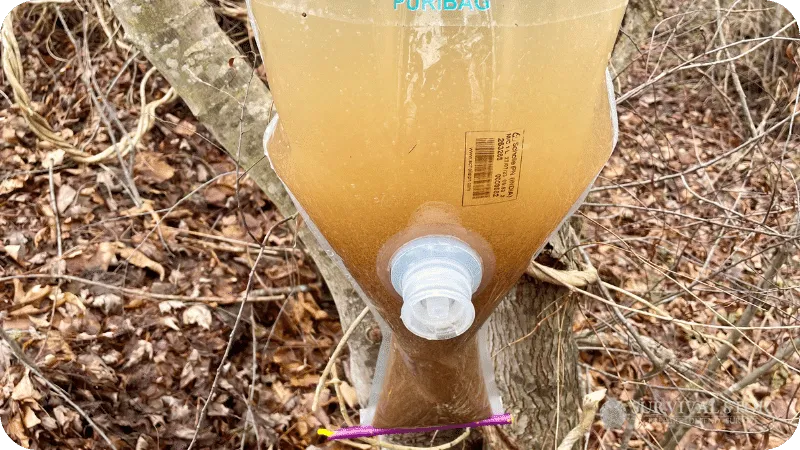
These satchets remove visible sediment and organic matter from water, on top of purifying it. So, it is great for muddy water. The flocculation process effectively clumped together the particulates, allowing them to settle at the bottom. Then, the disinfectant steps in to make the water safe to drink.
According to the WHO, this purifier is effective against bacteria, viruses, and protozoa. One of our testers reported that:
“This is the only purifier I trust for truly nasty water – brown, chunky, swampy stuff that most tablets can’t touch.”
The process does involve more steps and time compared to some simpler methods. But, not having to deal with muddy water makes it more than worth it!
See our guide on the best emergency water filters for how we combined this with the Puribag system.
PROS
Effective against many pathogens, including protozoa
Removes mud and organic materials
Suitable for treating large volumes of water
CONS
More complex and time-consuming
Leaves a noticeable chlorine taste
Bulkier packaging compared to tablets
Easiest to Use: Aquatabs
AquaTabs are a no-fuss, no-frills purification option that shine in one particular scenario: clear-looking water with a questionable source. Just drop a tablet into your water, wait 30 minutes, and drink. No mixing. No second step. No weird aftertaste that sticks to your tongue. They’re ideal for stress-heavy scenarios when you don’t have time (or mental energy) to second-guess directions.
Features
- Active Ingredient: Sodium dichloroisocyanurate (NaDCC)
- Treatment Time: 40 minutes
- Pathogens Targeted: Bacteria, viruses
- Shelf Life: 5 years
- Taste Impact: Virtually none—clean and neutral
Our Testing Scores
Here are the testing scores I logged during hands-on testing
| Test Category | Score (Out of 10) | Why? |
|---|---|---|
| Ease of Use | 10 | One tablet per liter. Dead simple. No measuring, no mixing, no two-step process. |
| Portability | 10 | Flat foil packs fit anywhere—wallet, glove box, Altoids tin. |
| Effectiveness | 6 | Great for bacteria and viruses. Won’t kill protozoa like Giardia or Cryptosporidium. |
| Taste | 7 | Slight chlorine note, but way better than iodine. Most testers barely noticed it. |
| Speed | 7 | 40-minute treatment time is decent; slower than filters. |
| Shelf-Life | 9 | Solid 5-year shelf life. Haven’t had any packaging issues, even after tossing it around in packs for months. |
Our Expert Take on Aquatabs
AquaTabs are my go-to for simple water purification in calm conditions, like treating rainwater, melted snow, or backup storage. They’re especially great if you’re stocking bags for family or group use, where not everyone has experience with filtration or tablets.

In fact, one of our testers pointed out that they like AquaTabs largely because they’re easy enough for children to use:
“I wanted something I could toss to my kid and not worry about explaining. Aquatabs are that simple.”
They don’t hit protozoa, so I don’t use them for swamp water or anything near livestock. But for cleaner sources or already-filtered water, they work like a charm.
Why aren’t they my favorite? Because they aren’t ideal for high-risk water, and they don’t do anything against organic matter. This makes them a little less useful than other options on this list.
PROS
Foolproof single-step process
Compact and ultralight
Minimal taste impact
CONS
Not effective against protozoa
Not ideal for high-risk water
Best for Comprehensive Protection: Katadyn Micropur MP1 Tablets
I keep a few Katadyn Micropur MP1 tablets tucked into my minimalist survival kit because they punch above their weight class. These are the lightest, most space-efficient tablets we tested that still offer full-spectrum protection, including protozoa like Cryptosporidium. They’re a great choice when you’re counting ounces (but they’re also one of the most expensive options).
Features
- Active Ingredient: Chlorine dioxide
- Treatment Time: Up to 4 hours
- Pathogens Targeted: Bacteria, viruses, and protozoa (Giardia, Cryptosporidium)
- Shelf Life: 5 years
- Taste Impact: Clean – no chemical flavor
Our Testing Scores
We tested these over the course of two months in swampy runoff, creek water, and even a muddy pond on a hot day. Here’s how they performed:
| Test Category | Score (Out of 10) | Why? |
|---|---|---|
| Ease of Use | 9 | Just drop and wait; couldn’t be simpler. No mixing or measuring. |
| Portability | 10 | Each tablet is individually sealed and practically weightless. Perfect for ultralight kits. |
| Effectiveness | 10 | Covered everything we threw at it, including protozoa-contaminated sources. No digestive issues after. |
| Taste | 9 | No noticeable taste at all. The water tasted like water, even from a pretty murky stream. |
| Speed | 4 | 4 hours is a long time when you’re trying to hydrate fast, but it’s the cost of thorough purification. |
| Shelf-Life | 9 | Great shelf life and durable packaging. No degradation even after rough storage. |
Our Expert Take on Katadyn Micropur MP1
These tablets are pretty popular with the prepping community online. They’re commonly recommended by other experts because they offer comprehensive protection. I have come across these tablets several times throughout the years, and while they do perform well, they aren’t my favorite.

When really sets them apart is the no-fuss experience. You don’t have to neutralize iodine or worry about taste, and they’re effective across the board. That’s great.
But, the 4-hour wait time is a huge trade-off. You can plan for it (like leaving it overnight), but when you need clean water on the move, finding four hours to wait on clean water can be a logistical nightmare. Plus, they require an opaque container.
Plus, they’re also one of the more expensive options available. The goal isn’t to be using them all the time, of course, but if you were going to splurge on something, I would recommend splurging on your bug out bag backpack, not your water purification tablets.
PROS
Lightweight and compact
No chemical taste
Kills bacteria, viruses, and protozoa
CONS
Long wait time
Single-use format can add up over time
Best Water Purification Tablet Comparison Chart
| Pathogens Covered | Treatment Time | Taste Impact | Portability | Shelf-Life | Cost | |
|---|---|---|---|---|---|---|
| Potable Aqua w/ PA+ | Bacteria, Viruses | ~30–35 minutes | Neutralized | Extremely compact | 4 years | Very affordable |
| P&G Purifier of Water | Bacteria, Viruses, Protozoa | ~30 minutes | Clean, slightly chlorinated | Compact powder packs | 3 years | Moderate |
| Aquatabs | Bacteria, Viruses | 40 minutes | Slight Chlorine taste | Ultralight Tablets | 5 years | Low |
| Katadyn Micropur MP1 | Bacteria, Viruses, Protozoa | Up to 4 hours | No taste | Individual foil packs | 5 years | Expensive per use |
My Field-Testing Insights for the Best Water Purification Tablets
I didn’t test these water purification tablets in a lab. Instead, they were tested in real-world conditions.
I didn’t just read labels and call it a day. I took these tablets into the field – muddy boots, wet weather, questionable water sources, and all.
Over the past year, I tested these alongside our testing team, which includes veterans, natural disaster responders, and survival experts who have been off the grid more than on it. We used them on:
- Muddy creek water with visible silt
- Rain runoff collected near a busy road
- Stagnant lake water with algae and leaf debris
During these testes, we tracked:
- Clarity: Did the water visually improve after treatment?
- Taste: Any chemical afterbite, or could you actually drink it without gagging?
- Ease of Use: Could we use them with cold hands, in the dark, while tired?
- Speed: How long until we could safely drink?
- Health Outcomes: No stomach issues 24–48 hours later = pass.
Spoiler: All four passed the stomach test, but only two stood out for real-world convenience. Micropur both handled protozoa, but I only used them when I had the time to wait. For quick, cold, tired moments? Potable Aqua with PA+ and P&G were what I reached for.
However, not everyone agreed with me. One of the other testers had a different suggestion:
“If I’m heading into unknown territory, I pack at least two of these — usually Katadyn for suspicious water and Aquatabs for speed.”
This wasn’t about perfection. It was about what actually works when you’re low on time, gear, and patience.
Do I Really Need Water Purification Tablets?
Spoiler: Yes. Even with a filter.
I love my Sawyer Mini and my Grayl, but I don’t trust anything as my only option – especially when it comes to water.
Here’s why:
- Filters clog. Tablets don’t. A filter filled with grit or mud is just dead weight.
- Filters don’t kill viruses. Some tablets do. Unless you’re rocking a high-end purifier, viruses will sneak right through.
- Filters are slow to share. Tablets scale. I can’t pass my mouthpiece around during a group bug-out, but I can toss everyone a tablet.
- Tablets weigh next to nothing and last for years. Seriously, toss a bottle in your glove box and forget it until the day you need it.
Water is just too important. You need more than one way to clean it, even if you have dozens of water storage containers in your basement. Sure, having a few ways to boil water without electricity is nice, but you shouldn’t count that as your only way to clean water, either.
If you’re relying on a filter without any chemical backup, you’re playing with risk.
How Water Purification Tablets Work
Water purification tablets use chemicals to kill waterborne pathogens, making water safe to drink.
Most purification tablets use either iodine or chlorine dioxide to do the dirty work.
- Iodine tablets are effective against most bacteria and viruses, but they don’t take out protozoa like Cryptosporidium.
- Chlorine dioxide goes further, killing bacteria, viruses, and those tough protozoa too.
Here’s the catch: they don’t remove heavy metals, chemicals, or sediment. That’s where your filter shines. Tablets and filters are teammates, not rivals. The tablet kills the nasties, and the filter pulls out the trash.
I treat my tablets like insurance. I use the filter when I can. I use both when I am not sure.
Filters vs. Tablets: What’s the Difference?
| Feature | Water Purification Tablets | Water Filter |
|---|---|---|
| Removes particles? | No | Yes |
| Kills viruses? | Yes (some) | No |
| Removes metals | No | Some |
| Shelf Life | Indefinitely | 4+ years |
| Portability | Bulky | Ultralight |
Simply put: you want both for complete coverage.
What to Consider When Choosing Water Purification Tablets
Not all tablets are created equal. Choose based on your environment and risk profile.
I’ve carried different tablets over the years, and the “best” one depends on where you are and what kind of water you’re dealing with. Here’s what I look for when choosing what to put in my kit:
- Kill spectrum: Some tablets just handle bacteria and viruses. Others, like chlorine dioxide, take out Cryptosporidium too. If you’re drinking out of ponds or lakes, that matters.
- Taste: Iodine tablets can leave that brownish aftertaste. Chlorine dioxide is usually more neutral. If you’re already dealing with stress, nasty-tasting water doesn’t help.
- Wait time: Some are ready in 30 minutes. Others take up to 4 hours. That might not matter when you’re camped, but in a bug-out situation, it’s something to factor in.
- Shelf life: Tablets are ideal for long-term storage. I stash extras in my get home bag and haven’t had to rotate them in years.
- Water clarity: If your source is murky or full of floaters, pre-filtering is non-negotiable. Alternatively, you can use the P&G Purifier for Water, which handles larger particulate matter. Tablets don’t clean dirt. They just kill the stuff you can’t see.
How to Use Water Purification Tablets
They’re dead simple, but only if you follow the directions.
Using tablets might seem foolproof, but there is a right way to do it. If you rush the process or skip steps, you’re gambling with your health.
- Use clear water when possible. If the water’s cloudy, run it through a bandana or coffee filter first. I keep a water filter in my kit for exactly this.
- Add the correct number of tablets. Most brands use one tablet per liter. More isn’t better. Stick to the instructions.
- Wait the full contact time. Some tablets work in 30 minutes. Others take up to 4 hours. Check the label and don’t cut corners.
- Shake the container if possible. That helps the chemicals distribute evenly, especially around the threads and cap.
- Keep the cap on tight while you wait. You want to trap the treatment gases inside, not let them escape into the air.
FAQs
Are water purification tablets safe for pregnant women?
Some are, some aren’t. Iodine-based tablets are generally not recommended during pregnancy. Check with a doctor and look for chlorine dioxide options instead. Iodine is a very effective poison, including to tiny people.
Do water purification tablets expire?
Yes. Most have a shelf life of 3–5 years. Always check the expiration date before relying on them. Old tablets may lose potency and be less effective.
What is the most effective water purification method?
A combo. Use a filter to remove sediment and chemicals, then tablets to kill anything microscopic. That’s the gold standard in the field.
What Water Purification Tablets to Get
Start with Potable Aqua with PA+. They’re our top pick for a reason.
If you’re a woman who might become pregnant in the future, AquaTabs are another solid option. They’re chlorine-based, making them safe for pregnancy and children.
You don’t need to ditch your filter. But if you’re not packing tablets too, you’re underprepared.
They weigh almost nothing.
They cost less than dinner.
They’ve saved my butt more than once.
My rule? Filter first, purify second. It’s the best of both worlds, and the best bet for staying safe when things go sideways. We go over filtration options in our emergency water guide.
