

For most individuals, I recommend the Osprey Kestral 38 backpack. It’s a great size for a bug-out bag backpack and withstood our extensive field testing.
After countless hours of traveling and trudging through the woods (and questioning my life choices), I finally managed to test dozens of bug-out bag backpacks. Spoiler alert: most of them are about as comfortable as a bed of nails and as practical as a screen door on a submarine. But, after sifting through all the duds, I did manage to bring you a gem: the Osprey Kestrel 38.
This pack not only survived our relentless abuse, but it was also one of the most comfortable I tested! Many of the experts on our testing team (including a veteran and survival expert) chose it as their favorite, too. Plus, we found a few others that are worth considering.

So, if you’re in the market for a bug out bag that won’t make you regret every step, keep reading.
My Favorite Bug Out Bag Backpacks


Laek Seafield 30L Waterproof Backpack
30 Liter capacity
Bucket Design
Waterproof
MSRP: $135.00
Save 15% off at LAEK with code “survivalstoic15”


SLNT Faraday Waterproof Backpack
20 Liter capacity
Bucket Design
4 External Pockets
MSRP: $299.95
Save 10% off at SLNT with code “survivalstoic”
Other Options we Like:
- Best Tactical: RTAC Large MOLLE Backpack – Jump to Review
- Best Bug Out Bag Backpack Alternative: Rockagator Mammoth Waterproof Duffel – Jump to Review
Best Bug Out Bag Backpack: Osprey Kestral 38
- Capacity: 38L
- Bag Style: Backpack
- Weight: 4.07 lbs.
- Material: 420D nylon
- MSRP: $199.95
The Osprey Kestral 38 is easily one of my favorite bug out backpacks, after extensive field testing. I love how this bag balances capacity, comfort, and durability, making it a top choice for survival situations.
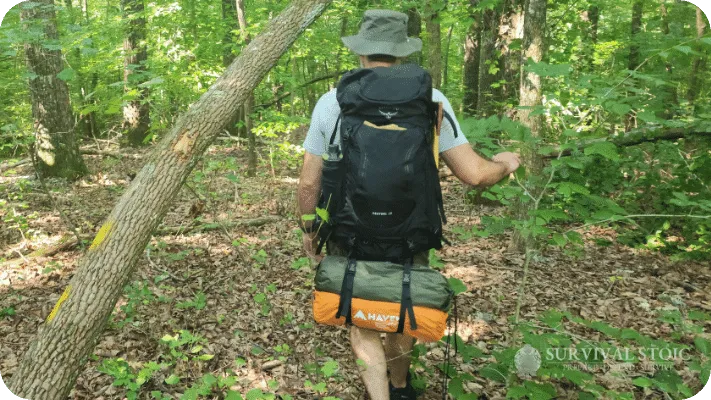
While the Kestrel 38 isn’t the largest pack on the market, its 38-liter capacity is deceptive. It comfortably accommodates gear for a week-long bugging out emergency, provided you’re not attempting to pack your entire garage (or packing for a whole family).
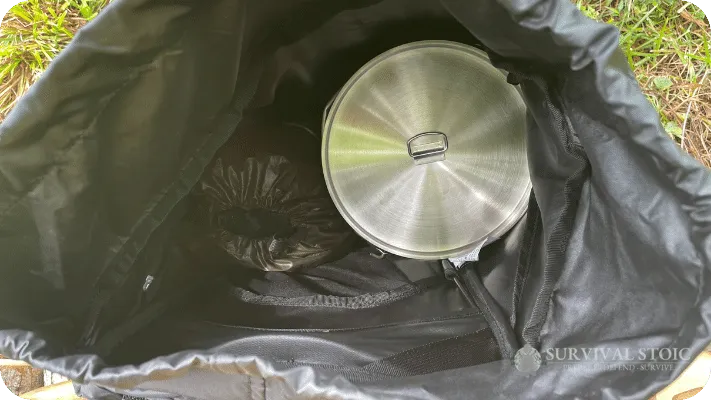
The top-loading design is complemented by a lower compartment with a floating divider and a side zipper. This makes it much easier to reach all my gear and keeps everything organized.
In a survival situation, the last thing I want to do is spend my time digging through my bag (or continuously packing and unpacking, as I have done with less-impressive bags).
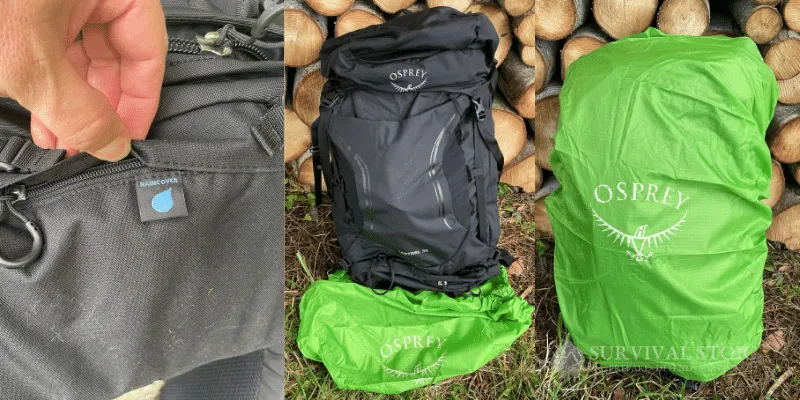
The Kestral 38 also has a built-in rain cover, which I found worked just as described. It was plenty protective enough to keep my gear drry – even during a storm.
The Kestral 38 is built to withstand the rigours of the backcountry, which makes most bug out situations a breeze. It’s made with rugged nylon fabric. Even after extensive use and testing, mine still looks like new.
Recommended for:
The Osprey Kestrel 38 stands out as the best bug-out bag backpack due to its thoughtful design, comfort, and durability. It’s a pack that not only meets the demands of survival situations but also has a level of comfort and organization that is hard to beat. It’s perfect for bugging out to a friends house or to a remote area (or any other outdoor activity, really).
Best Small Bug Out Bag Backpack: Mystery Ranch Scree 22
- Capacity: 22L
- Bag Style: Backpack
- Weight: 1.9 lbs.
- Material: 70D nylon ripstop
- MSRP: $199.00
After putting the Mystery Ranch Scree 22 through its paces, I can confidently say it’s the best small bug out bag I’ve encountered. It’s a compact option for those who want to pair it with a larger duffle (like I reviewed below) or for anyone who wants a lightweight minimalist setup.

At 22 liters, it is not huge. However, I did manage to pack some basic survival items without feeling like I was playing Tetris. Our expert recommended packing:
“a single change of clothes (maybe socks and underwear, too), basic food, simple shelter gear, maybe a few first aid supplies.”

We used this backpack for both outdoor hiking and overnight camping trips, plus took it on a few typical road trips.
The top pouch, featuring a mesh liner and an internal carabiner, became my go-to spot for quick-access items like a headlamp, emergency repair tools (think duct tape and zip ties), an extra compass, and a map. The design was obviously made by someone who uses these bags for survival situations.
My favorite feature of the Scree 22 is the 3-ZIP, though. Unzipping it fully allows the front panel to open wide, granting unfettered access to the main compartment. No more blindly fishing around for that elusive granola bar.

Inside, a deep sleeve comfortably accommodates a one-liter hydration reservoir. It isn’t a lot of water, but it is a little bit.
The bag’s minimalist pocket structure embodies the “Keep It Simple, Stupid” philosophy. It spares me the frustration of rummaging through countless compartments during high-stress situations.
Carrying comfort is paramount, and the Scree 22 delivers. The adjustable shoulder straps allow me to bring the bag closer to my body, enhancing stability and comfort. However, the waist strap is a simple nylon cord. While it is functional, it doesn’t offer the padded support I prefer.

Durability is a hallmark of Mystery Ranch, and the Scree 22 is no exception. The robust materials withstand the rigors of outdoor adventures, and the water-resistant zippers provide a nice seal against the elements, keeping my gear dry without the need for cumbersome rain covers or extra folding.
Recommended for:
In the realm of small bug out bags, the Mystery Ranch Scree 22 is absolutely one of my favorites. It just has so many little features that add up to a much less frustrating time.
Best Waterproof Bug Out Bag Backpack: Laek Seafield 30L Waterproof Backpack
Save 15% off at LAEK with code “survivalstoic15”
- Capacity: 30L
- Bag Style: Backpack
- Weight: 2.7 lbs.
- Material: 600D nylon
- MSRP: $135.00
After extensive testing, I can say confidently that the Laek Seafield 30L Waterproof Backpack is the best waterproof bug out bag I’ve tested. The pack does exactly what it says on the tin – keep my stuff dry.

This backpack is essentially a dry bag that is setup with backpack straps.
Let’s address the elephant in the room: achieving that watertight seal requires rolling the top four times. Yes, it’s a bit of a chore initially, but once mastered, it’s as second nature. It only took me a few minutes to get and effective seal.
The bag is crafted from recycled 600 denier polyester with a double-sided TPU coating. Plus, the extra 100 denier bottom panel adds an extra layer of protection. Even after my testing, this bag had very little apparent wear.
At 30 liters, this pack is Goldilocks-approved: not too big, not too small. It’s just right for a 72-hour emergency stash. I can pack all my essentials into it without turning into a pack mule.

The Seafield 30L doesn’t skimp on comfort. The structured back panel, soft padding, and cushy shoulder straps make carrying this bag much more comfortable than other options. The fully adjustable chest strap and padded waistband are a must-have for longer trips.
However, I did notice that the bag sits a tad low and doesn’t hug the hips as snugly as I’d prefer. It’s a minor gripe in an otherwise stellar design.

In high-stress situations, simplicity is your best friend. With fewer pockets to rummage through, I can quickly access what I need without playing hide and seek with my gear. As one expert put it:
“It does what it says on the tin. I would personally recommend this bag because it gets the job done without all the flashy accoutrements.”

In a bug-out scenario, blending in can be as crucial as the gear you carry. This bag’s unassuming design says, “I’m a normal dude; I probably don’t have much on me (to steal).” It’s the kind of low-profile look that doesn’t scream, “Valuable survival gear inside!”
Recommended for:
I highly recommend the Laek Seafield 30L Waterproof Backpack for those wanting a fully waterproof bag. If you have a truck, it is a must have. It’s robust construction and comfortable design easily beat out the competition.
Best Budget-Friendly Bug Out Bag Backpack: Ampex 35L Backpack
- Capacity: 35L
- Bag Style: Backpack
- Weight: 3.7 lbs.
- Material: Polyester
- MSRP: $99.99
When it comes to selecting a bug out bag, the Ampex 35L Backpack caught my attention with its promising features. We’ve reviewed Ampex’s gear in-depth before, but in this instance, I specifically looked at whether or not their bag was suitable as a bug out bag.

Spoiler alert: it was.
The 35-liter capacity is a great balance between spaciousness and manageability. It has plenty of room for extended trips, without making it feel like you’re hauling a body. The bucket-style design allows for efficient packing, and the U-shaped front zipper is a godsend for actually accessing my gear.
The lower compartment has an internal divider that keeps my sleeping bag separate from the rest of my gear – which is always a nice touch – since I can get to it quickly.

Ampex didn’t skimp on the suspension system, either. The adjustable frame, sternum strap, and hip belt work together to distribute weight effectively through the hips, sparing my back and shoulders from unnecessary strain. I did find that the pack fit comfortably, but adjustment and setup took some trial and error.
The only disadvantage with this is once it was setup for me, it didn’t work well for others. This is typical for good hiking backpacks with a proper suspension system though.
The side pockets are roomy enough to accommodate items like water filters and tools, while the adjustable straps and loops come in handy for securing larger gear such as camp axes.

Recommended for:
The Ampex 35L backpack is another suitable bug out bag that costs about half as much as other options on this list. If you just can’t afford a $200 bag for each person in your family, get this one instead. While it has a minor shortcoming, its overall performance and design make it a reliable choice for those preparing for the unexpected.
SLNT Expanded Waterproof Faraday Backpack – Best for Electronics
Save 10% at SLNT with code “survivalstoic” at checkout
- Capacity: 20L
- Bag Style: Backpack
- Weight: 3.04 lbs
- Material: 420D Waterproof Nylon
- MSRP: $299.95
The SLNT Waterproof Faraday Backpack is perfect for carrying electronics during a bug out scenario. Not only is it waterproof, but the main compartment is a full faraday cage.
As we discussed in our Best Faraday Bag guide, Faraday bags provide EMP Protection for electronic devices like emergency radios, GPS units, and modern flashlights.

I like to store my critical devices along with other essentials in this backpack. If there is an EMP attack, they are not only protected, but they are already in a backpack that I can just grab and go. No need to take them out of a separate faraday cage and then repack them in something else.
This backpack reminds me of a dry bag – it is waterproof and fully submersible for up to 30 minutes in 10 feet of water. But it also combines other features that make it a functional backpack as well.
The straps are padded and fully adjustable. There is a pocket on one side for a canteen or water bottle, and a MOLLE strip on the opposite side where I can attach an IFAK or a utility pouch.

I like the front pockets on this backpack. The top one has a RFID blocking pouch, perfect for credit cards or key fobs. This pocket also has two smaller inside pockets near the top, while the full pocket goes all the way down to the bottom of the backpack.

The outside front pocket has three interior pockets and is great for critical documents and maps. Both of these outside pockets are water resistant and have durable YKK water resistant zippers.
Probably my favorite feature (other than being waterproof and EMP proof) is the hidden back pocket. Here I can store critical items like cash, passports, or even a compact concealed carry handgun. The zipper is hidden behind the padding where it is not obvious to others.

This backpack also comes with a removable faraday bag for smaller items if I want to carry them separate from the backpack.

SLNT also has an insert for this backpack that is a sort of organizer for the interior (sold separately). If you plan to store a laptop or tablets it is a must have. It can also be easily taken out to allow more room. For instance, if I have just a few devices I want to protect, I can also use it for other items I don’t want to get wet, like clothing, fore starting gear, and food.

The only real downside to this backpack is the capacity. At 20L it doesn’t give me a lot of room for everything that I need. But, since I have other family members with me, it is a great way to split up the load and provides full protection for my electronics that other backpacks don’t.
Recommended for:
The SLNT Waterproof Faraday Backpack is for anyone that has critical electronics that they would like to protect and store for a bugout (or even a bug-in) scenario. Not only is it waterproof but EMP proof as well.
Best Tactical Bug Out Bag Backpack: Rattlesnake Tactical Large Backpack

- Bag Style: Backpack
- Weight: 3.7 lbs.
- Material: Polyester
- MSRP: $99.00 (often on sale for much less)
When I first laid eyes on the Rattlesnake Tactical Backpack with Holster, my initial thought was, “Well, this bag practically screams, ‘I probably have a gun on me.'” With MOLLE attachment points galore, it’s got that ‘mall ninja’ vibe that I don’t typically recommend for a bug out bag.

The laser-cut MOLLE is a nice touch, making it easier to weave your MOLLE straps without the usual hassle. Inside, it’s a standard affair with plenty of pouches for organization and numerous attachment points on the exterior. It’s just a really standard bag.
One of the biggest benefits of this bag is its price tag. It costs much less than most options out there. I have seen this on sale for $25 sometimes at Ammo Depot. However, it does cost less for a reason. This isn’t a top-end hiking bag like I have been reviewing.

The universal pistol holder does it’s job surprisingly well, based on my testing. Once your firearm is in it, it isn’t going anywhere!
However, I did find accessing my weapon hard in an emergency due to the challenging placement. Personally, I prefer to keep my firearm on my person for easier access.

This bag feels like it’s designed for a three-day patrol. It’ll carry some ammunition, food, tent supplies, hygiene items, and the like. It has plenty of capacity for a 72-hour bug-out bag.
The waist strap leaves something to be desired. It doesn’t provide much support; it merely keeps the bag attached to your body without effectively distributing the weight.
Recommended for:
If you’re set on a “tactical-style” bag, the RTAC Large Backpack is as good as any. It doesn’t have any massively helpful features, but it isn’t poorly designed, either. The price is great though when it is on sale.
Best Bug Out Bag Backpack Alternative: Rockagator Mammoth Waterproof Duffle Bag

- Capacity: 60L
- Bag Style: Duffle
- Weight: 3.49 lbs.
- Material: Ripstop, waterproof nylon
- MSRP: $119.99
When it comes to hauling a mountain of gear through a monsoon, the Rockagator Mammoth Series Waterproof Duffle Bag is easily my favorite option. After putting this monster of a bag through a lot of abuse, I can confidently recommend it as the best waterproof bug out bag for larger families of groups.

This duffle is massive, offering 60 liters of storage capacity. It’s perfect for stashing communal gear like food, cooking supplies, electronics, and those specialty items that are too heavy or niche for individual packs. One of our testing experts noted that it’s ideal for:
“things that need to stay dry or too niche to keep on me, but are still important enough to bring.”
Of course, you aren’t going to be navigating dense forests with it slung over your shoulder. This bag is more suited for vehicle transport or team carry.

The Mammoth Series duffle is built to withstand just about anything. It’s made with heavy-duty materials and a roll-top closure system that creates a waterproof dry-bag seal. It’s the kind of bag you can toss in the back of a pickup truck without a second thought about the weather.
The bag features sturdy rubber handles on either side, making it easy to grab and go. It also includes a detachable shoulder strap for longer carries. However, as one of our experts pointed out:
“Shoulder straps aren’t padded or anything, which does impact long-term comfort.”
So, while it’s manageable for short distances, you might not want to plan any marathon hikes with it.

The Mammoth Series duffle is equipped with multiple daisy chain connection points and D-ring attachment points, providing ample options for securing additional gear. However, the D-rings are plastic, and as our expert mentioned, “I’d rather they be aluminum or a similar material.”
Recommended for:
The Rockagator Waterproof Duffle Bag is a top contender for larger families and groups. It is a perfect option to pack extra food or electronics. Pair it with personal Scree 22s for a complete survival system that can support dozens of people.
How We Picked The Best Bug Out Bag Backpacks
When it came to selecting the crème de la crème of bug out bag backpacks , I didn’t just rely on manufacturer specs or online reviews. Instead, I took these packs on trips and into the wild, loaded them with actual survival gear, and put them through the wringer.
Thanks to our diverse testing team, we gathered insights from individuals with varying backgrounds, ensuring a well-rounded evaluation.
Here are the factors I rated each bag on:
- Durability: Survival situations aren’t gentle, and neither was I. I subjected each bag to plenty of rough, real-world experiences, like dragging them through the underbrush and exposing them to the rain. If the bag couldn’t withstand the abuse, it wasn’t mentioned on this list. After all, a bug out bag that falls apart when you need it most is about as useful as a chocolate teapot.
- Capacity and organization: Playing a high-stakes game of Tetris, I packed and unpacked each bag under timed conditions. Surprisingly, the bags that performed the best were those with fewer pockets. Bags that turned into black holes, swallowing gear into unreachable abysses, were swiftly eliminated.
- Comfort and fit: Of course, I also carried each bag, fully packed. Ill-fitting straps, poor weight distribution, and lack of ventilation became glaringly obvious after a few miles. Some bags hadn’t been tested all that much during the design phase, and it showed.
- Accessibility: In emergencies, fumbling for gear isn’t an option. I conducted drills to test how quickly and easily I could access essential items. I threw out bags that required a map and a prayer to find anything.
Thanks to this rigorous, hands-on testing process, I identified the bags that truly stand up to the demands of survival situations. It’s not just about having a bag; it’s about having the right bag.
Why You Should Probably Spend More
When it comes to prepping, I’m all about snagging deals and cutting costs where it makes sense. (I even wrote a whole guide on prepping on a budget.) But if there’s one piece of gear where you shouldn’t pinch pennies, it’s your bug out bag. Think about it: this bag holds all your survival essentials. If it falls apart (or simply doesn’t work), you’re in a world of trouble.
Sure, that bargain bin backpack might seem like a steal, but more often than not, you get what you pay for. Cheap bags from online retailers might not even last a couple of years. During my testing, many showed signs of wear after only a few hours of use.
Manufacturers cut corners in places you might not immediately notice. Take zippers, for instance. Some companies use chain-stitching to save a buck, but if one link breaks, the whole zipper can unravel faster than your plans in a disaster. Premium bags often feature more robust construction.
Spending more doesn’t always give you more bells and whistles. Many of the most expensive bags out there are very simple. But, it does mean a smarter design. Take the 3-ZIP system from Mystery Ranch, for example. It’s not about flashy extras; it’s about accessing your gear quickly and efficiently when time is of the essence.
For those on a tight budget, I recommend allocating more funds to your bug out bag and economize on other gear. We provide budget-friendly options for almost everything else you’ll need, allowing you to invest in a bag that actually holds up.
Bigger Isn’t Always Better
It’s often assumed that larger packs are inherently superior. At first glance, the logic seems sound: more space equals more gear, right?
But unless you’re training for a ruck march, lugging around a 50-60 liter behemoth can be more hindrance than help. For most, I actually recommend a 30-40 liter bag, as this seems to strike the best balance between capacity and manageability.
That’s why most bags on this list fall into this range. It’s simply the best option for the average prepper.
Overpacking is a frequent pitfall; many items deemed essential often collect dust at the bottom of oversized packs. If you don’t have enough room in a 40L bag for all your gear, you need less gear.
Take a look at our bug out bag list for the things you actually need – and what you can safely skip.
Streamlining your gear lightens your load and reduces the chance of injury. In my opinion, agility often trumps abundance in survival scenarios.
Tactical Backpacks Are Overrated
There’s a pervasive myth in the prepping community that tactical backpacks are the epitome of survival gear. I will admit, they certainly look the part with their MOLLE webbing and military-inspired aesthetics. However, it’s time cut through the hype: opting for a tactical backpack might just be painting a bullseye on your back.
Strapping on a tactical backpack is akin to wearing a neon sign that reads, “Valuable gear here!” In high-stress situations, standing out is the last thing you want.
A bag festooned with MOLLE webbing and tactical patches screams preparedness, making you a prime target for those looking to capitalize on your foresight. Blending in is vital to avoiding unwanted attention.
Sure, tactical packs boast rugged materials and durability. However, they did not peerform any better than your average hiking bag during my testing (in fact, they often performed worse).
They might work great as a range bag, but they aren’t suitable for bugging out.
These bags are often based on soldiers’ need. But, as many veterans will tell you, just because the military gives you something doesn’t mean it is the best (just as often, it means it isn’t). As one of our veteran testers said during testing:
“If the military would have issued me one of these bags, I would have been golden.”
Instead of going full-on Rambo, consider a low-profile backpack in neutral colors. Brands like Osprey and Mystery Ranch offer designs that blend seamlessly into civilian settings while providing ample space and organization for your gear. Hiking bags are far less likely to draw attention, and they tend to be more comfortable, too.
So, highly recommend selecting a more practical backpack, rather than one screaming “I’m prepared.”
Comfort vs.Capacity: The Eternal Bug-Out Bag Dilemma
In the grand quest to assemble the ultimate bug-out bag (BOB), it’s easy to fall into the “more is better” trap. After all, who wouldn’t want to be prepared for every conceivable apocalypse scenario?
But let’s get real: overpacking your BOB is like signing up for a self-inflicted torture marathon. An overloaded pack will weigh you down, sapping your energy and burning precious calories. Plus, it increases the risk of injury.
In a survival situation, that’s a trifecta of trouble you can’t afford.
Before you start cramming your bag with gadgets aplenty (and every “cool” thing a Youtuber tries to sell you), focus on the core survival items:
- Shelter: Lightweight survival tents or emergency bevies
- Water: Portable filtration systems and ready-to-drink water
- Bug Out Bag Food : Non-perishable, high-calorie items
Stick to these basics and don’t get drawn into preparing for every “what if” scenario. If specific emergencies are common in your area, by all means, prepare for them. But don’t try to prepare for every apocolypse imaginable.
Remember: every extra pound is another pound you’ll curse later.
How you pack is also just as crucial as what you pack. Here’s how one of our veteran testers recommends packing:
- Heaviest items: Place them close to your back and centered between your shoulders and waist. This positioning maintains balance and conserves energy.
- Mid-weight items: Surround the heavy items to stabilize the load.
- Light items: Store them on top or in external pockets to prevent them from getting lost.
Proper weight distribtion prevents the pack from pulling you backwards or throwing off your center of gravity. In practice, a properly packed load often feels like a lighter load.
Don’t wait for doomsday to discover your BOB is a backbreaker. Regularly test your fully loaded pack over substantial distances. Pay attention to discomfort or strain, and adjust the load or straps as needed. It’s best to test your BOB a couple times a year, replacing seasonal supplies as you do so.
In the end, the goal is to strike a balance between being prepared and being mobile.
Which Bug Out Bag Backpack to Get
For most preppers, I recommend the Osprey Kestral 38. It performed best in all of my testing, striking a nice balance between capacity and comfort.
For a smaller option, pick the Mystery Ranch Scree 22. It’s 3-Zip is absolutely game changing and one of my favorite features of all the bags I tested.
You can also use some of these as get home bags. While they’ll need to be filled with different items, you’ll want the same sort of backpack for your bug out bag as you’d want for a get home bag (though you may choose a smaller option).
Remember: less is often better. Use our bug out bag weight calculator to build your bug out bag before you start buying supplies to make sure you aren’t overloading yourself. Also review our Bugging out vs Bugging in guide for tips on how to make the best decision on when to go and when to stay.
