

MREs (Meals Ready-to-Eat) don’t have a fixed expiration date, but they do have a real-world shelf life that depends almost entirely on temperature. This guide is based on military storage data and real-world testing, not just manufacturer estimates.
In ideal conditions, most MREs last 3 to 5 years, and often much longer. Stored cool (around 60–70°F), they can remain safe and edible for 7–10+ years. But leave them in a hot garage or car, and that same MRE might only last a few months.
Where the MRE was stored before you purchased it also matters. If you’re looking for reliable options, see our guide to the best MREs to buy.
The problem is that most shelf life estimates online are either overly optimistic or completely ignore how quickly heat breaks these meals down.
This guide cuts through that.
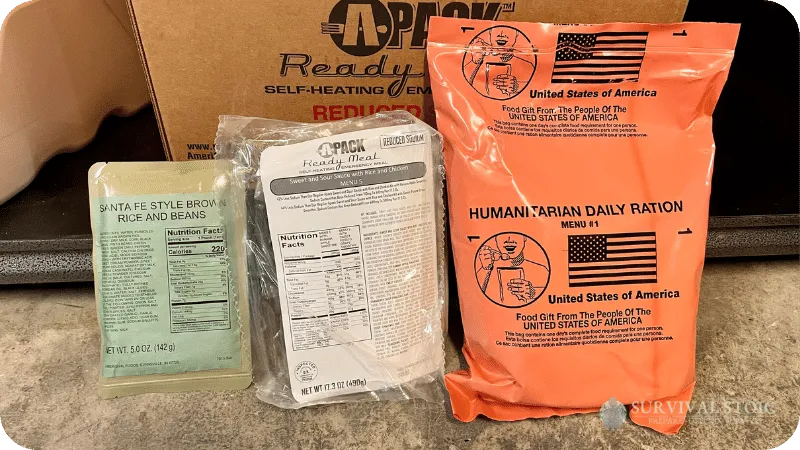
If you’re building a full emergency food setup, start with our complete survival food guide.
We’ll show you:
- How long MREs actually last at different temperatures
- How to read MRE date codes
- How to tell if an MRE is still safe to eat
- And how to store them so they last as long as possible
Quick Answer
How long do MREs last?
- At 70°F (room temp): ~5 years
- At 80°F: ~2–3 years
- At 90°F: ~1 year
- At 100°F+: a few months to 6 months
- At 60°F or below: 7–10+ years
MREs don’t expire on a fixed date. Instead, they gradually degrade over time, with heat being the biggest factor. Most MREs become unpleasant before they become unsafe.
⚠️ Heat is the #1 factor that determines MRE shelf life, not time.
MRE Shelf Life Chart (Temperature-Based)
Here’s a realistic breakdown of how storage temperature affects MRE lifespan:
| Storage Temperature | Expected Shelf Life |
|---|---|
| 120°F | ~1 month |
| 100°F | ~6 months |
| 90°F | ~1 year |
| 80°F | ~2–3 years |
| 70°F | ~5 years |
| 60°F | 7–10+ years |
These estimates are based on military storage data used by the U.S. Army, which tracks how MREs degrade at different temperatures.
Key takeaway:
Heat destroys MREs far faster than time. This is why MREs are just one part of a larger long-term food storage plan.
An MRE stored in a hot car for one summer can degrade more than one stored for several years in a cool basement.
MREs are shelf-stable because they’re sterilized and sealed, but they’re not chemically frozen in time. Fats oxidize, vitamins break down, and flavor compounds degrade with heat exposure.
It’s not just the heat in a trunk that kills MREs, either. It’s the constant vibration. Over years of driving, the friction can cause the retort pouches to develop “micro-abrasions” or pinhole leaks, especially if they are rubbing against hard gear.
If you must store MREs in the car, wrap them in a soft cloth or keep them in a padded sleeve to prevent the packaging from wearing thin.
Unlike MREs, which have a limited shelf life, dry staples like rice and beans can last decades when stored properly. This guide walks through how to store rice and beans step by step.
Why does heat kill MREs? In food chemistry, the Arrhenius Equation describes how the rate of chemical reactions, like the oxidation of fats and the breakdown of vitamins, increases exponentially with temperature.
For every 18°F (10°C) increase, the chemical aging of your food roughly doubles. This is why a single summer in a 120°F trunk can “age” an MRE by two years in just a few months.
To make your MREs last as long as possible, focus less on the calendar and more on keeping them cool and stable.
If you’re comparing options, it’s worth looking at how MREs stack up against emergency food kits and freeze-dried meals.
Real-World Shelf Life Scenarios
To make this practical, here’s what MRE shelf life looks like in common situations:
- Stored in a basement (65°F): 7–10+ years
- Stored in a house (72–75°F): ~4–6 years
- Stored in a garage (seasonal heat): ~1–3 years
- Stored in a car trunk (summer exposure): weeks to months
How to Tell If an MRE is Bad
Here is our downloadable field guide on how to inspect MREs, designed specifically for buying surplus cases:

MREs rarely “spoil” in the traditional sense, but they can become unsafe if the packaging fails or bacteria develop inside the pouch. Different parts of the MRE can go bad at different times, too.
Not all components age equally. If you’re testing an older MRE, open the cheese spread or fruit-based sides (like applesauce) first. These are chemically active and will darken or become acidic long before the main entree or the crackers fail. If the cheese is a dark, oily orange instead of pale yellow, the storage temperature was likely too high.
Here’s how to check an MRE before eating it:
1. The pouch is swollen or bloated
This is the biggest red flag. Swelling usually means gas buildup from bacterial activity. This can indicate spoilage inside the sealed pouch.
If an MRE pouch is swollen, do NOT eat it.
2. There are leaks or damage
Inspect the packaging closely:
- Small punctures
- Seal separation
- Sticky residue or dried food on the outside
Even tiny leaks can allow oxygen in and bacterial growth. If the seal is compromised, it’s not worth the risk.
3. It smells off when opened
MREs don’t smell amazing, but they shouldn’t smell rotten.
Watch for sour, rancid odors and “chemical” or unusually sharp smells. If it smells wrong, trust your instincts and toss it.
4. The color or texture looks wrong
Some natural changes happen over time, but major changes are a warning sign:
- Unusual darkening or discoloration
- Slimy texture
- Separation that doesn’t look normal
When in doubt, don’t eat it.
5. The packaging looks “aged out”
Even if the pouch isn’t damaged:
Faded printing, brittle outer bag, and excessive wear can indicate long-term exposure to heat or poor storage conditions.
Most MREs become unappetizing before they become dangerous, but once the packaging is compromised, all bets are off.
6. Check for a red line indicator
Check if your MRE cases have a Time-Temperature Indicator (TTI). This is a small sticker (usually a circle within a square) found on the outside of military-grade MRE cases. The inner circle darkens over time based on heat exposure.
If the inner circle is lighter than the outer ring, it’s good. If it’s the same color or darker, the MREs have reached their “inspection date” due to heat, regardless of the Julian code.
We recommend combining MREs with other foods to build a more complete emergency food supply because of this sensitivity to heat.
One of the most consistent patterns we’ve seen is that MREs stored in vehicles degrade faster than expected, even beyond what temperature charts predict. Heat, vibration, and pressure over time all contribute to faster breakdown.
How to Read MRE Date Codes
MREs don’t use standard expiration dates. Instead, they’re marked with a Julian date code that tells you when they were packed.
Once you know how to read it, it’s simple.
Step 1: Find the 4-digit code
You’ll usually see a number like:
2023
3125
2120
Step 2: Understand the format
The code follows this structure:
YDDD
- Y = Year (last digit)
- DDD = Day of the year (001–365)
Example
3125
- 3 = 2023
- 125 = 125th day of the year
That means this MRE was packed on May 5, 2023.
If you are buying a full case of military MREs, look for a small sticker on the box: a circle within a square. This is a Time-Temperature Indicator (TTI).
- Inner circle matches or is darker than outer ring: The case has reached its “Inspection Test Date” due to heat exposure, regardless of the year on the box.
- Inner circle is lighter than outer ring: The MREs are good.
Important: It’s a pack date, not an expiration date
This is where most people get confused. The date tells you when it was made, NOT when it expires. These are typically based on storage at 80°F, not ideal conditions.
What does that mean in the real world?
If you find an MRE with a pack date from 5 years ago:
- Stored cool (basement)? → likely still good
- Stored hot (garage)? → likely degraded or borderline
The date code tells you when the clock started, but the temperature determines how fast it runs.
MRE Date Code Calculator
MRE Date Code Calculator
Enter the 4-digit MRE production code (YDDD) from the case or pouch.
Example: 4300 = year ending in 4, day 300 of that year.
Note: MRE “inspection dates” and real-world shelf life depend heavily on storage temperature and packaging condition. Always inspect for swelling, leaks, off odors, or damaged seals before eating.
How to Store MREs for Maximum Shelf Life
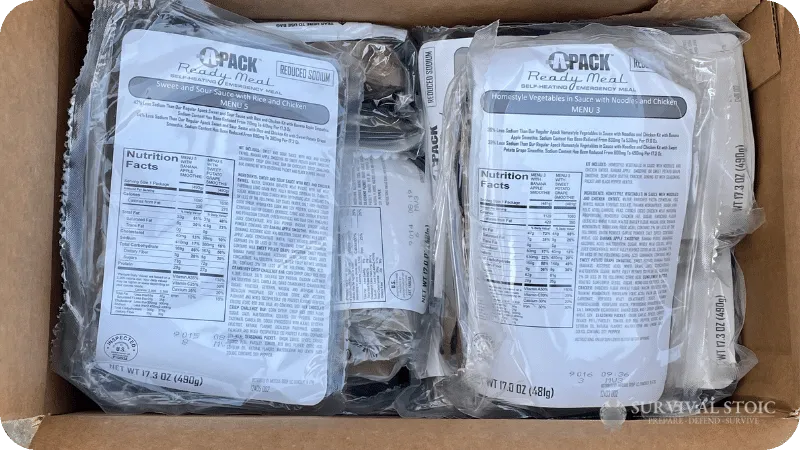
If you want your MREs to last as long as possible, focus on one thing above all else: keeping them cool and stable. Temperature matters far more than time. A properly stored MRE can last years longer than one exposed to heat for even a few months.
Ideal storage temperature
- Best range: 50–70°F
- Cooler is better, as long as it’s dry and stable
- Avoid temperature swings whenever possible
Think: the same conditions you’d want for long-term food storage or a pantry.
Where NOT to store MREs
These common spots will drastically shorten shelf life:
- Attics → extreme heat buildup
- Garages → temperature swings + summer heat
- Cars/trunks → can exceed 120°F in summer
Even a single hot season in these environments can cut shelf life down to months instead of years.
Best places to store MREs
For long-term storage, choose locations that stay consistently cool:
- Basement (ideal if dry and climate-stable)
- Interior closet (away from exterior walls)
- Climate-controlled storage room
Store MREs off the floor and away from exterior walls to avoid temperature fluctuations and moisture exposure.
You don’t need special containers or complicated systems. Just keep your MREs cool, dry, and out of the heat, and they’ll last significantly longer.
While an MRE might be safe to eat at 10 years, the Vitamin C and Thiamine (B1) levels drop significantly after the 5-year mark. If you are relying on only old MREs in a long-term survival scenario, you could technically face nutritional deficiencies even if your stomach is full.
For bulk storage, you’ll also want proper methods like mylar bags and long-term food storage techniques.
MREs vs. Freeze-Dried Food (Which is Better?)
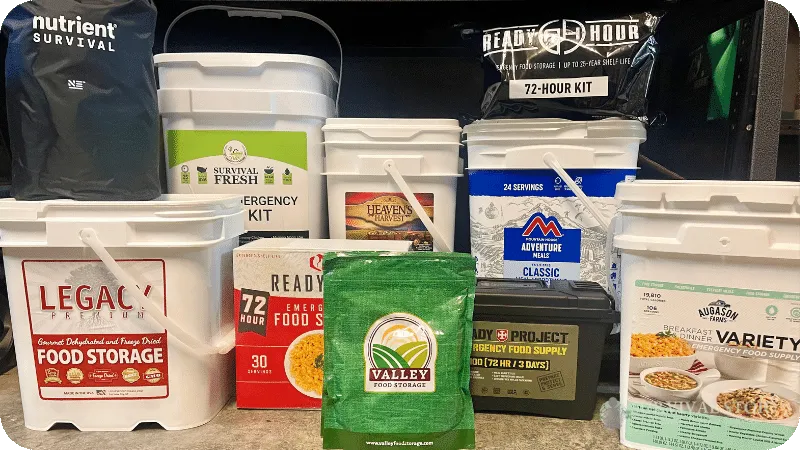
MREs are often compared to freeze-dried meals, but they’re built for completely different situations.
Here’s how they actually stack up:
| Feature | MREs | Freeze-Dried Food |
|---|---|---|
| Shelf Life | 3–5 years (longer if cool) | 20–30+ years |
| Prep Required | None (ready to eat) | Requires water |
| Weight | Heavy | Very lightweight |
| Taste (long-term) | Degrades over time | Stays consistent |
| Best Use | Immediate emergencies | Long-term storage |
When MREs make more sense
MREs are ideal when you need food that works right now:
- Power outages
- Bug out situations
- Car emergency kits
- Short-term disasters
You don’t need:
- Water
- Cooking gear
- Prep time
You can just open it and start eating.
When freeze-dried food is better
Freeze-dried meals are built for long-term storage:
- 20–30 year shelf life
- Lightweight and compact
- Better for bulk storage
The tradeoff:
- You need clean water
- You need time to prepare it
The reality that often gets missed
MREs and freeze-dried food aren’t competitors. They’re complementary.
- MREs = short-term, grab-and-go
- Freeze-dried = long-term storage
Most well-prepared setups include both. Use MREs for immediate readiness and freeze-dried food for long-term security.
Should You Rotate MREs?

Unlike canned goods, MREs don’t require strict rotation, but that doesn’t mean you should ignore them entirely.
The short answer: yes, you should rotate MREs, but loosely. Focus more on storage conditions than exact dates.
You should rotate your MREs if:
- They’ve been stored at room temperature (70–80°F) for several years
- You’re not sure how they were stored previously
- You’re building a long-term food supply that you plan to rely on
In these cases, use a simple rule: Eat the oldest first and replace as needed.
If your MREs are stored properly in a cool environment with minimal heat exposure, they can last long enough that frequent rotation isn’t necessary.
People treat MREs like canned food and rotate them constantly. That’s not needed, and it often leads to wasted money.
The smarter approach is to store them properly and check conditions occasionally, only rotating when needed.
Good storage matters more than strict rotation. Keep MREs cool, and they’ll last far longer than most people expect.
That said, one of the most overlooked issues with older MREs is calorie density. As fats degrade, total usable energy can drop, meaning you may need more food to meet the same energy needs.
Frequently Asked Questions
Can you eat expired MREs?
Yes, many MREs are still safe to eat years after the pack date, especially if stored in cool conditions. However, quality declines over time. Always inspect for damage or swelling before eating.
This is why many people balance them with longer-lasting foods in a complete survival food plan.
How long do MREs last in a car?
Not long. Summer heat can exceed 120°F inside a vehicle. At those temperatures, MREs may last only a few weeks to a few months
Cars are one of the worst places to store MREs long-term.
Do MRE heaters expire?
MRE heaters don’t expire in the same way food does, but they can lose effectiveness over time, especially if exposed to moisture.
- If sealed and dry → usually last for years
- If compromised → may not heat properly
What’s the longest an MRE has lasted?
There are reports of MREs lasting 10+ years when stored in cool conditions (around 60°F). That said, taste and texture will degrade significantly. Not all components age equally, either.
Can you freeze MREs?
Yes, but it’s not necessary. Freezing can extend shelf life. However, repeated freezing and thawing may damage packaging. A consistently cool environment is usually the better option.
If you freeze them, do it once and leave them frozen; don’t let them bounce between 20°F and 50°F. This can cause the laminate layers of the pouch to delaminate and develop “stress cracks.”
Do MREs lose nutritional value?
Yes. While an MRE might remain “safe” to eat for 10–15 years in a cool basement, the Vitamin C, Vitamin A, and Thiamine (B1) levels degrade significantly after 5 years. For a short-term emergency, this doesn’t matter, but for long-term survival, you shouldn’t rely solely on “vintage” MREs for your total nutritional needs.
How We Tested & Verified

This guide is based on a combination of:
- Military and manufacturer data on MRE shelf life at different temperatures
- Real-world storage observations (including hot vs climate-controlled environments)
- Packaging analysis of retort pouches and how they degrade over time
We focused on practical outcomes, not just lab estimates, because how MREs are stored in real life (garages, cars, closets) has a much bigger impact than most official guidelines suggest.
Where possible, we prioritized:
- Consistent temperature-based data
- Long-term storage comparisons
- Observable signs of degradation
The goal is simple: give you a realistic expectation of how MREs actually perform, not just what they’re technically “rated” for.
We’ve stored MREs in both climate-controlled environments and high-heat conditions (like vehicles and garages) to observe how quickly quality declines. One of our testers, Blake, has years of experience storing and consuming MREs and other military rations across a wide range of conditions, including extended field use and long-term storage testing.
Bottom line
MREs don’t have a fixed expiration date, but they do have a predictable lifespan if you understand how they work.
In most cases, you can expect:
- Around 3–5 years at room temperature
- Much longer in cooler conditions
- Much shorter if exposed to heat
The biggest mistake people make is focusing on the date instead of the environment. Temperature determines shelf life, not the calendar.
If you store your MREs in a cool, stable place and check them occasionally, they’ll last far longer than most people expect and remain a reliable part of your emergency food supply.
Next steps:
Want to build a smarter food supply?
Most people either overbuy the wrong foods or store them in ways that ruin their shelf life.
We break this down step-by-step.
Join the Survival Stoic newsletter for:
- Practical food storage strategies that actually work
- Real-world gear and supply recommendations
- Simple, no-nonsense preparedness guides
No fluff. No panic. Just useful information you can actually use.
