
Need to check how old your MREs are? Use our MRE expiration calculator below.
If you’re trying to figure out which MREs are actually worth buying, you’re not alone. Between my time in the military and years of testing MREs again as a civilian prepper, I’ve eaten more of these pouches than I’d like to admit: in the field, on training exercises, camping trips, and during emergency preparedness testing with my family.
But here’s the part most “best MRE” guides don’t explain clearly: There are two completely different ways civilians buy MREs.
And depending on your goal, the best option changes.

Not all MREs are worth stocking. Some are overpriced surplus with very little shelf life left, while others are stripped-down versions that barely resemble the military meals people expect.
In this guide, I’ll break down the best MREs you can actually buy today, including full military-style meals, budget-friendly options, and the entree packs most preppers prefer.
Quick Verdict: Best MREs for Most People
If you just want the short answer, here it is.
- Best for most preppers: MRE Entrees – cheapest, lightest, and easiest to store
- Best full-day ration: Humanitarian Daily Rations (HDR) – around 2,000 calories per pack
- Best military-style MRE: MRE Star Complete MRE Case – closest civilian equivalent to real issued MREs
Most civilians are better off stocking MRE entrees plus a few simple add-ons like ration bars or peanut butter packets. But if you want the full military-style experience with heaters and sides, a complete MRE case like MRE Star is the way to go.
Below is a quick comparison of my favorite options.
Quick Comparison of the Best MREs
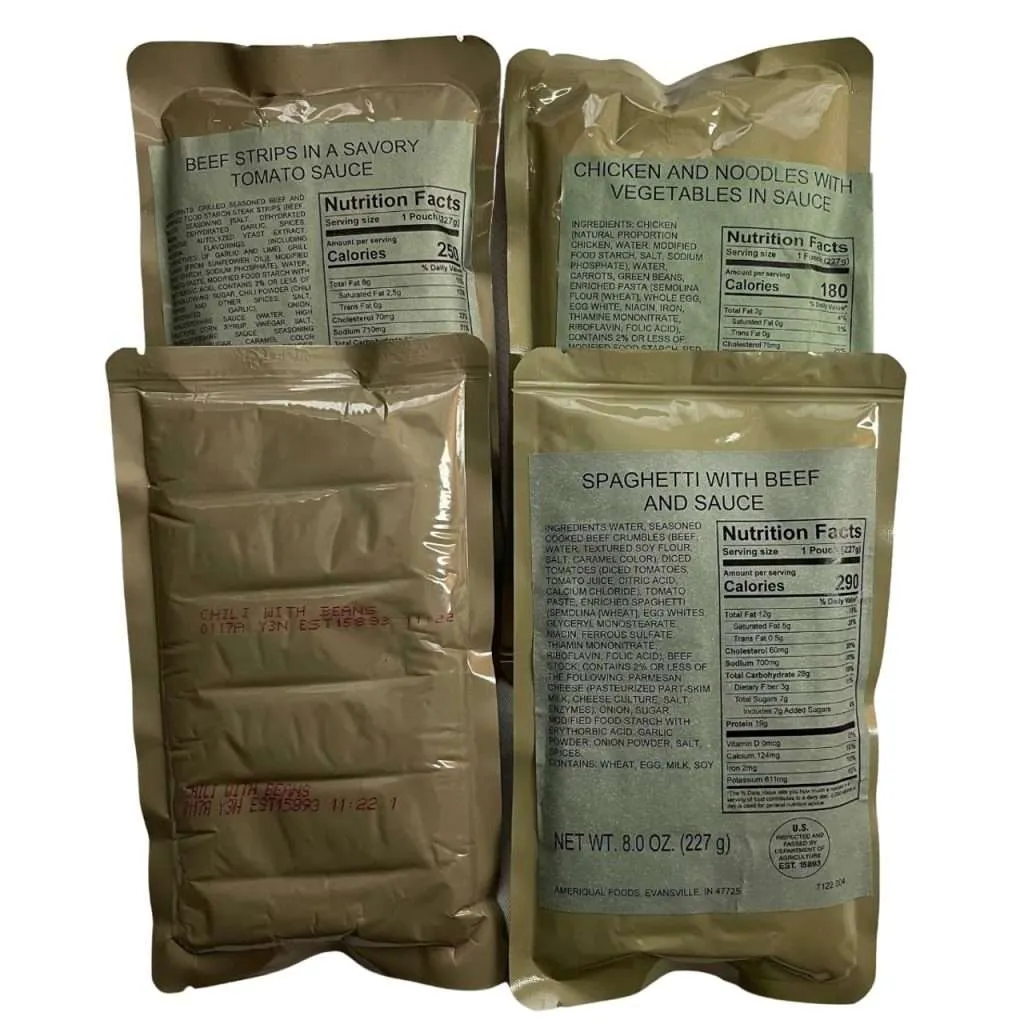
Individual Entrees
Lightweight
Multiple Choices
MSRP: $1.95 – $ 2.95
Save 10% at AN Outdoors with code “SURVIVE10”

Save 10% at AN Outdoors on your first purchase with code “SURVIVE10”
Save 10% at Prepared Bee with code with code “HQMBKIDJPL”
What This Guide Covers (and What It Doesn’t)
This guide focuses on the best civilian-available MRE options for emergency preparedness.
That includes:
- MRE entrees (the most practical option for most preppers)
- Full military-style MREs like MRE Star
- Humanitarian Daily Rations (HDRs), which provide a full day of food in one pack
There are other military rations (such as First Strike Rations (FSRs) and specialized cold-weather meals), but these are harder to source and significantly more expensive. For most civilians building emergency kits, they’re not the most practical option.
If you’re looking for long-term food storage instead of ready-to-eat meals, you’ll usually be better served by freeze-dried emergency food kits, which we cover in our separate guide.
Why You Can Trust Our MRE Reviews
Blake has years of military experience and has relied on MREs during training and field operations. Since leaving the service, he has continued testing emergency food, bug-out gear, and preparedness supplies as part of his real-world survival planning.
For this guide, we handled and evaluated the MREs ourselves, looking at packaging quality, heater performance, calorie density, taste, and practicality for real emergency kits.
Some of the meals were even tested with kids at home, which quickly reveals which options are actually edible and which ones will get rejected during a stressful situation.
Our goal is to find the MREs that actually make sense for real people building bug-out bags, emergency food supplies, and family preparedness kits.
If I Could Only Buy One
If I had to choose one MRE option and nothing else, I would buy MRE Entrees only.
Based on my years of eating MREs, I’ve noticed one thing consistently: the entree is the only part people reliably eat. The extras — crackers, drink mixes, candy, utensils — sound useful, but they often get ignored, traded, or thrown out.
Buying full MRE kits means paying for a lot of things you won’t use. Entree packs fix that.
They’re more space-efficient, more cost-effective, and let you choose meals you’ll actually eat instead of being stuck with random menus. You end up with more usable calories and less waste.
For most situation, the better setup is simple: MRE entrees, play a few small add-ons like ration bars or peanut butter packets.
We have another review article on the best bug out bag food that includes some of these “add on” options.
That gives you flexibility without overcomplicating your kit, and it works better in practice than relying on full MREs alone.
If You Want the Real Deal Full MRE
Some people don’t want stripped-down entree packs. They want the complete military-style MRE experience, complete with heaters, sides, accessory packs, and everything else that comes in a traditional ration.
If that’s what you’re looking for, the MRE Star Complete MRE Case is one of the best civilian options available.
These meals include the full components you’d expect in an MRE, and during our testing, the flameless ration heater performed better than any civilian MRE heater we’ve used. It heated meals quickly and actually got them properly hot — something many civilian MRE heaters struggle to do.
Full MRE cases are bulkier and more expensive than entree packs, but they’re useful for:
- emergency kits where you want a complete meal in one pouch
- preparedness training or disaster response kits
- situations where you may not want to add extra food items
If you want something closest to what soldiers actually carry, MRE Star is the best place to start.
Where MREs Fit In a Real Emergency Food System
MREs are one of the most practical types of emergency food, but they’re also one of the easiest to misunderstand.
They’re not designed to replace your entire food supply. They’re designed to solve a specific problem: eating when cooking isn’t possible.
That makes them extremely useful in situations like:
- bug-out scenarios
- travel or evacuation
- short-term disruptions
- anytime you don’t have water or time to prepare food
Where MREs fall short is long-term use.
They’re heavier than other options, take up more space, and aren’t ideal to eat day after day. Even in the military, they’re typically used in rotation, not as a permanent food source. The most effective way to use MREs is as part of a larger system.
A simple way to think about it:
- MREs → convenience and mobility
- Emergency food kits → bulk calories and long-term storage
- Supplemental foods → protein, variety, and nutrition
Each one fills a different role.
If you rely on MREs alone, you’ll run into limitations quickly. But when you use them alongside other food sources, they become one of the most versatile tools you can have.
The Two Ways Most People Buy MREs
Before diving into the rankings, it’s important to understand something most “best MRE” guides don’t explain.
There are two completely different ways civilians buy MREs, and the best option depends on what you’re trying to accomplish.
Option 1: MRE Entrees (Best for Most Preppers)
Instead of buying full MREs, many preppers stock MRE entrees plus a few simple extras like ration bars, peanut butter packets, or granola bars.
In a complete MRE, the entree is the part people actually eat. During my time in the military, soldiers constantly traded away the sides or threw them out entirely. When we tested MREs again at home, the same thing happened.
Buying entrees separately gives you:
- Better value per calorie
- Less wasted food
- Smaller, lighter storage
- The ability to choose flavors you actually want
For bug-out bags, emergency kits, and short-term food storage, this is usually the smartest option.
Best choice: The MRE Entrees from Army Navy Outdoors are the best option for most people. They’re inexpensive, compact, and let you choose the exact flavors you want instead of being stuck with random menus.
You can pair them with simple add-ons like ration bars, peanut butter packets, tortillas, or granola bars to create a more complete emergency meal.
Option 2: Full Military-Style MREs
Some people want the complete military experience: a full MRE with heaters, sides, and accessory packs.
These include:
- Flameless ration heater
- Drink mixes and condiments
- Multiple food components
- Around 1,000–1,250 calories per meal
They’re bulkier and more expensive, but they’re also fully self-contained meals.
If that’s what you’re looking for, I’ll show you the best full MRE cases to buy, and how to avoid the questionable surplus versions floating around online.
Best Choice: If you want the closest thing to a real military-issued meal, the MRE Star Complete MRE Case is the best option. These meals include heaters, sides, and full accessory packs, giving you the complete MRE experience in a civilian-available format.
What It’s Actually Like Living on MREs for 30 Days
I’ve done what many people only speculate about: living on MREs for nearly a full month.
Not as a one-off experiment, but during real military training where MREs were the primary food source day after day. The first few days are manageable.
MREs are filling, calorie-dense, and convenient. You don’t have to think much about food, which is part of their appeal. When you’re busy or stressed, that simplicity works in your favor.
By the end of the first week, things start to change. Even with different menu options, most meals follow the same pattern: heavy entrees, dense textures, and a lot of sodium. You’re still getting enough calories, but the food starts to feel repetitive in a way that’s hard to describe until you’ve experienced it.
You notice it in small ways:
- you stop finishing entire meals
- you start picking at certain components
- you gravitate toward the same “safe” options
After a couple of weeks, the effects are more obvious.
Digestion becomes an issue. MREs are designed to be shelf-stable and calorie-dense, not easy on your system. Most people who have spent time in the field will recognize this immediately. It’s one of the most consistent complaints.
Energy levels can also shift. You’re still fueled, but it’s not the same as eating a more balanced diet. Meals feel heavy, and that heaviness adds up over time.
By the end of the month, the biggest challenge is appetite, not hunger.
You’re not running out of calories. You’re running out of desire to eat them.
Food fatigue sets in hard. Even meals that were fine at the beginning become difficult to finish. This is something most people underestimate when planning around MREs.
What This Means for Civilian Preparedness
MREs work extremely well for short-term use.
For:
- 24 to 72 hours
- a few days during a disruption
- situations where cooking isn’t possible
They’re one of the most practical options available. But they’re not designed to be your only food source long-term.That’s why even the military limits extended MRE use and rotates in other food whenever possible.
For most people, the better approach is to use MREs for convenience and mobility but rely on other food sources for longer-term sustainability
MRE Taste Rankings (Based on Our Testing)
One thing every soldier learns fast: not all MRE menus are created equal. Some are surprisingly good, some are passable at room temperature, and some… well, let’s just say they test your mental resilience more than your physical endurance.
Below are the MRE entrees that consistently scored highest in our taste tests: both from my years in the military and from our recent civilian testing with my family (including a couple of very honest kid tasters).
These are the menus I’d buy again without hesitation.
| Taste Tier | MRE Menu | Notes |
|---|---|---|
| Excellent | Chicken Burrito Bowl | Great seasoning and texture even when eaten cold |
| Excellent | Santa Fe Rice & Beans | One of the best vegetarian-style options |
| Very Good | Southwest Beef & Black Beans | Hearty and filling with good protein |
| Very Good | Chili with Beans | Reliable flavor that holds up well cold |
| Good | Beef Taco Filling | Mild flavor and kid-friendly |
| Good | Beef Enchilada | Comfort-food style meal |
| Decent | Penne with Vegetable Sauce | Better when heated |
| Decent | Beef Stew | Classic but slightly bland |
| Decent | Cheese Tortellini | Mixed reactions during testing |
1. Chicken Burrito Bowl (Best overall flavor & texture)
If I had to live off a single MRE entree for a week, this would be it. The chicken is tender, the rice holds up well, and the seasoning actually tastes like real food. It’s filling without being overly heavy, and it doesn’t require heat to be enjoyable.
2. Santa Fe Rice & Beans – Solid vegetarian-ish option
Every branch has a “surprise favorite,” and this one has been mine since my early military days. It’s hearty, mildly spicy, and consistently tastes good, even when you tear the pouch open in the cold. It’s also one of the few vegetarian entrees that doesn’t feel like a compromise.
3. Southwest Beef & Black Beans – Great calories, solid comfort food
This one feels closest to a proper meal when you’re tired or stressed. The beef and beans combo is protein-heavy, thick, and satisfying, especially after long hikes or during emergency scenarios when you’re active. It also reheats extremely well in an MRE heater, if you choose to use one.
4. Chili with Beans – Classic & forgiving even at room temp
Chili is one of those meals that holds up surprisingly well in MRE form. Even cold, the flavor is solid and the texture stays consistent. It’s not winning any gourmet awards, but it’s hard to mess up chili, which makes this one of the safest entrees to stock in bulk.
5. Beef Taco or Beef Enchilada — Best Kids-Will-Actually-Eat-It Menu
Not all children will touch an MRE (understandably), but in our testing, these were the two entrees most likely to be finished by kid testers. They’re mild, familiar, and pair well with crackers or tortillas if you keep extras in your kit.
Honorable Mentions
These menus didn’t crack the top five but are still solid options if you find them available:
- Penne with Vegetable Sauce — surprisingly decent, especially heated
- Beef Stew — classic military staple, very filling
- Cheese Tortellini — hit-or-miss with kids, but good when warm
Menus We Avoid
Because people always ask: yes, there are a few MRE menus we try to skip.
The common offenders:
| Menu | Why We Skip It |
|---|---|
| Vegetable Omelet | Infamous texture and flavor issues |
| Fruit Smoothie Pouches | Unpopular with both adults and kids |
| Thin Sauce Entrees | Texture can become unpleasant |
| Seafood Options | Rare but generally unpopular |
These aren’t unsafe, just consistently unpopular in every taste test we’ve done.
Best MREs to Buy for Emergencies
When people search for the best MREs, they’re usually picturing the full military-style meals issued to soldiers.
Those do exist in civilian versions, but they’re not always the most practical option for preparedness.
After testing dozens of MRE options over the years, we’ve found that the best choice usually depends on how you plan to use them.
For example:
- Entree-only packs are the best option for most preppers because they’re cheaper and easier to store.
- Humanitarian Daily Rations (HDRs) are great for families because they provide a full day of food in one pack.
- Military-style MREs like the MRE Star case are best if you want a complete meal with heaters and accessories.
Below are the MRE options that performed the best in our testing.
| Pick | Type | Calories (per day/case context) | Value Score | Taste Score | Practicality Score | Overall Score | Approx. Cost / 100 Calories | Kid-Friendly? | Best For |
|---|---|---|---|---|---|---|---|---|---|
| MRE Entrees | Entree-only | ~150–300 each | 10 | 7 | 9 | 9.0 | $0.01 / 100 cal (approx) | Maybe | Budget preppers, hiking, BOB |
| Humanitarian Daily Rations (HDR) | All-day ration | 1,800–2,200 | 9 | 6 | 8 | 8.2 | $0.02 / 100 cal | Yes | Families, bug-out, shelter-in-place |
| MRE Star Complete MRE | Full military-style | ~1,100–1,250 each | 7 | 7 | 9 | 7.8 | ~$0.04 / 100 cal | Maybe | Complete self-contained meals |
| Ameriqual APack Case | Full military-style | 1,000–1,100 each | 7 | 6 | 8 | 7.2 | $0.04 / 100 cal | No | Adult preppers, realism, training |
| 3-Pack Ameriqual Kit | 48-hour kit | 3,000–3,300 total | 6 | 6 | 8 | 6.8 | $0.05 / 100 cal | No | Quick starter kits |
| Entree & Sides Case | Entrees + sides | ~6,000 total | 6 | 7 | 7 | 6.9 | $0.08 / 100 cal | Mixed | Variety without full MRE bulk |
MRE Entrees (Best Overall MREs for Emergencies)
- Meal Type: Entrée-only military MRE components
- Calories: ~150–300 per entrée
- Heater Included: No
- Menu Variety: Dozens of military menu options available
- Weight/Bulk: Very compact; significantly smaller than full MREs
- Pack Type: Retort pouch (fully cooked shelf-stable meal)
MRE Entrees are a great budget-conscious way to stock up on emergency food. The entrée is usually the best part of the MRE, and buying them separately saves space and money compared to full meal kits.
For years, I would break down MREs and toss most of the sides, keeping the entrees. Once I realized that you could just purchase the entrees, my life got a lot simpler.
Army Navy Outdoors lets you choose the specific entrées you want, which avoids the common problem of getting stuck with menus you don’t like. After dealing with some questionable MRE meals in the military, this alone is a huge reason I recommend buying them this way.

These entrées require no preparation. Just tear open the pouch and eat. While they can be heated, most people in the military simply eat them at room temperature.
They’re also significantly cheaper than buying full MREs. Most entrées cost under $3, which makes them one of the easiest ways to build up emergency calories without spending a fortune.
What I’d Actually Do With It
Entrée-only MREs are what I recommend for most civilian preparedness kits.
They work well for:
- bug-out bags
- get-home bags
- camping or hiking food
- compact emergency food storage
Because they’re small and lightweight, you can store multiple entrées in the same space as a single full MRE. That flexibility makes them extremely useful when space is limited.
What I’d Add to Make a Complete Meal
Since entrée packs don’t include sides, I usually add a few simple items to round them out.
Good additions include:
- peanut butter packets
- tortillas or crackers
- ration bars or energy bars
- electrolyte drink mix
- trail mix or nuts
These additions turn a simple entrée into a much more filling field meal without adding much weight.
Recommended For
If you’re looking for a budget-friendly way to start building an emergency food supply, MRE entrees are hard to beat. I’ve also used them while camping and hiking, and they’re perfect for these situations.
PROS
Budget-friendly
Lightweight and compact
Fully cooked and ready to eat
Ability to choose specific menus
CONS
Lower calorie count per pouch
No sides or heater included
Humanitarian Daily Rations (Best Budget-Friendly MRE)
- Meal Type: Full-day humanitarian ration
- Calories: ~1,800–2,200 per package
- Heater Included: No
- Menu Variety: Limited menu rotation
- Weight/Bulk: Moderate; vacuum-packed to reduce space
- Pack Type: Vacuum-sealed food bundle containing multiple items
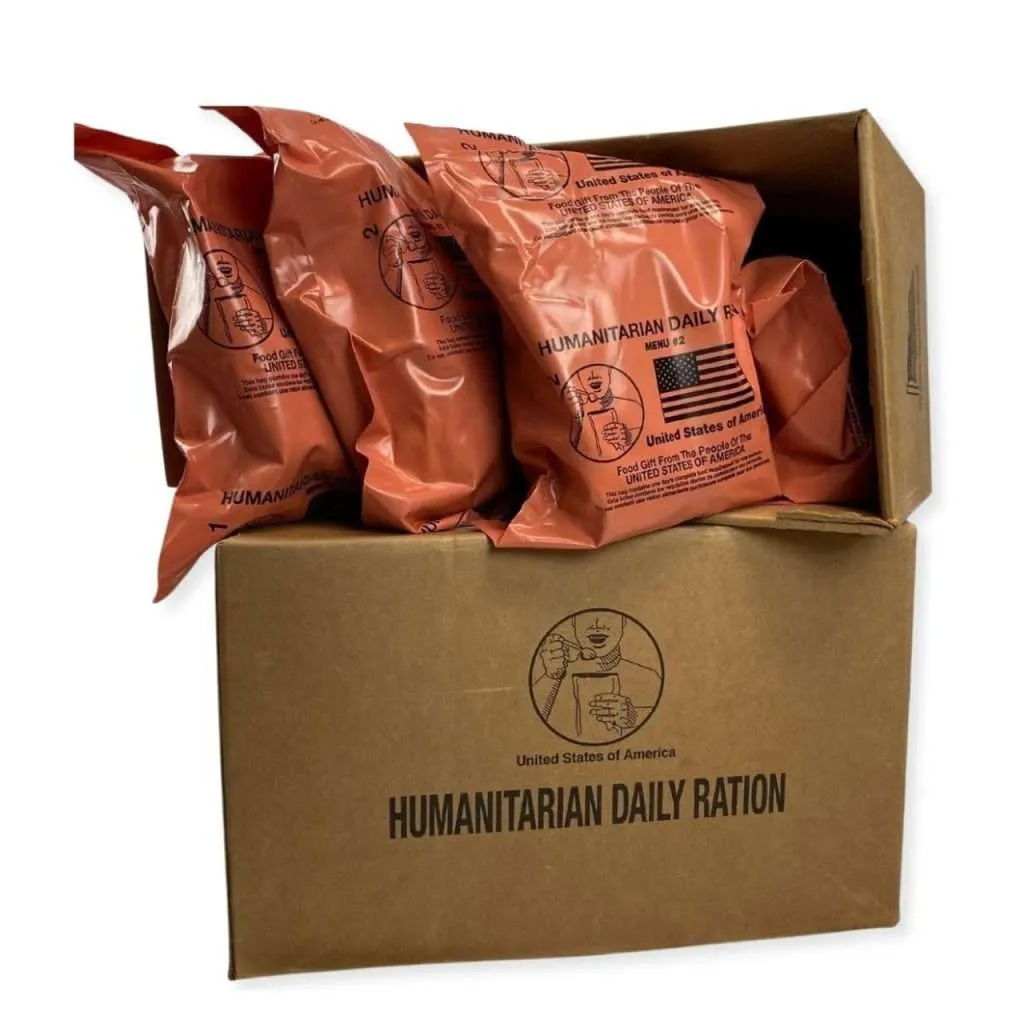
Complete MREs absolutely have their place. However, I prefer the Humanitarian Daily Rations (HDRs) over traditional military MREs for civilian preparedness.
HDRs are designed to provide a full day’s worth of food for one person, rather than a single meal like a standard MRE. Each package typically includes two entrées along with extras like bread, spreads, cookies, and pastries.
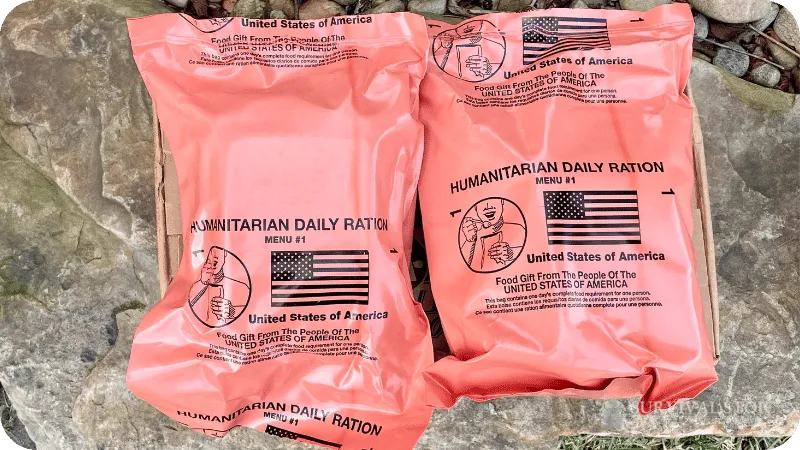
One thing I noticed while testing these is that many of the items feel more like civilian food than traditional military rations. For example, several menus include a “toaster pastry” that’s essentially a Pop-Tart. These familiar items make HDRs surprisingly appealing, especially for families.
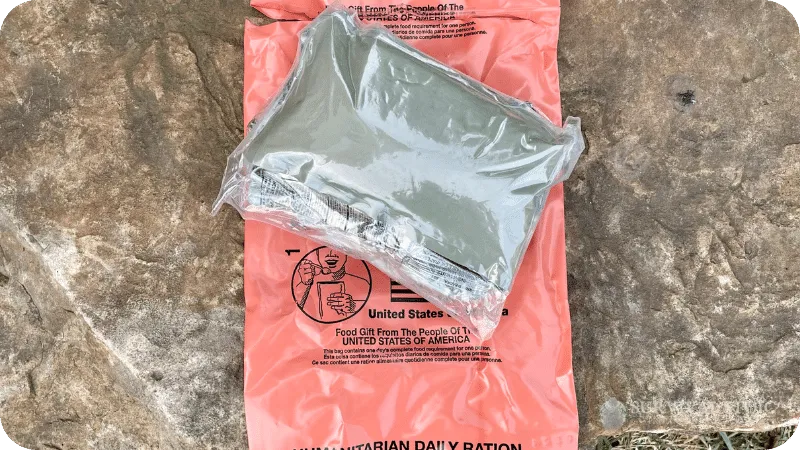
Another advantage is the vacuum-packed packaging, which helps reduce bulk compared to traditional MRE meal bags. Each ration contains enough calories to sustain someone for a full day, which makes them a practical option for emergency kits.
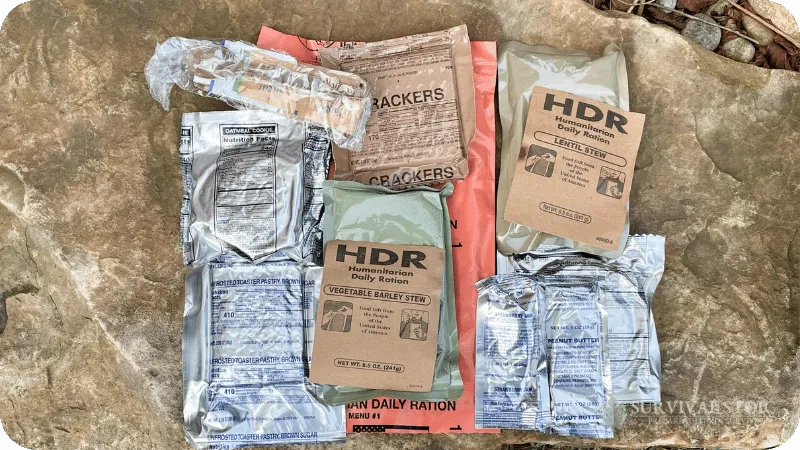
Compared to traditional MREs, HDRs typically contain more total food and calories per package, and they’re often cheaper. A case of 10 can cover one person for around 10 days of emergency food, depending on how the meals are rationed.
My only complaint is that the menu variety is somewhat limited. After a few days, the meals can become repetitive, so I often recommend supplementing them with entrée-only MRE packs.
What I’d Actually Do With It
HDRs are one of the best options for budget-friendly emergency food storage.
They work especially well for:
- bug-out bags
- home emergency food kits
- family preparedness supplies
- vehicle emergency kits
Because each ration contains a full day of calories, they’re easy to plan around when building a 72-hour or multi-day emergency kit.
Recommended For
If you want a complete emergency ration that provides a full day of food at a reasonable price, HDRs are one of the best options available. They’re especially useful for bug-out bags, family emergency kits, and situations where cooking may not be possible.
PROS
Around 2,000 calories per package
Vegetarian meals
Familiar civilian-style foods
Child-friendly sides
CONS
Limited menu options
No heater included
MRE Star Complete MRE Case (Best Military Style MRE)
- Meal Type: Full military-style MRE
- Calories: ~1,100–1,250 per meal
- Heater Included: Yes (flameless ration heater)
- Menu Variety: Rotating menu options
- Weight/Bulk: Bulkier than entrée-only packs
- Pack Type: Complete MRE pouch with sides and accessory pack
If you want something that feels closest to a real military-issued MRE, the MRE Star Complete MRE Case is one of the better civilian options available.
Unlike stripped-down civilian versions, these meals include everything you’d expect in a traditional MRE: an entree, sides, snacks, and a flameless ration heater.

And honestly, the heater was the biggest surprise during testing.
The heater in these worked extremely well, better than any other civilian MRE heater I’ve used. It got hot quickly and stayed hot long enough to actually warm the entree properly. Most civilian MRE heaters struggle to get more than lukewarm, but these performed much better than even the military versions.
The entrees themselves were decent overall. Nothing gourmet, but perfectly edible and filling. Some menus — like the Southwest Chicken — had more spice than expected, which may or may not be a good thing depending on who’s eating it. Adults will probably enjoy it, but younger kids might find it a bit strong.

One interesting component that showed up in several meals was freeze-dried beef as a side item. It does add a solid amount of protein, which is great in a survival situation, but the texture was a little odd. The pieces were extremely crumbly (almost powdery), which made them somewhat awkward to eat on their own.
Personally, I think they would work much better if they were packaged in jerky-style sticks instead of loose freeze-dried chunks.
Other side dishes included the usual suspects, like crackers, oatmeal cookies, and cheese spreads.
That said, overall meal quality was solid, and the heater performance alone makes these stand out among civilian MRE options.

What I’d Actually Do With It
This is the option I’d choose if I wanted true self-contained emergency meals.
They work best for:
- emergency kits
- vehicle emergency supplies
- disaster preparedness supplies
- preparedness training or field drills
Because everything is included in the pouch, these are ideal for situations where you may not have access to cooking equipment or additional food items.
Recommended For
If you want a true military-style MRE experience with heaters, sides, and full meals, the MRE Star Complete MRE Case is one of the best civilian options available. These work well for emergency kits, training scenarios, and situations where you want a fully self-contained meal instead of just entree packs.
PROS
Excellent flameless heater performance
Complete meal with sides and accessories
Good calorie count per meal
Closer to military MRE experience
CONS
Some meals are spicier than expected
Freeze-dried beef side has an odd crumbly texture
Bulkier than entree-only options
Ameriqual APack Case
- Meal Type: Full military-style MRE
- Calories: ~1,000–1,100 per meal
- Heater Included: Yes
- Menu Variety: Random assortment (usually several different entrées per case)
- Weight/Bulk: Bulkier than entrée-only packs
- Pack Type: Complete MRE pouch with entrée, sides, snack, and accessory pack
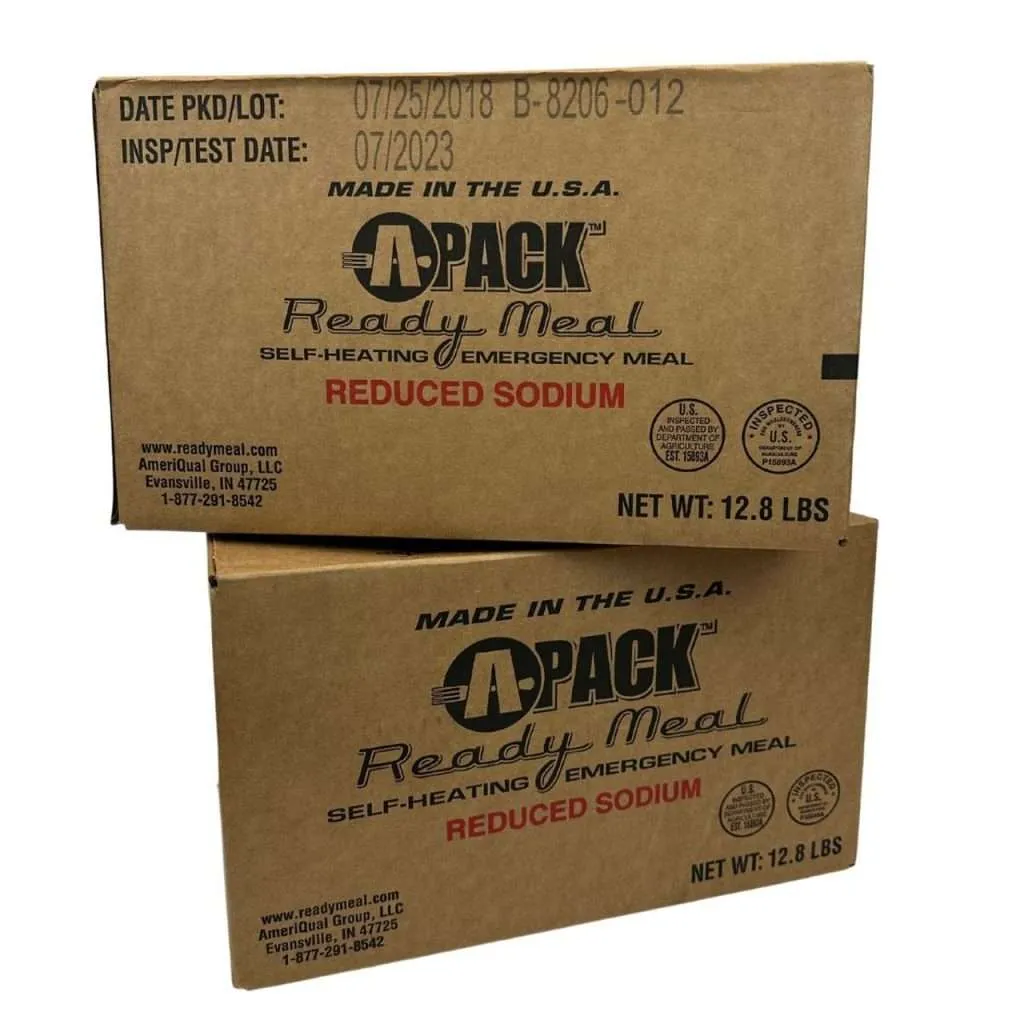
Ameriqual APack MREs are manufactured by Ameriqual, one of the largest suppliers of operational rations to the U.S. military.
This case includes 12 full military-style MRE meals, each containing an entrée, sides, snacks, and an accessory pack. Each meal provides roughly half a day’s worth of calories, which means most people would eat two per day in a survival situation. Highly active soldiers sometimes eat three.
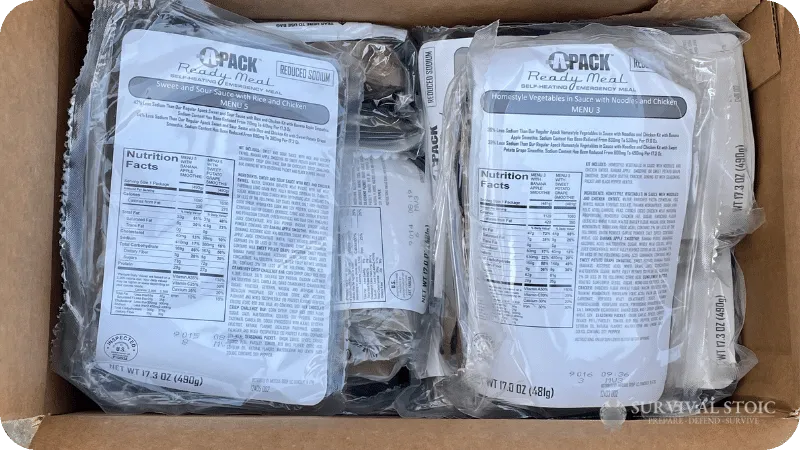
The case comes with random menu selections, but many of the entrées overlap with the entrée-only options discussed earlier. My case included about six different entrée types, which provided a decent amount of variety.
Military menus are designed to be nutritionally complete and calorie-dense, which is why MREs are so commonly used for emergency preparedness.
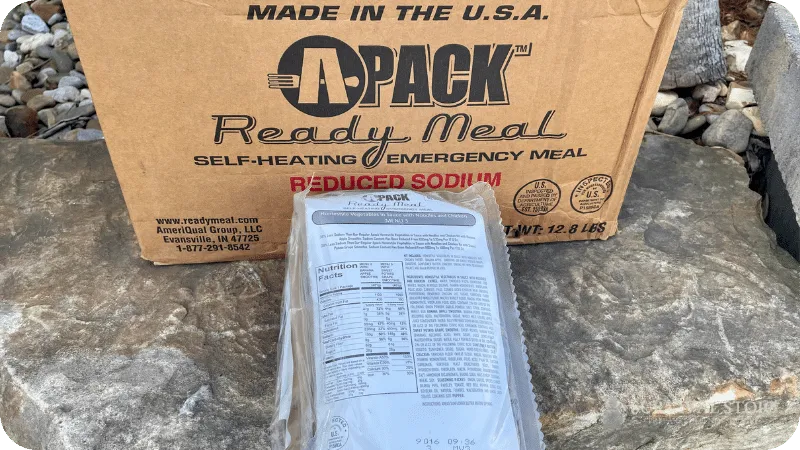
One thing to keep in mind is that these meals are designed primarily for adult soldiers, not families. When my kids tried them during camping and hiking trips, they usually preferred the sides (like peanut butter) rather than the entrées themselves.
Compared to humanitarian rations, these meals tend to have fewer sweet or snack-style foods, which can make them less appealing to picky eaters.
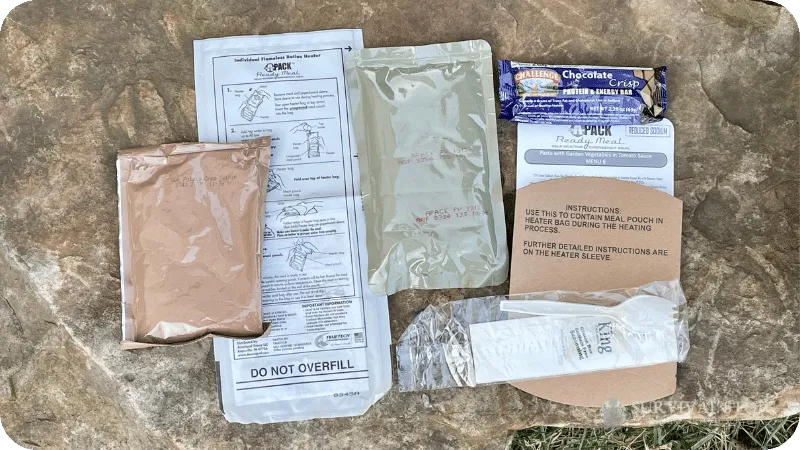
These MREs are somewhat bulkier than HDRs because they include multiple food components and a flameless ration heater. However, heating is optional; the meals are fully cooked and can be eaten cold if necessary.
What I’d Actually Do With It
This type of MRE case works best for people who want traditional military-style emergency meals.
They’re a good fit for:
- emergency preparedness kits
- disaster supply storage
- vehicle emergency kits
- training or preparedness drills
Buying a case is also one of the most economical ways to stock up on complete MRE meals.
Recommended For
I recommend the Ameriqual APack MREs if you want a traditional military-style MRE experience at a reasonable price. They provide a full meal with sides and accessories and are easy to store in bulk, though they may not be the best option for families with picky eaters.
PROS
Around 1,000 calories each
Multiple entrée varieties per case
Complete military-style meal kits
Economical when purchased by the case
CONS
Menu selection is random
Not very kid-friendly
Bulkier than entrée-only options
3-Pack Ameriqual Kit
- Meal Type: Complete military-style MRE
- Calories: ~3,000–3,300 total (three meals)
- Heater Included: Yes
- Menu Variety: Random entrée selection
- Weight/Bulk: Compact compared to full MRE cases
- Pack Type: Three individual complete MRE pouches
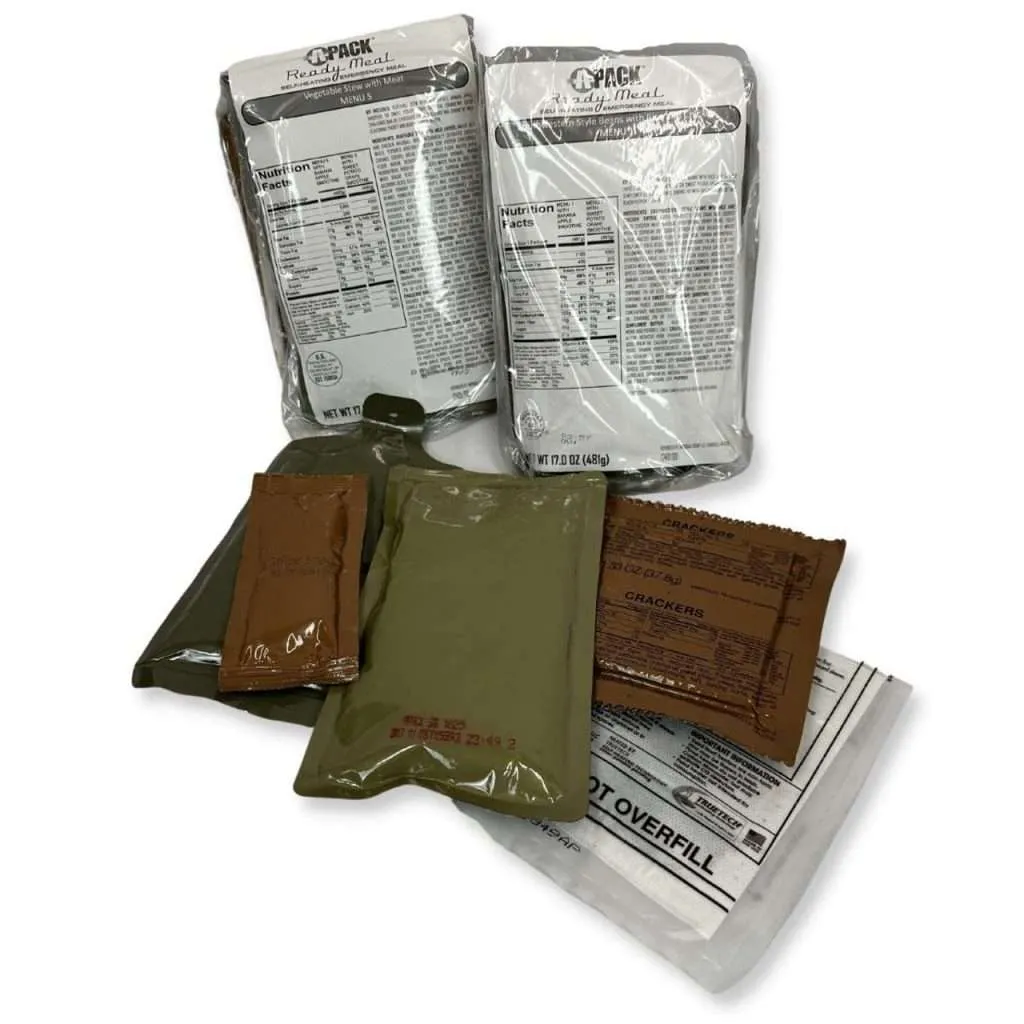
The 3-Pack Ameriqual MRE Kit is a simple way to add ready-to-eat food to a short-term emergency kit.
With three complete MREs, this pack provides roughly 3,000 calories total, which works out to about 1,500 calories per day for two days. That’s enough to get through the early stages of an emergency, especially if you supplement with a few additional snacks.
(Alternatively, you can purchase two of these kits and have enough food for a full 72-hour emergency supply, which is what I did.)
Each meal includes an entrée along with several sides, such as crackers, spreads, snacks, and occasionally items like a fruit “smoothie” drink.
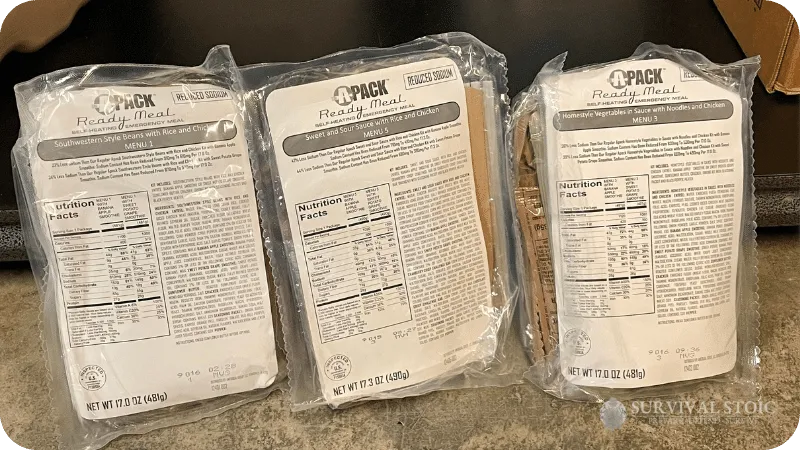
As with most military-style MREs, the entrée selection is random, which is standard for these types of rations. During my time in the military, we rarely had the option to choose our meals either.
These meals are nutritionally complete and designed to sustain active adults, but they aren’t always ideal for picky eaters. When our kids tried them, even the fruit smoothie wasn’t particularly popular.
For long-term home storage, buying full MRE cases usually makes more sense. But for small emergency kits or tight budgets, this kit is a convenient option.
What I’d Actually Do With It
This kit works well for small emergency kits where space is limited.
Good use cases include:
- bug-out bags
- get-home bags
- vehicle emergency kits
- short-term disaster kits
Because each pack contains complete meals with heaters and sides, it’s an easy way to add ready-to-eat food without assembling separate components.
Recommended For
I recommend the 3-Pack Ameriqual MRE Kit if you need a simple, portable food solution for short-term emergencies. It’s an easy way to add complete meals to a bug-out bag or 72-hour emergency kit without buying an entire case.
PROS
Around 3000 calories total
Very portable
Complete meals with sides and heater
Good for compact emergency kits
CONS
Entrée selection is random
Not very kid-friendly
MRE Entree & Sides Case (Best Variety Without Full MRE Bulk)
- Meal Type: Entrée + snack components
- Calories: ~6,000 total
- Heater Included: No
- Menu Variety: Random assortment of entrées and sides
- Weight/Bulk: Much lighter than full MRE kits
- Pack Type: Individual MRE entrée pouches + side items
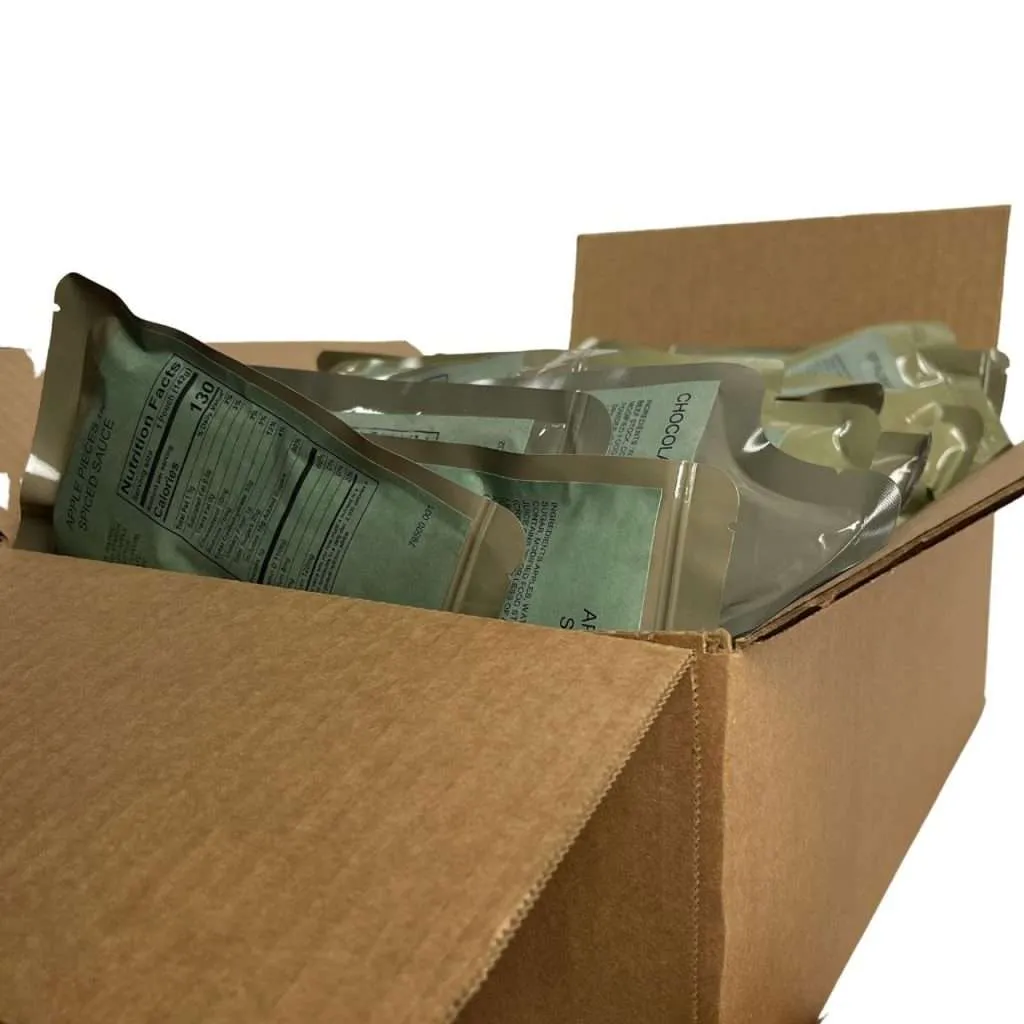
The MRE Entree & Sides case is essentially a middle ground between buying entrée-only packs and purchasing full military MREs.
Instead of complete meals with heaters and accessory packs, this case includes 18 individual MRE entrees and 6 side items. That gives you a little more variety and snacking options without the extra bulk of full MRE kits.
For many civilian preparedness situations, this setup actually makes more sense.
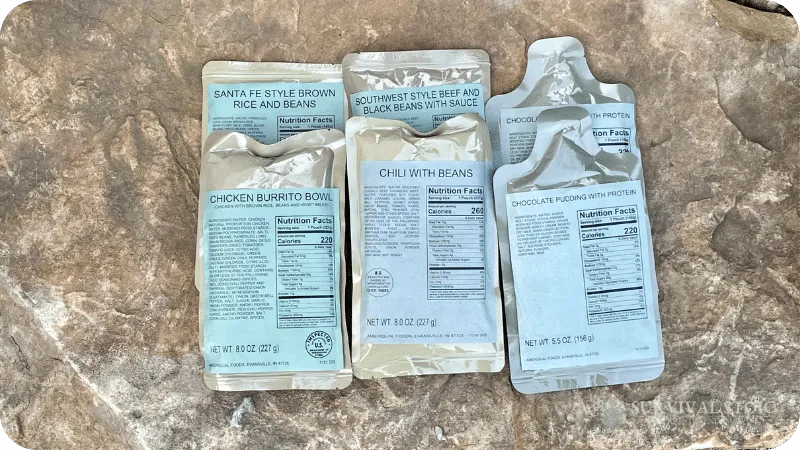
You still get the main entrée components, which are the most calorie-dense and filling part of an MRE, but you also get a few additional sides to round things out.
My kids actually prefer several of the sides to the entrées themselves, which is one reason I like having a few mixed into the case.
Unlike ordering individual entrées, you can’t choose the exact flavors in this case. However, the company typically includes a range of options so you don’t end up with the same meal over and over.
When I opened my case, there was a decent mix of entrées, including several of the same flavors I recommended in the entrée-only section.
Like other MRE components, these meals are fully cooked and ready to eat, so no preparation is required. They’re also fairly compact, making them easy to store in a bug-out bag, vehicle kit, or pantry food supply.
Altogether, the case provides around 6,000 calories total, which comes out to roughly $0.08 per 100 calories.
What I’d Actually Do With It
This is a great option if you want more variety than entrée-only packs without committing to full MRE kits.
Good use cases include:
- bug-out bags
- vehicle emergency kits
- hiking or camping food
- supplementing emergency food storage
The sides also work well as quick snacks between meals, while the entrées provide the bulk of the calories.
Recommended For
I recommend the MRE Entree & Sides case if you like the simplicity of entrée-only packs but want a little more variety and snack options without the bulk of full military MRE kits.
PROS
Good variety of meals and snacks
Compact and lightweight
Ready to eat (no heating required)
CONS
Exact menu selection is unpredictable
Higher cost per calorie than entree-only case
MREs to Avoid
Not all MREs are worth buying. During testing and research, we ran into several types of MREs that tend to cause problems for preppers.
These options may still work in an emergency, but they’re usually poor value or less reliable than the alternatives above.
Very Old Surplus MREs
Some surplus sellers unload extremely old cases of military MREs at a discount.
While MREs can last for years when stored properly, many surplus listings are already close to their shelf life when you receive them.
Look for sellers that clearly show:
- production dates
- inspection dates
- recent manufacturing runs
If that information isn’t provided, it’s best to skip the purchase.
Cheap “Civilian MRE” Knockoffs
Some companies sell heavily marketed “tactical” MREs that are essentially repackaged camping food with inflated prices.
Common signs of these products include:
- very low calorie counts
- extremely small meal portions
- minimal ingredients compared to real military rations
In many cases, you’re better off buying actual military-style MREs or simple entrée packs rather than overpriced tactical branding.
Extremely Spicy Menu Options (For Family Kits)
Some MRE menus can be surprisingly spicy.
Meals like Southwest-style chicken or heavily seasoned rice dishes may be fine for adults, but they can be a problem if you’re building emergency food supplies for kids.
If you’re stocking MREs for a family emergency kit, look for milder menu options that everyone will actually eat.
Common MRE Mistakes That Waste Money
MREs are simple on the surface: you buy them, store them, and eat them when needed.
But most of the mistakes people make come from treating them like a complete food solution instead of a specific tool. These are the ones we see most often.
1. Buying full MRE kits when you only need the entrees
This is easily the most common mistake.
Full MREs include a lot of extras:
- crackers
- drink mixes
- candy
- utensils
In theory, that sounds useful. In practice, most of it goes unused. After years of eating MREs, the entree is the only part people consistently finish. The rest tends to get traded, ignored, or thrown out.
If your goal is efficient food storage, buying entrees only gives you more usable calories and better bang for your buck.
2. Buying old surplus MREs to save money
Cheap surplus MREs are tempting, but they’re one of the easiest ways to end up with food you don’t want to eat.
MRE shelf life is heavily affected by temperature. Even if the inspection date looks fine, poor storage can degrade the food much faster than expected. With older surplus, you’re often dealing with reduced taste and texture, questionable storage conditions, and inconsistent quality.
For something you may rely on in an emergency, that tradeoff usually isn’t worth it.
3. Storing MREs in hot environments
Heat is the fastest way to shorten the life of an MRE. Storing them in places like garages and vehicles can significantly reduce shelf life, sometimes by years.
MREs last longest in cool, stable environments. If you’re planning to keep them for any length of time, where you store them matters just as much as what you buy.
4. Relying on MREs as your only food source
MREs work well for short-term use, but they’re not designed to be your entire food system. They’re heavy and relatively expensive per calorie. Even in the military, they’re typically used in rotation just because they weren’t designed to be lived on long-term.
Used correctly, they’re one of the more practical food items you can have. Used alone, their limitation show up quickly.
5. Not testing them before you store them
This one gets overlooked.
People often buy a case of MREs, store it, and assume it will work when needed, without ever opening one. But not all meals are equal. Some are much better than others.
Trying a few ahead of time helps you avoid meals you won’t eat and choose better options. Plus, it’ll help you understand how they actually work before it’s an emergency.
What to Look for When Buying MREs
Not all MREs are the same. Some are full military-style meal kits with heaters and accessories, while others are simply the main entrée packaged separately.
When choosing MREs for emergency preparedness or bug-out kits, there are a few factors that matter most.
Calories
Calories are the primary purpose of an MRE. Most military MREs provide about 1,200–1,300 calories per meal, which is enough to sustain someone in physically demanding conditions.
Many civilian MRE options provide fewer calories, especially entrée-only packs.
For emergency preparedness, higher-calorie meals are usually the better option.
Shelf Life
MREs typically last around 3 years when stored at 80°F, according to the U.S. Defense Logistics Agency.
Cooler storage temperatures can extend that lifespan significantly.
Proper storage is one of the most important factors in how long an MRE remains safe to eat. You can extend shelf life considerably based on where you store them, as we discussed in our MRE shelf life guide.
Heater Performance
Many full military-style MREs include a flameless ration heater (FRH).
These heaters use a chemical reaction activated by water to generate heat, warming the meal in about 10–15 minutes.
Some civilian kits skip the heater entirely to reduce cost.
Packaging and Durability
MREs are designed to survive harsh environments. Quality options use thick retort pouches and durable packaging that can handle transport inside a backpack or bug-out bag.
Poor packaging can lead to punctures or swelling, which makes the meal unsafe to eat.
Taste and Menu Variety
Let’s be honest. Some MREs taste far better than others.
Military menus have improved dramatically over the years, but certain options are still notorious.
Menu variety matters if you’re storing multiple cases for emergency food supplies.
How We Tested and Rated MREs
These recommendations aren’t based on marketing claims or old military memories alone. Between my years of eating MREs in the field and our recent hands-on testing at home, we’ve evaluated dozens of entrees, full military-style meals, HDRs, and civilian MRE cases. Our team also tested many of these meals with our kids, because if children won’t touch it during a normal day, they definitely won’t eat it during an emergency.
Here’s how we rated each one:
Our MRE Testing Criteria
Not all MREs are created equal. Some are great emergency meals, while others are overpriced surplus with questionable shelf life.
To keep our testing consistent, we evaluated each MRE using four practical criteria:
- Value – How much usable food you get for the price
- Calories – Total energy per meal or ration pack
- Taste – Flavor and texture when eaten cold or heated
- Practicality – How well the meal works in real emergency scenarios
Each category was weighted based on what matters most during an emergency.
| Category | Weight | Why It Matters |
|---|---|---|
| Calories | 35% | Energy is the primary reason people carry MREs |
| Value | 25% | Emergency food should be affordable to stock in bulk |
| Taste | 20% | People often stop eating food they dislike |
| Practicality | 20% | Weight, packaging, and ease of use in emergencies |
1. Value
Value accounted for 25% of our overall score, because emergency food should be affordable enough to store in meaningful quantities.
Preppers are working within budgets, so value matters. For each MRE or entree, we calculated:
- Cost per calorie
- Cost per complete day of food (for HDRs and full MREs)
- Waste factor (how many components actually get eaten)
Military MREs are famous for including extras most people never touch. In the field, I threw away half the sides more often than I’d like to admit. That hasn’t changed — our civilian taste tests confirmed that most people still prefer the entree over everything else.
That’s why MRE entrees consistently provided the best value in our tests. They’re cheaper, lighter, and you’re not paying for components your family will likely toss. Full MREs will get you to 1,500–2,000 daily calories faster, but you may be paying for food no one will eat.
To keep value honest, we used the Department of Defense’s daily calorie guidelines for adults (1,500–2,000+ calories) and cross-checked each product’s price against how much usable food you actually get.
2. Taste (Because Stressed People Get Pickier, Not Less)
Taste made up 20% of our testing score, because people often stop eating food they dislike during stressful situations.
Soldiers routinely lose weight on MREs in the field because they simply stop eating the parts they don’t like. The same thing will happen to you in an emergency. That’s why we weigh taste more heavily than many testing organizations do.
For each entree or meal, we evaluated:
- Flavor (Is it bland? Over-salted? Actually enjoyable?)
- Texture (The biggest failure point in MREs)
- Room-temperature performance (Most people don’t use the heater constantly)
- Kid reactions (Our kids are “average picky,” so their feedback is realistic)
Across the board, entrees like Chicken Burrito Bowl, Santa Fe Rice & Beans, and Chili with Beans consistently scored highest with both adults and kids.
Meanwhile, certain items (looking at you, fruit smoothie pouches) were rejected every single time.
When you’re stressed, tired, or cold, food needs to be simple and comforting. That’s why we focus on entrees you’ll actually finish.
3. Calories & Nutritional Content
Calories accounted for 35% of our scoring, since energy is the primary reason people carry MREs in emergency situations.
MREs were built for short bursts of high-output activity — not long-term nutrition.
We reviewed:
- Calorie density
- Protein and carb balance
- Sodium levels (military MREs are notoriously high)
- Digestibility (constipation is a real and common side effect)
- How well each meal pairs with common prepper add-ons like granola bars, ration bars, or peanut butter
There’s a reason the U.S. military limits exclusive MRE use to about 21 days: they’re heavily processed, low in fresh nutrients, and tough on your digestive system. Veterans know this first-hand.
For short-term emergencies (48 hours to a few days), MREs shine. For anything beyond that, we recommend pairing them with other shelf-stable foods or leaning on a proper emergency food kit.
4. Practicality (Weight, Packaging, and Ease of Use)
Practicality made up the remaining 20% of our evaluation.
In an emergency, food needs to be easy to carry, simple to eat, and reliable in different conditions.
For each product we considered:
- Packaging size and weight
- Whether the meal required heating
- How well it performed when eaten cold
- Whether the meal worked well in bug-out bags or emergency kits
Meals that were compact and easy to eat scored higher in this category.
Types of MREs
There are many types of MREs. Three major companies make MREs for the military, and the exact flavors vary by company. Ameriqual is the biggest MRE supplier and the most readily available.
On top of different companies, there are also different ways MREs are packaged. For the average person, these differences are the most important. Here are some of the MRE types you should consider when preparing for an emergency:
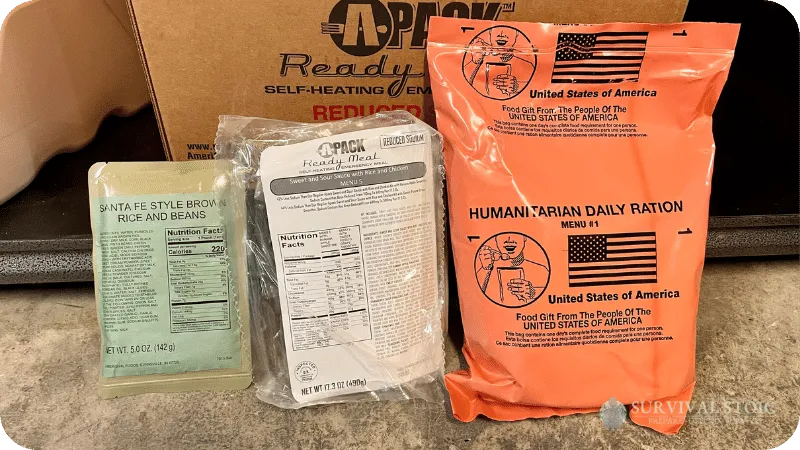
- Military-style MREs: These are packaged based on military standards. Usually, they have one entree and several sides. Drink mixes of some sort are common, too. These are around 1,000 calories each.
- Humanitarian MREs (HDR): These MREs are designed to be handed out to civilians in a humanitarian situation. They are vegetarian and have fewer food options. However, many of the sides are more “comfort food” oriented, like cookies and pastries.
- Entree-only cases: Entrees are the main part of an MRE, and many people don’t want to mess around with all the extras. Purchasing the entrees only is also cheaper.
Civilian MREs vs Military MREs
Not all MREs are the same. Some are true military rations, while others are civilian versions designed for the preparedness market.
Both can work for emergency food storage, but they serve slightly different purposes.
Military MREs
Military MREs are the same style of rations issued to U.S. troops. They are designed to provide a complete meal in a self-contained package.
Typical features include:
- 1,200–1,300 calories per meal
- Flameless ration heater (FRH) for heating food without a stove
- Multiple components such as entrées, snacks, desserts, and drink mixes
- Accessory packs with items like utensils, coffee, and condiments
- Durable packaging designed for field use
These are ideal for:
- bug-out bags
- disaster kits
- long-term emergency supplies
However, they are usually more expensive and heavier than simpler options.
Civilian MREs
Civilian MREs are often simplified versions of military rations. Many companies sell entrée-only packs or reduced component kits to lower costs.
Common differences include:
- fewer food components
- lower calorie counts
- no heater included
- simpler packaging
For many preppers, these options actually make more sense because they are:
- cheaper
- lighter
- easier to store in bulk
Entrée-only MREs are especially popular for bug-out bags and hiking kits, where space and weight matter.
Which One Should You Buy?
Most civilians don’t actually need the full military-style meal kit.
For many preparedness plans:
- Entrée-only MREs are the most practical option
- Full military MREs are best if you want a complete self-contained meal
Both options can work well — the right choice mostly depends on budget, storage space, and how you plan to use them.
Quick Comparison
| Feature | Military MRE | Civilian MRE |
|---|---|---|
| Calories | ~1,250 per meal | 150–300 per entrée |
| Heater | Usually included | Usually not included |
| Components | Full meal kit | Often entrée only |
| Weight | Heavier | Lighter |
| Cost | Higher | Lower |
Who Actually Needs MREs?
MREs aren’t just military rations. They’re designed to provide portable, ready-to-eat calories when cooking isn’t possible.
That makes them useful in several preparedness and outdoor scenarios.
Bug-Out Bags
MREs are one of the easiest ways to add calories to a bug-out bag, since they’re fully cooked and ready to eat, unlike freeze-dried foods that require water. If you’re building your kit from scratch, our Bug Out Bag Checklist walks through every essential item you should include.
MREs are especially useful when:
- you need fast calories
- you don’t have time to cook
- you may not have access to water or fuel
Many people store one or two MRE meals in a bug-out bag as backup food.
Get-Home Bags
Compact meal options like MRE entrees or small MRE kits are especially useful in a get-home bag, where space and weight matter more than long-term food storage.
If you’re assembling one, our Get Home Bag Guide explains exactly what to pack and why.
In this situation, MREs are valuable because they:
- provide high calories in a compact package
- require no cooking equipment
- can be eaten while moving
Some people prefer entrée-only MRE packs for this purpose since they are lighter than full meal kits.
Camping and Hiking
While freeze-dried meals are often lighter, MREs are convenient for camping trips because they:
- don’t require boiling water
- can be heated with the included ration heater
- are easy to prepare in poor weather
They’re also popular for winter camping, where cooking can be more difficult.
Home Emergency Food Backup
MREs can also be part of a home emergency food supply, especially for short-term disasters like power outages or storms.
They’re ideal for situations where:
- electricity is out
- cooking appliances aren’t available
- you need quick meals during an emergency
Many preppers store a case or two alongside other emergency foods.
Training and Preparedness Drills
Some people buy MREs specifically to test their emergency plans.
Running a 24-hour or 72-hour drill using real MREs helps you learn:
- how filling they actually are
- how well the heaters work
- which menus you prefer
This kind of practice is extremely valuable for preparedness planning.
MREs aren’t meant to replace all emergency food.
Instead, they work best as portable backup meals that can be eaten quickly when cooking isn’t possible.
For many preparedness plans, they’re most useful when combined with longer-term food storage options like freeze-dried meals or pantry staples.
Field Stripping an MRE
When you purchase a complete MRE, you won’t want to leave it as-is. Most veterans field-strip their MREs, which cuts down on the packaging and weight. Doing this is very simple but highly recommended. It just takes a few seconds!
Simply open the MRE and take out all the individual components. Throw away anything you don’t want. Then, duct tape everything you do want together with 100mph duct tape.
At this point, you can also add some condiments and other items. Some leftover sauce packets from Taco Bell can go a long way!
How Long Can You Live on MREs?
Despite what you may have read, MREs are not designed for long-term survival. Even the military doesn’t recommend eating MREs for more than 21 days. If MREs could be eaten forever, field chow wouldn’t exist.
The military would not deal with trying to cook in the field if it could just hand service members an MRE.
Studies have been done on how long people can eat MREs. Eating MREs up to the military-imposed 21-day limit directly impacts the microbiome – and not in a good way.
The effects of MREs have been known for a long time. One study had participants eat MREs for 34 days, and the results were not inspiring. Troops participating lost up to 11% of their body weight, had significantly lower reaction times, and performed worse on mental tests. The study also reported:
The MRE subjects reported that they lost their appetite and theat they experienced gas pressure more frequently than the control subjects.
Another study found that consuming MREs for 30 days led to:
Uncomfortable physical symptoms and a small to moderate decrement in physical performance.
Simply put, I would only recommend eating MREs for a few days in an emergency. Children and the elderly may be more at risk for these negative side effects. If you’re looking for long-term food storage, plenty of emergency food companies provide better options.
Still, they are a popular option when preparing for a food shortage. The timelessness of MREs still has a strong hold on the prepper community, even if there are many better options these days.
How Long Do MREs Last?
MREs are not the long-term food storage option many people think they are. According to U.S. Army ration planning guidance, MREs are designed to maintain quality for roughly 36 months at 80°F, but that drops to around six months at 100°F.
In the heat, they only last about a month, though. We don’t recommend storing MREs in your car during the hot summer months!
You don’t need to refrigerate MREs. However, theoretically, they will last the longest at cooler temperatures.
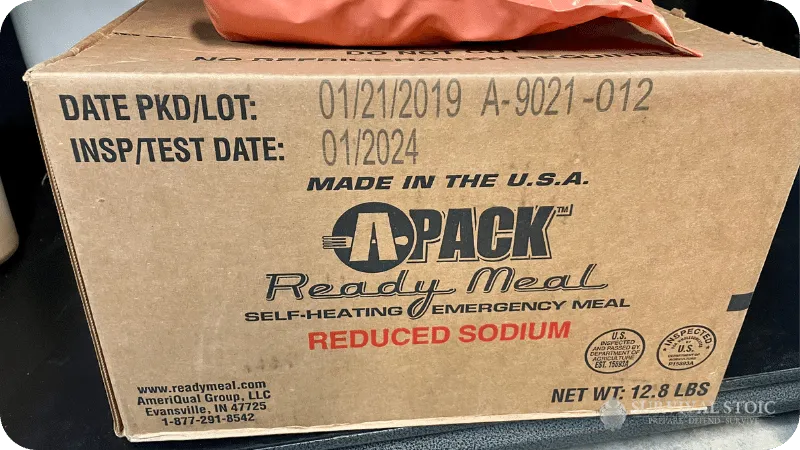
The date on MREs isn’t an expiration date. Instead, it’s the “inspection date,” which is when the military says the MRE needs to be inspected. Typically, this date is three to five years after the MRE was packaged. It’s a reminder to check the packaging and ensure nothing seems “off” with the meal.
All the MREs I ate in the military were at least a few years old. I don’t think I’ve ever seen an MRE from the current year, so don’t feel like you need to get a “fresh” one. After leaving the military, I also had several leftover MREs that sat in my closet for t a few years, and they were perfectly fine when I ate them on a camping trip later.
As you can see above, my MREs are five years old, and they are just fine.
How to Read an MRE Date Code
MRE date codes are unreasonably complicated, but it is easy to read them in just a few seconds once you get the hang of it. To start, you’ll want to find a four-digit code on your MRE. It’ll probably be by the recipe listing and alongside a bunch of other numbers.
The very first number of this four-digit code is the year it was made. MREs don’t last ten years, so it should be the last year that ended in that number. For instance, 2024 will be represented by a “4”. If your MRE’s date starts with “1,” it was made in 2021.
The next three digits are the day that the MRE was made. There are 365 days in a year, so the maximum number will be 365. Typically, this number is less important. Getting a ballpark estimate based on the year is fine. Don’t feel like you have to count on your calendar to figure out what month your MRE was made.
MRE Date Code & Expiration Calculator
Use this MRE expiration calculator to convert the 4-digit military date code (YDDD) into a manufacture date and estimate the shelf life of your MRE.
MRE Date Code Calculator
Enter the 4-digit MRE production code (YDDD) from the case or pouch.
Example: 4300 = year ending in 4, day 300 of that year.
Note: MRE “inspection dates” and real-world shelf life depend heavily on storage temperature and packaging condition. Always inspect for swelling, leaks, off odors, or damaged seals before eating.
How Storage Temperature Affects MRE Shelf Life
Research from the U.S. Army’s Natick Soldier Research Center shows that storage temperature dramatically affects MRE longevity, ranging from about one month at 120°F to several years when stored near 50°F.
Heat Is the Enemy
High temperatures break down MRE ingredients quickly. Even though the packaging is designed to protect the food, heat speeds up chemical reactions inside the pouch.
That means an MRE stored in a hot car or garage can lose years of shelf life in just a few months.
For example:
| Storage Temperature | Estimated Shelf Life |
|---|---|
| 60°F | 7+ years |
| 75°F | 3–5 years |
| 90°F | 1–2 years |
| 100°F+ | Months |
Leaving MREs in a vehicle during the summer can easily expose them to 120°F or higher, which dramatically shortens their lifespan.
Cool Storage = Longest Shelf Life
If you want your MREs to last as long as possible, store them in a cool, dry, and dark location.
Good storage locations include:
- A closet inside your home
- A climate-controlled pantry
- A basement shelf
- A cool storage room
Avoid storing MREs in places that experience temperature swings, such as:
- Vehicles
- Attics
- Garages
- Outdoor sheds
When stored properly, many MREs remain safe and edible well beyond their official inspection date, but temperature control makes a huge difference.
Consider reading our guide on how long MREs last, which walks you through exactly how to store MREs and check for freshness.
MRE Alternatives
MREs absolutely have their place. They’re tough, portable, and you can eat them in a ditch during a rainstorm while questioning your life choices. But… they’re not the best long-term survival food for most civilians.
And trust me, after living off MREs in the military longer than any human should, I learned two things:
- You can survive off them.
- You probably shouldn’t make a habit of it.
If you want something tastier, cheaper per calorie, or gentler on your stomach, these are the options we actually use at home and pack into our bug-out gear.
Survival foods have become a lot more accessible over the last few years. You can purchase a whole emergency food kit with a 25-year shelf life for $200, which will feed you for a week!
Here are some of my favorite MRE alternatives:
- Grizzly Gear Emergency Food Rations: These little 3,600-calorie bars shocked me. I expected “compressed sadness,” but my kids ate them like candy during testing. They’re lightweight, heat-resistant, and genuinely tasty, which is saying something since my kids won’t even finish an MRE smoothie pouch.
- Mountain House Freeze Dried Meals: If you haven’t tried freeze-dried meals since Boy Scouts, times have changed. Mountain House meals are hands-down the best thing we’ve tested that still counts as “survival food.” They taste like something you’d willingly eat, even after a long day outside. The only downside? You need hot water, which typically means increasing your water storage.
- The Nutrient Survival Go-Bag: Let’s call this what it is: the opposite of an MRE. It’s nutrient-dense, lightweight, and keeps you going without turning your stomach into a brick. Inside the Go-Bag, you get five days’ worth of food, all vacuum-sealed and organized.
- Survival Tabs: These are weirdly good. They taste like candy, they’re packed with vitamins, and they take zero space. Are they a full meal? No. Would I want to live off them for days? Also no. But they’re unbeatable for get-home bags and car emergency kits.
- Your own freeze-dryer. You could also create your own shelf-stable meals using a home freeze dryer. This is often cheaper, depending on the amount of freeze dried food you make. However, the upfront cost can be substantial.
The best prepping setup isn’t MREs vs alternatives.
It’s MREs + one or two better long-term foods.
Here’s the combo we recommend after all of our testing:
- MRE entrees → Quick calories, no cooking, morale-boosting when you’re tired
- Grizzly Gear bars → High-calorie no-cook backup
- Mountain House meals → The “tasty” morale food when you have a heat source
- Survival Tabs → Ultra-light calorie and vitamin boost
This mix covers every emergency scenario: no-cook, fast-cook, kid-friendly, high-calorie, and long-term storage.
And — extra bonus — you’re not stuck eating an MRE fruit smoothie pouch ever again.
Where to Buy MREs Safely
Not all MRE sellers are equal.
Because many MREs come from military surplus supply chains, it’s common to find sellers offering outdated rations, poorly stored inventory, or incomplete kits missing heaters and accessories.
Before buying, it’s worth taking a few seconds to make sure you’re purchasing from a reputable seller with fresh inventory.
Use this quick checklist before ordering:
Manufacturer clearly identified
Reputable listings should identify the manufacturer, such as Ameriqual, Wornick, Sopakco, or MRE Star. Avoid listings that only say “military style MRE” without specifying where they were produced.
Clear date code or inspection date information
Good sellers will list the production date code or inspection date range. MREs don’t use standard expiration labels, so knowing the production year helps estimate remaining shelf life.
Proper storage conditions
MRE shelf life depends heavily on temperature. Look for sellers that store inventory in temperature-controlled warehouses, not outdoor containers or hot storage units.
High inventory turnover
Large preparedness retailers tend to rotate stock quickly, which means you’re more likely to receive fresh rations with longer shelf life remaining.
Reputable MRE Retailers
Army Navy Outdoors
Army Navy Outdoors is one of the most reliable sources for individual MRE entrees, sides, and surplus meal components. They offer a wide range of menu options and often allow you to select specific entree flavors, which is rare in the surplus market.
They’re also one of the few retailers that consistently stocks large quantities of genuine military components, making them a solid option for preppers building custom meal kits.
Save 10% at AN Outdoors on your first purchase with code “SURVIVE10”
Prepared Bee
Prepared Bee carries MRE Star MREs. MRE Star produces complete civilian MRE meals and sells them directly through their website.
Because these meals come straight from the manufacturer, you’re getting newly produced rations rather than surplus inventory, which can help maximize shelf life.
Their complete MRE kits also include full accessory packs and flameless heaters, making them one of the closest civilian equivalents to traditional military-issued MREs.
Save 10% at Prepared Bee with code with code “HQMBKIDJPL”
Avoid Suspicious MRE Listings
Be cautious of listings that:
- Don’t list a manufacturer
- Hide or avoid date code information
- Offer prices that seem unusually cheap
- Use stock photos instead of real product images
These listings often contain very old surplus rations or incomplete meal kits.
MRE FAQs
How many MREs do you need for 72 hours?
For a typical 72-hour emergency kit, most people store 6 MRE meals per person. If you’re using entrée-only packs, plan 2–3 entrées per meal or supplement with bars.
Military MREs contain about 1,200–1,300 calories each, and the military typically issues two to three meals per day, depending on activity levels.
For most civilian emergency situations, a simple rule is:
- 2 MREs per person per day
- 6 MREs for a 72-hour emergency supply
If you expect heavy activity or cold weather, adding an extra meal per day can be helpful.
How many MREs should you eat per day?
The U.S. military typically plans for 3 MREs per day, which provides roughly 3,600–3,900 calories.
However, many people find that 2 MREs per day is enough in less physically demanding situations.
Typical civilian usage:
- 2 MREs per day for light activity
- 3 MREs per day for heavy activity or field conditions
Because MREs are calorie-dense, eating the entire meal is often more filling than expected.
Do you need the heater for MREs?
No. MREs are fully cooked and safe to eat cold.
The flameless ration heater (FRH) simply makes the meal more enjoyable by warming it.
Many preppers like heaters because they:
- improve taste and texture
- allow a hot meal without a stove
- work well in power outages or field conditions
But if necessary, you can eat every component of an MRE without heating it.
Do MREs expire or just have inspection dates?
MREs technically use inspection dates rather than strict expiration dates.
The printed code shows when the meal was manufactured, and the military uses inspection schedules to evaluate long-term storage quality.
Most modern MREs are designed to last roughly:
- 3 years at 80°F
- 5+ years in cooler storage
Temperature has a major impact on shelf life, which is why proper storage matters.
What are the best MREs for kids?
Children often prefer milder menu options and simpler foods.
Good choices typically include meals with:
- pasta
- rice
- crackers
- peanut butter
- dessert items
Avoid very spicy menu options such as heavily seasoned Southwestern meals, which can be too strong for younger kids.
Many families also find that entrée-only packs or humanitarian daily rations are easier for children to eat.
Are MREs safe for long-term storage?
Yes, MREs are designed for long-term storage and emergency use.
They are sealed in retort pouches, which are similar to canning technology used in shelf-stable foods.
However, MREs are not meant to last forever.
Their shelf life depends heavily on storage temperature and packaging conditions.
Before eating an older MRE, check for:
- swollen packaging
- punctures or leaks
- unusual smells or discoloration
If the packaging appears compromised, the meal should be discarded.
Bottom Line
MREs remain one of the most practical emergency food options when you need portable, ready-to-eat calories that require little or no preparation. They’re durable, compact, and designed to work in exactly the kind of situations where cooking isn’t possible.
For most civilians, simple entrée-only MRE packs provide the best balance of cost, weight, and convenience. They’re easy to store in bug-out bags, hiking kits, and emergency supplies without taking up too much space.
If you want the full military-style experience, complete MRE cases (like the MRE Star kits we tested) offer a complete meal with heaters, sides, and accessories.
Ultimately, MREs work best as portable backup food, not your entire emergency food plan. Many preppers combine them with longer-term food storage like freeze-dried meals or pantry staples.
If you’re building out your preparedness supplies, these guides can help next:
A little planning now makes a huge difference when an emergency actually happens.
