

Based on my personal testing, Nutrient Survival’s Powdered Eggs are the best powdered eggs by far. However, they are also very expensive. For a cheaper option, consider Augason Farms Dried Whole Egg Powder.
I taste-tested over a dozen powdered egg brands, and at one point, my family lived on shelf-stable foods for over two weeks while we worked through them.

While I did try many different powdered egg brands, I only recommend three. I’ll also include a few tips near the end of this article for cooking powdered eggs so that they resemble fresh eggs as much as possible.
A Quick Look at My Favorite Powdered Egg Brands

25 Year Shelf Life
35 servings
Vitamin Fortified
Cost: 93 cents per egg
Save 10% at Nutrient Survival with code “ss10”

10 Year Shelf Life
85 servings
Affordable
Cost: 88 cents per egg
Save 10% at Augason Farms with code “survivalstoic”

10 Year Shelf Life
64 Servings
#10 Can
Cost: $1.37 cents per egg
Save 10% at Heaven’s Harvest with code “survivalstoic”
Where Powdered Eggs Fit in a Real Emergency Food System
Powdered eggs aren’t a complete food system. But they do solve a very specific problem: protein.
Most ’30-day’ food kits provide 1,500 calories but often less than 40g of protein, barely enough to maintain muscle during high-stress activity. Adding just two servings of powdered eggs doubles that protein count for less than $2.00.
Powdered eggs can help fill that gap. They’re one of the easiest ways to add protein and fat to an otherwise carb-heavy food supply.
That’s how we use them. Not necessarily as a stand-alone food source, but as a supplement to other foods, like emergency food kits and pantry staples like powdered milk.
For example, adding powdered eggs to a simple rice or pasta dish can make it more satisfying. You can also bake with them, which opens up a whole new world of food.
They also store well, last for years, and don’t require refrigeration, which makes them one of the more practical protein options for long-term storage.
For situations where cooking isn’t possible, MREs fill a similar role but with different tradeoffs.
If I Could Only Buy One
If I had to choose one powdered egg option and nothing else, I would buy Nutrient Survival’s Powdered Eggs.
They’re the closest thing to real eggs we tested.
Most powdered eggs have an off texture or break apart into small, dry pieces when cooked. These don’t. They scramble up like actual eggs, and even my kids didn’t notice much of a difference.
They’re also one of the only options that are fortified with additional nutrients, which makes them more useful in a real emergency where diet quality matters.
They’re expensive, but they’re one of the few powdered eggs that feel like something you’d actually want to eat, not just tolerate. If you’re starting from scratch, this is the one I’d buy first.
Powdered Eggs Reviews
Nutrient Survival Powdered Vitamin Eggs
Save 10% at Nutrient Survival with code “SS10”
- Price per Egg: 93 cents
- Fortified? Yes
- Sizes: Available in #10 cans and pantry packs
Out of all the powdered eggs I’ve tasted, Nutrient Survival’s powdered vitamin eggs are easily the best. They tasted the closest to fresh eggs that I have found. I’ve found that they scramble up just fine; even my children didn’t really notice a difference!
I’d easily name them the best powdered eggs for scrambled eggs out of all the different brands I’ve tried.
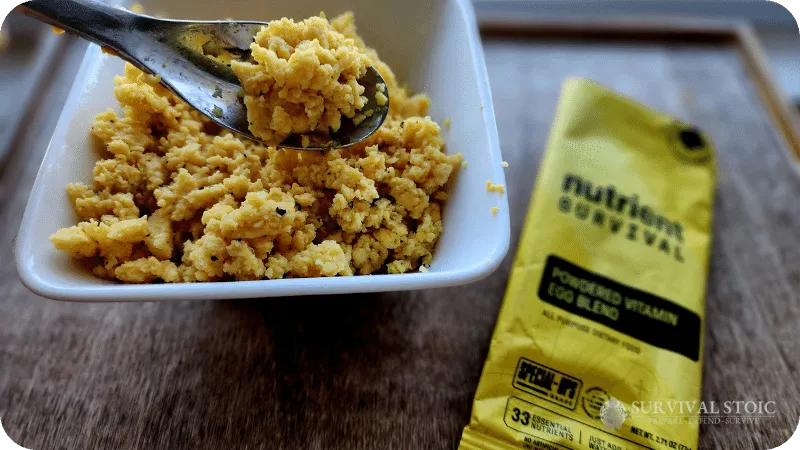
Nutrient Survival also enhances all their foods with vitamins, as I mentioned in my Nutrient Survival review, and their eggs are no different. These eggs have 14 vitamins and 8 minerals, which is far more than any other powdered eggs on the market.
You can purchase these eggs in large #10 cans or small packets with only the equivalent of three eggs in them. For long-term storage, the #10 cans make the most sense (and are cheaper per serving). But, it really does depend on how many eggs you go through. You don’t want to open a giant can of powdered eggs when you only eat a couple of eggs a week.
One thing I did notice was that these powdered eggs left a sizable mess in my pan. I was using stainless steel, but that’s typically what I use to cook eggs, and the mess with these eggs was much worse than usual. I recommend adding more fat than you think you need to avoid sticking, or use a non-stick pan.
Nutrient Survival’s powdered eggs also last much longer than the competition. They have a 25-year shelf-life, making them some of the best powdered eggs for long-term storage.
These eggs are a bit lot more expensive than some other options, but that’s largely because of all the added vitamins. You’re also getting more, nutritionally speaking. All of their foods are more expensive, as I expressed in my review. If you’re looking for a cheaper option, try Augason Farm’s eggs below.
Best Budget-Friendly Powdered Eggs: Augason Farms
- Price per Egg: 88 cents
- Fortified? No
- Sizes: Available in #10 cans and pantry packs
Augason Farms powdered eggs are some of the cheapest you can purchase, especially in bulk. We also have a discount code for 10% off that makes them even cheaper:
Simply use the code “survivalstoic” at checkout on Augason Farms website!
These powdered eggs are not as good as fresh eggs, but they aren’t bad either, in my opinion. I added salt and pepper to them and scrambled them like regular eggs. They do taste like powdered eggs, but they’re still passable. Luckily, you get used to this a bit as you eat them, though I didn’t like them nearly enough as Nutrient Survival’s eggs (and none of our other testers did, either).

They aren’t necessarily the best powdered eggs for scrambled eggs – that’d be Nutrient Survival. But, for their price, you really can’t beat them, and they are great for recipes. You’re paying around 88 cents per egg.
The price per egg is fairly close between brands, but the real difference is upfront cost and overall positioning.
Augason Farms is typically sold in larger, more affordable bulk cans, which makes it easier to build a food supply without a high initial investment. Nutrient Survival, on the other hand, is positioned as a premium product with added nutrients, which increases the total cost even if the per-egg price looks similar.
Augason Farms does offer several different sizes. You can purchase #10 cans for bulk storage or pantry packs for daily use. I recommend the bulk cans for long-term storage and the smaller packs for those who want to use the eggs now (unless you go through a lot of eggs, of course).

These powdered eggs have a shelf life of 10 years, which is pretty long, considering fresh eggs only last three to five weeks when refrigerated.
However, it isn’t as long as Nutrient Survival’s eggs, which last another 15 years.

As I mentioned in my Augason Farms review, this company offers many other single-ingredient #10 cans. They have several recipes featuring their powdered eggs and other ingredients, which is a great place to learn how to use powdered eggs in an emergency situation.
Best Powdered Eggs for Baking: Heaven’s Harvest
- Price per Egg: $1.37
- Fortified? No
- Sizes: Available in #10 cans
Heaven’s Harvest eggs can be used in baking recipes without needing reconstitution, making them an excellent choice for those who prefer using powdered eggs in their recipes.
However, they don’t work well for scrambled eggs. Their texture is extremely rubbery and thick. I tried adding more water than suggested to thin it up a bit, but it didn’t help much.

I wouldn’t recommend these powdered eggs if you want to eat them scrambled.

But, they do work just fine for baking.
Heaven’s Harvest’s eggs have fewer servings in each can, but the price is about the same. This fact pushes the price up, making it one of the most expensive brands.
However, we do have a 10% discount code for all their products, which helps with the cost:
Simply use the code "survivalstoic" at checkout.
Heaven’s Harvest does have several other foods that I do like a lot, which you can read about more in my Heaven’s Harvest Food Review.
These eggs have a 10-year shelf life, just like Augason Farm’s. Again, this is significantly lower than Nutrient Survival’s shelf life, but it is much longer than fresh eggs.
Based on my testing, these powdered eggs do not make a huge mess when you cook them. They made relatively the same size mess that fresh eggs make in my pan.
What It’s Actually Like Using Powdered Eggs for a Week
We used powdered eggs regularly over a couple of weeks while testing different brands.
At first, the difference from fresh eggs is obvious. The texture is slightly off, and most brands break into smaller pieces instead of forming larger, soft curds. Some also have a drier feel if you don’t add enough fat.
After a few meals, though, you adjust. The bigger factor becomes consistency.
Some brands cook up close to real eggs. Others stay rubbery no matter what you do. That difference matters more over time than the initial taste.
Where powdered eggs really stand out is in convenience. They store easily and don’t spoil. You can also use them just like fresh eggs in a recipe. On their own, they can get repetitive. However, when used as part of a larger meal, they work much better.
Common Mistakes When Using Powdered Eggs
Powdered eggs are simple to store, but they’re easy to misuse if you haven’t worked with them before.
- Expecting them to taste exactly like fresh eggs. They don’t. Even the best powdered eggs are slightly different in texture and flavor. If you expect them to be identical to fresh eggs, you’ll be disappointed.
- Not adding enough fat when cooking. Powdered eggs tend to stick more and feel drier than fresh eggs. Adding butter or oil makes a noticeable difference in both flavor and texture. Without it, they can come out rubbery or dry.
- Using them only for scrambled eggs. Scrambled eggs are actually where powdered eggs struggle the most. They work best for baking and casseroles. If you use them this way, the difference from fresh eggs is much less noticeable.
- Opening large cans without a plan. 10 cans are great for long-term storage, but once opened, they don’t last nearly as long. If you’re only using a few eggs at a time, it’s easy to waste a large can. Smaller packs or splitting into sealed containers can help avoid this.
How We Tested the Best Powdered Eggs
I tested these powdered eggs a lot like I test all survival foods. Here are some of the key factors I looked at:
- Preparation: I followed each brand’s recommended water-to-powder ratio (at least the first time). When I felt it was necessary, I did experiment a bit with the ratio to see if I could make the eggs later. I paid attention to clumping and how hard the eggs were to mix thoroughly.
- Taste Testing: I also taste-tested the eggs with our Testing Team. Our main goal was to find the powdered eggs that tasted the closest to real eggs. With this in mind, we looked at flavor and texture. Often, it was the texture that threw us off, not necessarily the taste.
- Cost Analysis: I calculated the cost per egg to determine which company was cheapest. I used each brand’s #10 cans to do this. The cost is higher if you choose the smaller packs.
- Packaging Quality: Since these powdered eggs are primarily designed for long-term storage, I considered how well the packaging was and how it could withstand sitting in a basement for a decade or more.
- Nutrition: Most of the powdered eggs I tried had similar nutrition to fresh eggs. However, some of them were fortified with extra vitamins, like Nutrient Survival, which gave them a leg-up.
All eggs were prepared using the manufacturer’s recommended ratios and cooked in similar conditions using standard kitchen equipment. When needed, we tested slight variations in water ratio to improve texture.
Are Powdered Eggs as Good as Real Eggs?
No, powdered eggs are not as good as real eggs. I’ve tried a lot of powdered eggs over the years, and none of them had the same flavor or texture as fresh eggs. You could tell they were powdered.
Now, that doesn’t mean they were bad or unedible. It’s just an obvious difference. Most powdered survival foods are dehydrated rather than freeze-dried because the process is cheaper and more space-efficient.
That said, in recipes, you cannot really taste the difference. This is where powdered eggs really shine, especially those that don’t need to be reconstituted before being added. I just add the powdered eggs to flour or any other dry ingredient and increase whatever liquid the recipe uses a little bit to cover.
When you cook powdered eggs into scrambled eggs, they tend to produce smaller “bits” of eggs. Many I’ve tried have also had an “off” texture, except for Nutrient Survival, which was pretty close.
If you want eggs to scramble or make an omelet, I recommend Nutrient Survival. They’re really the only eggs I’d use for that purpose.
Tips for Cooking Powdered Eggs
After cooking so many powdered eggs, I’ve learned a thing or two about how to make them taste the best:
- Always whisk the powder well to reconstitute it. Then, leave the egg mixture to sit for a few minutes. This will help soften any lumps that are still in the mixture. Afterward, whisk it again to make sure everything is reconstituted.
- Add fats to increase flavor, like butter. Augason Farms has a good powdered butter you can use for this purpose. (You can also add the butter to powdered milk to make it more like half-and-half.)
- Make sure to use salt and pepper, just like you would in fresh eggs. Stock up on these seasonings for an emergency.
- Adding cheese is another great option. There are several freeze-dried options. Again, Augason Farm’s is my go-to for shredded cheese.
Which Powdered Eggs Should You Get?
If you want the best-tasting powdered eggs out there, get Nutrient Survival’s powdered Eggs. They also happen to be the most nutritious!
For those on a budget, Augason Farm’s powdered eggs are another solid choice. They aren’t quite as good, but they’re much cheaper.
Of course, you cannot only eat eggs! Luckily, there are tons of emergency food kits out there to help you start stockpiling food right now. Powdered eggs are one of the easiest ways to fix the biggest weakness in most emergency food setups: lack of protein. But they work best when they’re part of a larger system, not the entire plan.
