

Based on my hands-on testing and tasting, Morning Moo’s Low-Fat Milk Alternative is the best powdered milk thanks to its taste and long shelf life.
I’ve tried several different powdered milk brands throughout the years, and I’ll be honest: many of them did not taste very good (especially according to my toddler). However, I have found five options that taste great and can be used for long-term storage.

I’ll outline my favorite powered milk brands below and discuss everything you need to know about storing powdered milk long-term.
Our Favorite Powdered Milk

20 Year Shelf Life
93 servings
Vitamin Fortified
Cost: 41 cents per oz
Save 10% at Augason Farms with code “survivalstoic”

Heaven’s Harvest Powdered Milk
25 Year Shelf Life
93 servings
Vitamin Fortified
Cost: 54 cents per oz
Save 10% at Heaven’s Harvest with code “survivalstoic”

Nutrient Survival Powdered Milk
25 Year Shelf Life
50 servings
Vitamin Fortified
Cost: 81 cents per oz
Save 10% at Nutrient Survival with code “SS10”

Nestle Nido Fortificada Powdered Milk
3-5 Year Shelf Life
26 servings
Vitamin Fortified
Cost: 54 cents per oz
Best Powdered Milk: Morning Moo’s Low-Fat Milk Alternative
Save 10% at Augason Farms with code “Survivalstoic”
- Cost Per Ounce: 41 cents
- Vitamins: Fortified with Vitamins A & D
- Shelf Life: 20 years
Morning Moo’s Low-Fat Milk Alternative is easily my favorite powered milk for several reasons. It tastes the best by far. You can drink it straight, just like regular milk, without adding any flavor enhancers or leaving it to chill for hours.
It doesn’t taste exactly like milk; it’s more like a vanilla milkshake. Unlike other powered milk, this one is made with a whey base, which makes it taste closer to milk. It’s also very creamy without the chalky texture I’ve noticed from other brands.
This milk is prepared with both warm and cold milk. In my opinion, it can be drunk right after you make it without needing to chill.

Morning Moo’s is also fortified with vitamins A and D, just like 2% milk. It isn’t the most nutritionally complete milk on this list, but it is far from the least nutritional out there.
One of my favorite aspects of Morning Moo’s is that it lasts for 20 years when properly stored. That’s far longer than the average powdered milk you’d find at the grocery store. Its lower fat content is one reason it lasts so long. Fat tends to go rancid fast, and the lack of fat keeps this milk safe to eat for longer.
While you can use Morning Moo’s in many different recipes, its low-fat content can interfere with some baking recipes, in my experience.
This brand also makes a chocolate milk alternative, which tastes very similar to a Fudgesickle. I highly recommend it for those with pickier children and who might just need a little pick-me-up after the apocalypse.
This milk is available in both #10 cans (20 year shelf life) and resealable pantry packs (5 year shelf life).
Best Tasting Powdered Milk: Heaven’s Harvest Whey Milk Alternative
Save 10% at Heaven’s Harvest with code “Survivalstoic”
- Cost Per Ounce: 54 cents
- Vitamins: Fortified with 33 essential nutrients
- Shelf Life: 25 years
Out of all the powdered milk we tasted, Heaven’s Harvest’s Whey Milk Alternative is the closest to real milk that I could find. If you mix it at room temperature, as suggested, and then add the last bit of water cold, you can drink it right away.

That said, the longer you leave it to sit, the better it tastes. Leaving it for a minute just lets the powder dissolve better, which fixes the taste.
This powdered milk is whey-based, so it is creamy and milk-like. It also lasts a long time due to its very low-fat content. I generally recommend storing food milk in its low-fat form. Then, if you want to make it full-fat, you can add powdered butter!

Heaven’s Harvest Whey Milk Alternative is also budget-friendly. While it isn’t the cheapest, it absolutely isn’t the most expensive option out there, either.
Best Fortified Powdered Milk: Nutrient Survival Vitamin Milk
Save 10% at Heaven’s Harvest with code “SS10”
- Cost Per Ounce: 81 cents
- Vitamins: Fortified with 33 essential nutrients
- Shelf Life: 25 years
Nutrient Survival’s vitamin milk is fortified with vitamins, like most of the company’s food. In fact, it contains far more vitamins than competing brands, hence the name “vitamin milk.” It really is milk with an insanely high number of vitamins and minerals in it.
This powdered milk also has a long shelf life of 25 years. That’s the longest out of any powdered milk I tested.

It does have a creamy texture, but it still tastes like other powdered milk, in my opinion. It also has a little “wang” to it, which I assume is because of the vitamins. It isn’t the tastiest milk out there, but Nutrient Survival really isn’t focused on being the tastiest.
Nutrient Survival is also more expensive than other options. This matches up with the company’s general priciness and is likely caused by all those added vitamins. After all, vitamins do cost something!
This powdered milk is designed to be mixed with cold water so you can drink it right away. The texture is better if you let it sit for a bit, in my experience. It helps the powder dissolve completely.
In a long term food shortage this is a great option since it is loaded with vitamins that will be hard to come by.
Best Powdered Whole Milk: Nestle Nido Forticada
- Cost Per Ounce: 54 cents
- Vitamins: Fortified with 9 vitamins
- Shelf Life: 3-5 years
Nestle Nido Forticada is the best whole milk option, but it has a much shorter shelf life than low-fat milk options. Fat goes rancid quickly, which greatly reduces the lifespan of this whole milk.
That said, this powdered milk will still last for 3-5 years, which is plenty for long-term food storage if you regularly use your supply. Practicing FIFO is necessary if you choose to stock up on this milk. You can’t just leave it in your basement for a decade and expect it to still be good!
This milk is fortified with nutrients. In fact, it was designed originally as a nutritional supplement for children and at-risk adults. It has vitamins A, C, and D, as well as iron. It isn’t nearly as fortified as Nutrient Survival’s vitamin milk, but it’s more fortified than Morning Moo’s Low-Fat Milk Alternative.
This brand tastes very similar to regular milk, and you can use it to replace milk in just about every recipe, based on my experience. It’s just regular milk that has been powdered!
You must mix this milk with warm water when preparing it, which means that you have to chill it afterward. This only works if you have a refrigerator, though, so it won’t work well in a grid-down scenario unless you have a generator.
Red Cow Powdered Milk
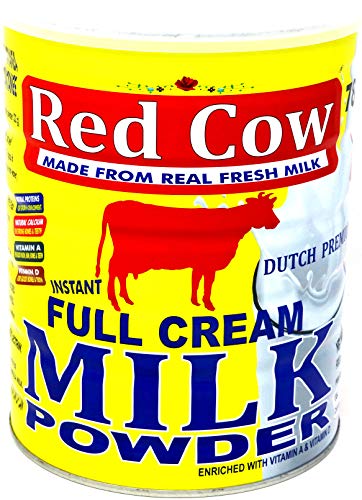
- Cost Per Ounce: 47 cents
- Vitamins: Not fortified
- Shelf Life: 3-5 years
Red Cow Powdered Milk is a slightly cheaper whole milk option. It has a great taste, but once again, it doesn’t last as long as low-fat powdered milk.
Based on my testing, it works well in most recipes, even more finicky baking recipes. It’s literally just whole milk that was heated to remove all the moisture content, so you can use it exactly like whole milk in recipes.
It stores for around three to five years in the proper conditions. After that, the milk fat will begin to rancid, which can be dangerous (and nasty). According to one study:
“The apparent toxic effects of rancid products are due mainly to an induced vitamin deficiency.”
Simply put, rancid fats destroy nutrients, which can actually lead to vitamin deficiency if consumed regularly over time. For this reason, it’s very important to be careful when storing fats long-term.
Red Cow powdered milk is very versatile. I found that mixing it at double strength was a good alternative to half-and-half in my coffee.
That said, it has to be mixed into warm water, so you’ll need to chill it before you drink it straight. If you’re using it in your coffee or a recipe, though, this doesn’t matter too much.
How I Tested and Chose the Best Powdered Milk
I’ve tried many different powdered milk brands over the years. After tasting and using several of the options in recipes, I eventually discovered which ones were best. Here are some of the things I considered when choosing which powdered milks to include on this list:
- Taste. I’ve tried several powdered milk brands that were simply unedible. Only the best-tasting powdered milks made it onto this list. My children try all the powdered milk I bring into the house, and it’s very important that I don’t have to fight them to drink it!
- Preparation. Powdered milk is just milk. It tastes different from fresh milk largely because of the texture of the leftover powder. Therefore, how well the powder of each milk brand dissolves is very important. I don’t want to be stuck drinking chunky milk.
- Nutrition. Many powdered milk brands are fortified to at least the extent of regular milk. Milk fat contains vitamins A and D, so low-fat options won’t contain these unless fortified. Many options are fortified even more, like Nutrient Survival.
- Shelf Life. How long powdered milk lasts depends largely on how much fat it contains. Low-fat powdered milk can often last 20+ years, while full-fat powdered milk only lasts 3 to 5. I didn’t add powdered milks with a below-average shelf life to this list.
- Cost. I broke down the cost per ounce for each powdered milk and chose the most cost-effective options.
Also see our Emergency Food Review Methodology for our testing guidelines.
How Much Powdered Milk You Should Store
The simplest answer to “how much powdered milk should I store” is “however much you need!” Thanks to dietary preferences, the amount of milk I need will be completely different from the amount you need.
The best way to determine how much milk you’ll need is to keep track of how much milk you use in the average week. Generally, you’ll need two cups of powdered milk to make a gallon of liquid milk.
Don’t forget recipes that require milk. You might buy bread from the store now. But if you’re preparing for a food shortage, you need to consider making your own? How much milk would you need then? You can check out some of our survival recipes that use powdered milk for ideas.
The general consensus is to store at least 16 pounds of powdered milk per person per year. That will make you about 58 gallons of milk or so a year – more than enough for a few glasses a week, plus a bit more for baking.
However, if you want to follow the advice of “three glasses of milk a day” from the USDA, you’d have to store 78 pounds of powdered milk per person.
My advice?
Aim for at least 16 pounds of powdered milk per person if you’re choosing a low-fat option that will store long-term. This is one situation where I would store just as much for kids as I would for adults. After all, kids need more milk than adults.
If you choose a full-fat option with a shorter shelf life, only store as much as you’ll use. Use the oldest powdered milk in your pantry first, then buy a new can to replace it.
How to Make Powdered Milk Taste Better
In many cases, powdered milk is literally just dehydrated milk. So, why does it taste different? It’s the leftover powder. Luckily, there are several ways you can make powdered milk taste better:
- Leave it to chill for up to 24 hours before you drink it, as this lets the powder dissolve completely. However, this does assume you have a working fridge to keep the milk cool.
- Add flavor enhancers like vanilla. Many of my favorite powdered milk already have these flavor enhancers added, which is often why they taste a bit like a vanilla milkshake.
- Use powdered milk in recipes where you aren’t likely to notice the taste difference. You can still get the nutritional benefits of milk without having to drink it straight.
Is Powdered Milk Nutritional?
Powdered milk is just as nutritional as real milk. Often, powdered milks are heavily fortified, as they’re primarily designed as a nutritional supplement. Therefore, many are even more nutritional than a gallon of milk you’d buy at the store.
If you do not purchase fortified milk, powdered milk has the same vitamins as regular milk. Milk fat contains the vitamins A and D found in milk, though, so low-fat milk will not contain these vitamins unless supplemented.
Powdered milk can begin to lose its nutritional value after 18 months, but this is minimal, according to Utah State University:
“Vitamin levels are stable for 6 months and only minimally decline after 18 months.”
Of course, you can’t live on powdered milk alone. You’ll need to store other foods or purchase an emergency food kit.
Where to Store Powdered Milk
Powdered milk should be stored in a cool, dry place. Basements can be a good option if they stay dry, but you can also store it in your usual pantry. I do not recommend storing it outside, or anywhere that isn’t climate-controlled, as heat can have a huge impact on how well powdered milk tastes, according to Utah State University:
“At hot temperatures the shelf life can be as little as 3 months. A 2USU research study demonstrated NFDM held at 32°C (90°F) for 6 mo began to develop off-flavors and by 24 mo was considered unacceptable by a trained sensory panel.“
In fact, it’s better to store powdered milk slightly chilled, like in a chilly basement:
“Storage at 10°C (50°F) resulted in minimal flavor changes in 52 months.”
Which Powdered Milk Should You Get?
Ready to add a powdered milk stash to your prepper pantry?
Pick up Morning Moo’s Low-Fat Milk Alternative for long-term storage. It lasts 20 years and tastes pretty good!
Augason Farms also sells other foods for long-term storage. I’ve taste-tested several of Augason Farms foods, and they all taste pretty good. Plus, most have a 25-year shelf life. They’re easily one of the best emergency food companies.
I’ve also covered long-term food storage for emergencies, which covers everything you need to know about storing food.
Now, check out our other Preparedness guides and reviews so you are ready physically and mentally as well!
