
We’ve spent decades using compasses for hiking and backcountry navigation, and we’ve tested them the way they’re actually used: shooting bearings in ugly terrain, measuring routes on topo maps, correcting for declination, and seeing which features still work when you’re cold, tired, and rushing.
This guide is built around what keeps you moving on a true line without electronics and what lets you reorient fast when you don’t have a signal, a battery, or a clear landmark. If you’re building your overall land-nav skills (map + compass + route planning), start with our Navigation hub.
After testing and comparing 25+ compasses, the Suunto MC-2 stood out as the best survival compass for most people.
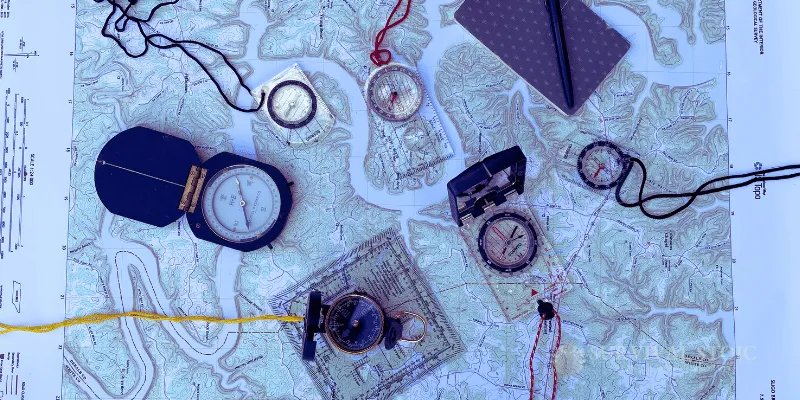
A compass can be the difference between a controlled return and an expensive, dangerous mistake. The wrong one creates drift and false confidence. That’s how small navigation errors turn into long nights.
If you’re building your first practical kit, our How to Start Prepping guide shows what matters first (and what to skip).
During testing, we used and compared Suunto, Silva, Cammenga, and Brunton, and we sanity-checked our conclusions with instructors who teach wilderness navigation.
Keep reading to see what we learned, which models are worth trusting, and what to avoid. We sanity-checked our conclusions with instructors who teach survival navigation.
Quick Comparison of our Favorite Survival Compasses


Very Durable
Military Issue
Tritium Indicators
Price: $$$
Save 10% at Army Navy Outdoors with code “SURVIVE10”
Best Survival Compass
Suunto MC-2 – The Best Compass Overall
Verdict: The Suunto MC-2 is the most complete survival compass on this list. It combines accurate sighting, true map usability, built-in declination adjustment, and multi-use survival features in a package that is intuitive under stress. If you are only going to own one compass for hiking, preparedness, or emergency navigation, this is the one to trust.
- Type: Orienteering Mirror Sighting Compass
- Size: 2.5” x 4” x .7”
- Weight: 2.6 ounces
- Declination Adjustment: Yes
- Glow in the Dark Indicators: Luminescent Marks
The Suunto MC-2 Compass is our top pick for the best survival compass.
This compass has all of the features needed to navigate a real survival situation. It is a mirror sighting compass that allows you to accurately sight an object in the distance and travel in a straight line. I can sight a landmark at the correct bearing, hike to that object, and repeat the process. That alone solves the problem of lateral drift.
The mirror also adds real survival value. It can be used for signaling, personal first aid, and other practical field tasks.
The MC-2 is also a true baseplate compass designed for use with topographical maps. I use the USGS version, which matches my 1:24,000 USGS maps. This allows me to measure distances directly without doing extra math. Even if you don’t use USGS maps, the inch ruler works universally.
The built-in declination adjustment is simple and effective. You read the declination off your map, adjust the screw, and you’re done. A small adjustment tool is included and attached to the lanyard, so you don’t have to search for a screwdriver.
The baseplate includes a magnifying lens, which can help read fine map details and can even be used to start a fire in direct sunlight. A clinometer and slope ruler are also built in, though most users will rarely need them.
I also like that the bezel clearly displays all eight cardinal and intercardinal directions (N, NE, E, SE, S, SW, W, NW) in addition to degrees. In a stressful situation, having those directions printed clearly removes guesswork.
When ordering, there are multiple versions available. I recommend the Northern Hemisphere model with USGS UTM scales.
The number of available configurations can be confusing when purchasing. You must ensure you select the correct hemisphere and map scale version.
It is also more expensive than basic baseplate compasses, but you are paying for precision, durability, and versatility.
Recommended for:
The Suunto MC-2 Compass is ideal for:
- Anyone who wants one compass that does everything
- Hikers, hunters, bushcrafters, and preppers
- Anyone building a serious bug out or get home bag
If you plan to rely on a compass in a real emergency, this is the tool to carry. If you are looking for the absolute cheapest compass available, or you only want a tiny backup for a kit, there are smaller and less expensive options.
PROS
Reliable
Easy to Use
Sighting Mirror
USGS Scales
Lifetime Warranty
CONS
Many Models to Choose From
Suunto MCB Mini Compass – Best Backup Compass

Verdict: The MCB Mini is not a primary navigation tool, but it is an excellent backup compass. It’s compact, affordable, and reliable enough to verify direction if your main compass or GPS fails. Keep it in a pack, vehicle, or survival kit, just don’t rely on it as your only navigation tool.
- Type: Mini Mirror Sighting Compass
- Size: 2.2” x 2.68” x 0.7”
- Weight: 1.27 ounces
- Declination Adjustment: No
- Glow in the Dark Indicators: No
The Suunto MCB Mini Compass is a compact mirror sighting compass designed specifically as a backup. Suunto refers to it as their “Safety Compass,” and that description is accurate.
It is similar to an orienteering compass but does not include a clear baseplate. It also lacks declination adjustment and a magnifying lens, so its map navigation capabilities are limited.
It does include straight edges with mm and 1/20 scales, allowing basic map use if necessary.
The built-in whistle on the lanyard, combined with the signaling mirror, adds useful survival functionality in a compact package.
The folding lid makes it easy to store in a pack, vehicle, or boat.
This is not a full-featured navigation tool, however.
Without declination adjustment or proper baseplate scales, it is not ideal for long-distance land navigation. It works best as a directional reference or backup verification tool.
Recommended for:
The Suunto MCB Mini Compass is best for someone looking for a compact backup compass to keep in a pack or emergency vehicle kit. It also pairs well as a secondary tool alongside a GPS unit. If you are buying your first or only compass, this should not be your primary choice.
PROS
Compact
Affordable
Sighting Mirror
Whistle Included
Floats
CONS
Not Great for Mapping
No Magnifying Lens
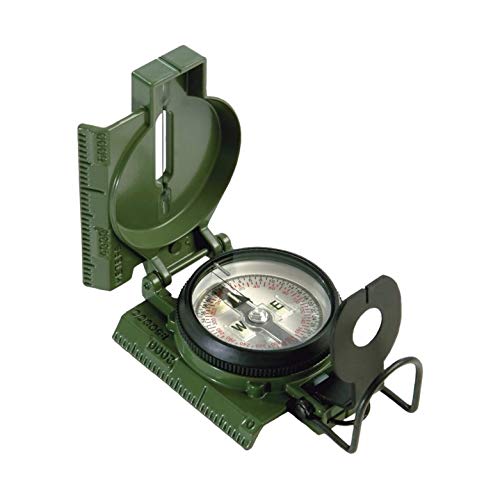
Cammenga US Military Compass – The Best Lensatic Compass
Save 10% at Army Navy Outdoors with code “SURVIVE10”
Verdict: The Cammenga is the most durable compass here and is proven in real military use. If you are hard on gear or already trained on a lensatic compass, it is a strong option. For most civilians, however, the weight and lack of declination adjustment make it less practical than a quality mirror compass.
- Type: Lensatic Compass
- Size: 2.25″ x 3″ x 1.1″ (closed)
- Weight: 16 ounces
- Declination Adjustment: No
- Glow in the Dark Indicators: Tritium
The Cammenga US Military Compass is the government-issued M-1950 compass used by the military.
The biggest advantage of this compass is durability. It is extremely rugged and battle-tested. Our team has seen this compass dropped over a cliff and run over during military operations, and it continued to function properly afterward.
If you are concerned about damaging your compass, this is the most durable option on our list.
This compass is not as intuitive as a mirror sighting compass.
While it does have a magnifying lens for sighting, it does not have a mirror, which removes a useful survival function for signaling or first aid. The magnifying lens is also not strong enough to start a fire.
It can be used with a map, but it is not designed primarily for baseplate-style navigation. There is also no built-in declination adjustment, so you must manually account for declination when calculating bearings.
At 16 ounces, it is also significantly heavier than most mirror compasses.
Recommended for:
The Cammenga US Military Compass is best suited for someone with military training who is already comfortable using a lensatic compass. It is also ideal for anyone who prioritizes maximum durability over convenience. If you are new to compass navigation or want an easier, lighter, more map-friendly system, there are better options available.
PROS
Very Durable
Military Standard
Tritium Indicators
CONS
No Mirror
Hard to Use
Heavy
Silva Ranger 2.0 Compass
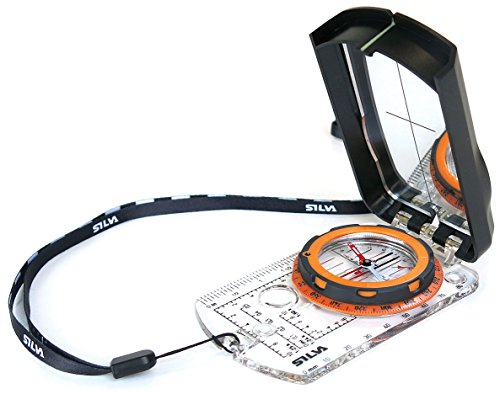
Verdict: The Silva Ranger 2.0 is a capable mirror compass with solid map features and good overall performance. It works well, but it doesn’t quite match the intuitive layout and refinement of the Suunto MC-2. If our top pick is unavailable, this is a dependable alternative.
- Type: Orienteering Mirror Sighting Compass
- Size: Approx 4” x 2.5” x 1”
- Weight: 4.8 Ounces
- Declination Adjustment: Yes
- Glow in the Dark Indicators: Luminescent Marks
The Silva Ranger 2.0 Compass is a mirror-sighting compass with many of the features I look for in a survival compass.
It has a sighting mirror that allows you to sight objects in the distance and travel in a straight line. It includes a clear baseplate for use with maps and a magnifying lens that can assist with starting a fire if needed.
I like that it has multiple map scales printed on the baseplate. In my experience, you often come across maps with different scales, so having multiple options is helpful.
The lanyard also has map scales marked on it. Since the lanyard is flexible, you can lay it on a map and bend it around curves for more accurate distance measurement. This is especially useful when mapping out a winding hiking trail.
There are a few design choices that I do not care for.
The bezel only has degree markings and does not include printed cardinal directions like the Suunto MC-2. In a stressful situation, having N, S, E, and W clearly marked makes things simpler.
I also do not like the shape of the baseplate. The curved ends make it slightly more difficult to line up precisely on a map compared to a straight-edged baseplate.
The lid feels larger than necessary, and unlike the MC-2, it does not include a tool for adjusting declination.
While Silva has a long history of quality compasses, manufacturing moved to China in 2005. Quality has improved in recent years, but it’s worth noting.
Recommended for:
The Silva Ranger 2.0 Compass is a good choice for someone looking for a capable mirror compass with solid map features. It is especially useful for hikers who value the flexible lanyard scale system.
PROS
Sighting Mirror
Easy to Use
Lanyard Marks
CONS
Made in China
Baseplate Shape
Bulky
Brunton TruArc 15 Compass

Verdict: The Brunton TruArc 15 has strong features and solid build quality, but its unconventional layout makes it less intuitive than our top picks. It can absolutely work in a survival situation, but only if you train with it consistently. For most users, there are simpler and more user-friendly options available.
- Type: Orienteering Mirror Sighting Compass
- Size: 4” x 2.5” x 0.6”
- Weight: 3.2 ounces
- Declination Adjustment: Yes
- Glow in the Dark Indicators: No
The Brunton TruArc 15 Compass is a made-in-the-USA mirror sighting compass that checks nearly every box on paper for a survival compass.
It includes a sighting mirror, magnifying lens, and a baseplate with USGS scales. The baseplate offers 1:24,000 scales for miles, meters, and feet, which makes measuring distance simple if you’re using USGS maps. It also features a global needle as standard, making it usable in both hemispheres without tilt issues. A built-in clinometer and toolless declination adjustment round out the feature list.
From a pure specifications standpoint, it has everything you would want.
The main drawback is usability.
The bezel is set up in reverse from most other compasses and includes a magnifying window over the bearing markings. If you exclusively train with this compass, it may not be an issue. However, if you’ve used other compasses (especially Suunto or Silva), the reversed layout can feel confusing under stress.
Sighting is also less intuitive than other mirror compasses. The bearing marks are easier to read at the top of the bezel through the mirror, but when read this way they appear 180 degrees off from the baseplate “shed” markings. It works, but it takes mental adjustment.
The toolless declination adjustment sounds convenient, but many users report difficulty fine-tuning it accurately.
Recommended for:
The Brunton TruArc 15 Compass is is best suited for someone who:
- Specifically wants a made-in-the-USA compass
- Values global needle capability
- Is willing to train exclusively with this layout
If you are new to compass navigation, or you want the most intuitive and stress-proof design available, there are easier options.
PROS
Sighting Mirror
Global Needle
Made in the USA
CONS
Hard to Use
Declination Adjustment
Suunto MB-6 Compass

Verdict: The MB-6 is compact, rugged, and highly portable, making it a solid niche option. However, its inability to work effectively with maps limits it as a primary survival compass. It’s best suited for minimalists or as a durable backup.
- Type: Mirror Sighting Compass
- Size: 2.6” x 1.85” x 0.9”
- Weight: 1.94 ounces
- Declination Adjustment: Yes
- Glow in the Dark Indicators: Luminescent marks
The Suunto MB-6 Compass is a compact mirror compass that folds into a durable metal matchbox-style case. This design makes it rugged and highly portable.
It includes a folding mirror and gun sight-style aiming system for sighting distant objects. While it looks different from a traditional orienteering compass, it functions in a similar way for line travel.
The biggest advantage of this compass is its compact size. It folds into a small metal case that fits easily in a pocket or pack without taking up much space.
The main limitation is map usability.
This compass cannot effectively be used with maps because it does not have a baseplate. If you plan to do map-based navigation, you will need a separate baseplate compass. While it does have declination adjustment, that only helps when transferring bearings; it does not solve the map measurement limitation.
If you expect to do any serious map work, this is not the one-compass solution.
It is also more expensive than some full-featured baseplate mirror compasses.
Recommended for:
The Suunto MB-6 Compass is well suited for someone who wants a rugged, compact compass and does not plan to rely heavily on maps. It works well as a durable backup for hikers or boaters. If you want one compass that handles both line travel and full map navigation, there are better options available.
PROS
Durable
Lifetime Warranty
Sighting Mirror
CONS
Price
Can’t Use with Maps
Silva Mini Compass

Verdict: The Silva Mini is an emergency-only compass. It’s small and better than nothing, but it should never replace a full-featured navigation tool. Carry it in a survival kit as a last-resort option, not as your primary compass.
- Type: Mirror Sighting Compass
- Size: 1.6” x 1.86” x 0.8”
- Weight: 1.6 ounces
- Declination Adjustment: No
- Glow in the Dark Indicators: Luminescent marks
The Silva Mini Compass is the smallest compass on our list and one of the most affordable.
Despite its size, it includes a mirror, which is unusual for such a compact compass. This makes it more capable than most button-style compasses and useful for basic line travel.
Its small size makes it ideal for lightweight backpackers or inclusion in a compact survival kit.
This compass is not built for heavy use.
It is made from thinner plastic and is not as durable as larger mirror compasses. Map navigation is possible in an emergency, but because of its size, it is not easy or practical for serious map work. It also does not have declination adjustment.
This should not be considered a primary survival compass.
Recommended for:
The Silva Mini Compass is best suited as an emergency backup in a small survival kit, bug out bag, or daypack. If you are looking for a main navigation tool for hiking or preparedness, you need something larger and more capable.
PROS
Affordable
Compact
Sighting Mirror
CONS
Durability
Limited Use with Maps
If I Could Only Buy One Compass
If I had to pick one compass to trust in a real survival situation, it would still be the Suunto MC-2, and it’s not a close call.
It combines everything a survival compass needs: accurate bearings over long distances, easy map navigation, built-in declination adjustment, and a sighting mirror that helps you actually travel in a straight line instead of wandering in circles. On top of that, the mirror, magnifier, and rugged build give it real multi-use survival value.
Most importantly, it’s easy to use under stress, which matters far more than extra features. In a survival situation, simplicity and reliability beat clever design every time.
If you only ever plan to buy one compass for hiking, hunting, bushcraft, or emergency preparedness, buy the MC-2, learn to use it well, and keep it with your kit. A compass only helps if you actually know how to use the one you carry.
Compasses to Avoid
Not every compass marketed as a “survival compass” is actually suitable for survival use. In fact, many of the cheapest options sold online are little more than toys, and trusting one in a real emergency can easily make a bad situation worse.
Cheap Button Compasses
Button compasses are the tiny round compasses often included in survival kits, paracord bracelets, or multi-tools. While they can give a general sense of direction, they are not accurate enough for real survival navigation.
They can’t be used with a map, don’t allow accurate bearings, and often stick or drift. They’re fine as a last-ditch backup, but they should never be your primary compass.
For real kits, we prioritize redundant navigation: see our Bug Out Bag and Get Home Bag for what we actually carry (and why).
No-Name “Survival” Compasses
Many inexpensive compasses on Amazon and big-box sites look impressive, often styled like military gear with metal cases and flashy markings. Unfortunately, many of these are cheaply made knockoffs with inconsistent needles and questionable accuracy.
Even small errors in bearing can send you miles off course over long distances. A compass that is off by just a few degrees can easily lead you deeper into trouble instead of toward safety.
Novelty or Gadget Compasses
Compasses built into watches, knives, bracelets, or keychains are convenient but usually too small or inaccurate for serious navigation. They can help with general orientation, but they shouldn’t replace a real compass.
If you wouldn’t trust it to get you home in a whiteout or thick timber, don’t trust it in a survival kit.
How We Tested Survival Compasses
You can trust this guide because we didn’t just read spec sheets and pick the most expensive models. Over the years, we’ve owned, carried, and used more than 25 different compasses in real-world conditions, from Boy Scout hikes decades ago to military field environments, backcountry trips, and everyday preparedness kits.
Our testing focused on how a compass performs when it actually matters, not just how it looks on a product page. If a compass was inconsistent, slow to settle, or hard to read under stress, it dropped immediately.
1. Bearing Accuracy & Needle Stability
First and foremost, we evaluated accuracy and consistency. A survival compass must:
- Settle quickly
- Return the same bearing repeatedly
- Track smoothly without sticking
We tested this by shooting repeated bearings to fixed landmarks and verifying consistency across multiple readings. Lower-quality compasses often show slight drift or hesitation in the needle, which may not seem significant at first but over long distances, even small deviations can compound into major navigation errors.
Liquid-filled capsules were evaluated for damping performance and long-term bubble formation.
2. Real-World Line Travel (Lateral Drift Testing)
We tested how well each compass allowed us to:
- Sight a distant object
- Walk a straight line through wooded terrain
- Maintain direction without prominent landmarks
This is where mirror sighting and lensatic designs clearly outperform basic baseplate compasses. Traveling through dense woods quickly reveals which compasses are intuitive and which create confusion.
If a compass made it difficult to confidently follow a bearing under movement, it was downgraded.
3. Map Navigation & Declination Use
Since survival navigation often requires maps, we tested each compass for:
- Ease of aligning with USGS maps
- Declination adjustment functionality
- Clarity of orienting lines and “shed” alignment
- Scale usability for measuring distance
Compasses without declination adjustment were tested with manual adjustment calculations to evaluate how practical they are under stress.
We also evaluated whether baseplate shape interfered with lining up grid lines; something rarely discussed but noticeable in use.
4. Durability & Field Handling
We evaluated durability with drops, wet conditions, temperature changes, and real carry in packs and pockets.
Military-style lensatic compasses were tested for impact resistance and structural integrity. Mirror compasses were evaluated for hinge durability and scratch resistance.
We also looked at long-term reliability. Some compasses in our collection are 30–40 years old, which provides insight into aging, bubble formation, and bezel wear over time.
5. Low-Light & Night Use
We compared luminescent paint versus tritium inserts in:
- Dusk conditions
- Full darkness
- After light charging
Tritium clearly offers superior long-term glow performance, but we also assessed how readable each compass remained when visibility was limited.
6. Multi-Use Survival Capability
Because this is Survival Stoic, we evaluated additional survival functions:
- Mirror effectiveness for signaling
- Magnifier usability for fire starting
- Ease of use for first aid inspection
- Overall packability for bug out bags and get home bags
The magnifying lenses were tested for fire-starting potential under direct sunlight. While not a primary fire method, we confirmed they can work with patience and proper tinder.
7. Ease of Use Under Stress
Perhaps most importantly, we evaluated how intuitive each compass feels.
In a real survival scenario, you may be:
- Cold
- Tired
- Injured
- Operating under stress
A compass that requires mental gymnastics to interpret is a liability.
We gave strong preference to compasses with:
- Clearly marked cardinal directions
- Smooth bezel rotation
- Easy-to-read degree markings
- Straightforward sighting systems
Field Evaluation Criteria
After field use and side-by-side comparison, we ranked each compass based on:
- Accuracy
- Durability
- Map usability
- Multi-function survival value
- Ease of use
- Long-term reliability
The goal was simple: identify the compass we would personally trust to get us out of trouble, not just one that looks impressive on paper.
Navigation is a skill, but the right tool makes that skill reliable.
Train With Your Compass Before You Need It
A compass will not save you if you don’t know how to use it.
Navigation is a skill, not just a piece of gear. In a real survival situation, you may be tired, cold, injured, or under stress. That is not the time to figure out declination or practice taking your first bearing.
Buy a map of your local area. Practice aligning grid lines. Adjust for declination. Take bearings to visible landmarks and walk them out. Do it until the process feels automatic.
The best way to avoid a survival situation is to never get lost in the first place. The second-best way is to carry a reliable compass, and know exactly how to use it.
If you already know the basics, skip ahead to the FAQs and ‘What’s Best for You’—the picks above are the short version.
Tips for Choosing the Best Compass
To select the best compass, it is essential to understand a few basics about compasses. Don’t just buy any cheap compass advertised for “survival.”
There are a few different types of compasses. Some are good in a survival situation, and some are not. Below we will discuss the differences, and then we will put it all together so you can decide which is the best for you.
Price
While, usually, you can find an excellent lower-priced option for most survival gear, this is not the case for a compass. As they say, “You get what you pay for.”
Stay away from anything that is under $25. These are cheap inferior copies. Most cheap compasses are inaccurate and are more difficult to use.
If you just want something to play with, cheap is fine, but a survival compass should not be something you just play with. Since your life depends on it, it needs to work correctly.
Brand
A reputable company should make your survival compass. I found many cheap knockoffs with strange brand names that are made in China. While they look like the more expensive compasses, they are different.
Cheap compasses are made from inferior materials that are simply not reliable. The needles can be inconsistent between readings, causing you to travel in the wrong direction. While a small error is negligible, it really adds up over a long distance.
Stay with these reputable brands:
- Suunto has been making compasses in Finland for over 80 years. Their specialty is compasses, and they are continually updating their processes to make their products more accurate and durable. They include a lifetime warranty and make some of the best compasses available.
- Cammenga is a US-based company that has been making the military’s standard issue M-1950 lensatic compass since 1992. They must meet all the military standards in their processes so their products are top-notch.
- Silva began in Sweden and made their first compass in 1928. They made compasses in Sweden until 2005, when they moved production to China. Since then, they have been bought and sold a few times. Since 2018 they have re-established themselves as a Swedish company. However, their manufacturing facilities are still in China. Their quality has improved in the past few years.
- Brunton is a US-based company that was founded in 1895. They began by making a pocket transit that was used by surveyors that included a compass and clinometer. It was often just called a “Brunton.” In 1996, they were acquired by Silva but were sold in 2006 and again in 2009 to another Swedish company. Manufacturing is still done today at its Riverton, Wyoming facility.
Different Types of Compasses
There are a few different types of compasses, each with a specific purpose. This is where it gets confusing when buying a compass.
First, we will review each type of compass.
Button
A button compass is what the name suggests. It is a small compass, not much bigger than a button. They are usually around 1” in diameter and are circular with no other baseplate or cover.
A button compass gives you an overall direction with no absolute accuracy. If you want to move North, it will give you a general Northerly direction.
These compasses cannot be used with a map, and they cannot be used to sight a bearing accurately.
While one of these is better than nothing, there are ways to determine the overall direction of the environment. The location of the sun, the moon, and moss on trees and rocks can tell you which way North is more reliably than a cheap button compass. Don’t waste your money.
Baseplate
A baseplate compass is a circular compass mounted to a thin rectangular base plate. The baseplate is usually a clear plastic.
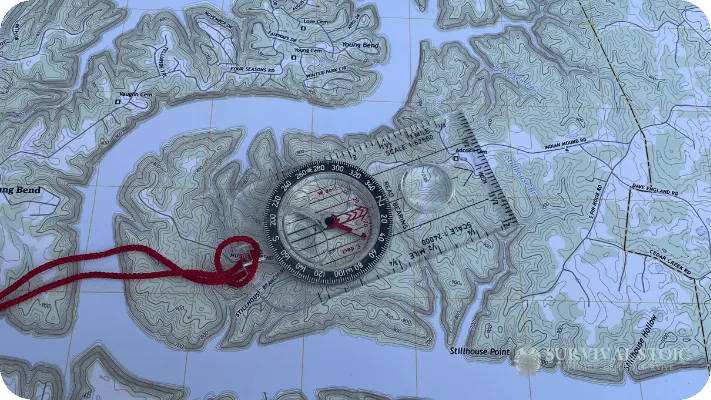
Baseplate compasses are designed to be used with maps to determine bearings and distances. They will have a ruler or scale printed on the side to measure distance on a map. They will also have a rotating bezel that is used to measure a heading between points on a map.
While these compasses will show you a bearing, they do not have any type of sighting mechanism. These can be used to navigate somewhat when there are prominent landmarks to follow. However, if there are no prominent landmarks or you do not know where you are, they will not be accurate enough to travel in a straight line.
Lensatic
A Lensatic compass is a circular compass inside a case with a lid and a sighting device. An excellent example of a Lensatic compass is the standard military M-1950 compass.
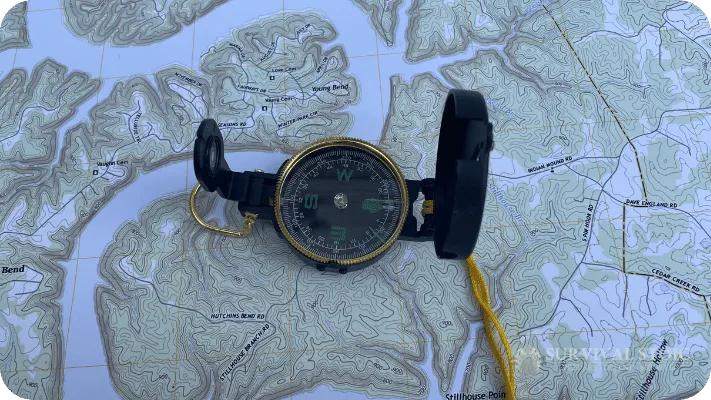
These are used to sight objects or landmarks in the distance so that an accurate bearing can be determined or followed. These compasses are the best for traveling in a specific direction and allow you to move in a straight line.
While they are not specifically made to use with maps, some have a flat base that can be used with a map when opened.
Transit Compass
While not as popular today with GPS and modern electronics, a transit compass is used by surveyors and map makers. These compasses are usually 3 inches or so in diameter, have a metal case and lid, and are very accurate and expensive.
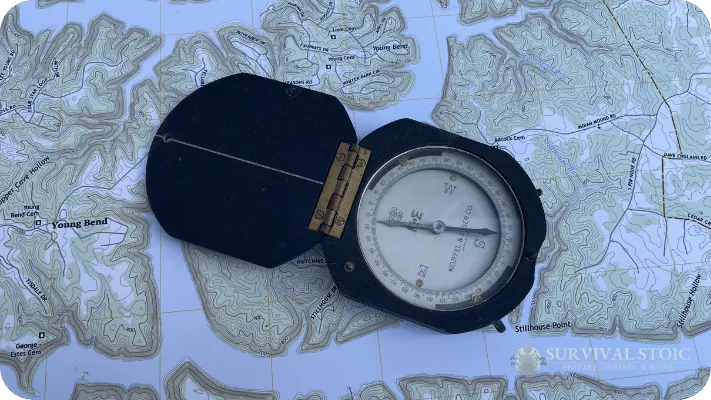
While you can’t find many of these sold new today, they are often sold as antiques. I have one from the 1930s that was my grandfather’s. He used it to survey while installing pipelines.
Orienteering or Mirror Sighting Compass
The term orienteering compass is often used a lot for baseplate compasses. This is likely a marketing tactic since it sounds “cooler.”
An orienteering compass or mirror sighting compass looks similar to a baseplate compass. However, it has a top-hinged cover that has a mirror. It also has a gun sight-type feature that allows you to sight objects in the distance.
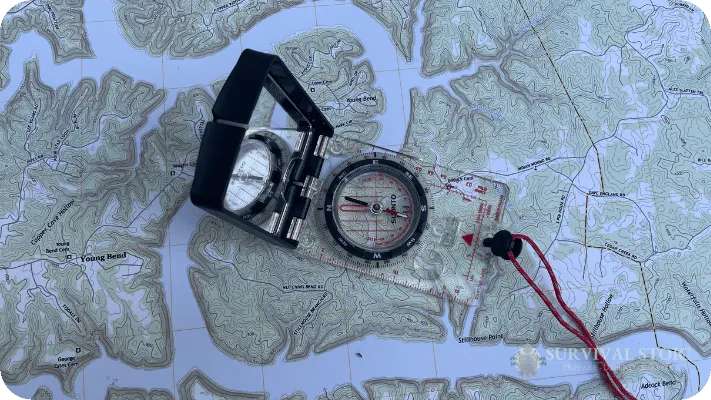
An orienteering compass can be used the same as a baseplate compass for determining direction and distance on a map. It can also be used like a Lensatic compass to sight objects in the distance accurately.
This type of compass is usually the best overall since it combines the baseplate and Lensatic compass.
Parts of a Compass
Understanding the parts of a compass is critical before purchasing one. Below, we will step through each feature while referencing this diagram.
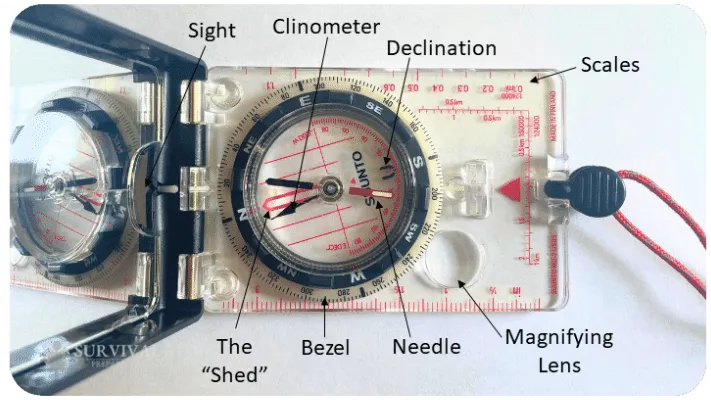
Needles
The needle is the heart of the compass. Compass needles will have two sides, one painted red or another color and the other painted black. The painted side of the needle points to “magnetic North.”
Some compasses have two types of needles available. The most common in the US is called ” Northern Hemisphere” or just “NH.” The other type is “Global.” If there is no indication, they are usually NH needles.
Since the Earth is curved, the magnetic field is different depending on where you are on the planet. If you are in the northern hemisphere, a compass needle is attracted to the poles at a different angle than in the southern hemisphere.
Since the needle floats around its center inside a capsule on the compass, you have to hold the compass level so it is free to rotate.
So, a compass with a needle tuned for the Northern Hemisphere will need to be held at an angle to rotate in the Southern Hemisphere freely. This makes it challenging to use on a flat surface.
In the US, both NH needles and Global needles will work. Global needles have more room for the needle to tilt inside the compass.
While some say that Global needles are better since you can walk and still use the compass, I am not sure who is trying to hike in the woods without watching where they go. This is the same as texting and driving. You cannot accurately use a compass, not trip over your feet, and track landmarks simultaneously.
Global needle compasses are more expensive than NH compasses, so again, this is just a marketing ploy to get you to spend more money on something you don’t need.
Unless you plan to travel to the Southern Hemisphere (that’s a long hike), an NH compass will work fine for you.
Rotating Bezel
A rotating bezel is needed to measure and follow bearings. Make sure your compass bezel has markings in degrees from 0 to 360. Some military compasses are marked in Mils, which is not helpful unless you were trained in the military.
Also, make sure your compass bezel is at least marked with “N” to indicate North. While North is basically 0 degrees, having this on the bezel is better so you don’t get confused in a stressful situation. The best compasses have N, S, E, and W marked for clarity.
Declination Adjustment
Declination is a complicated subject that could be its own article.
There are basically three directions for North depending on your reference point. There is true North, magnetic North, and grid North. Maps are a flat representation of a curved surface.
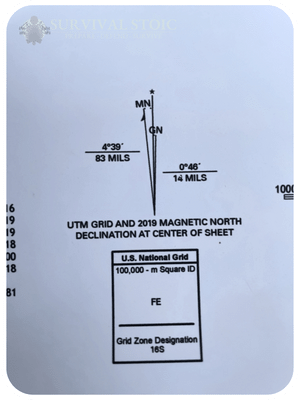
The declination adjustment is printed on the map to make up for the differences between the North direction on a map and the magnetic North that your compass reads. This adjustment will be different depending on where you are on the earth.
A compass with declination adjustment makes it easy to adjust for this difference and measure bearings accurately on the map. If your compass does not have a declination adjustment, you can still use it, but you must add or subtract the declination from every measurement you take.
Having built-in declination adjustment on your compass is the best and makes calculating bearings easier.
Orienting Lines
The best baseplate and orienteering compasses will have orienting lines printed on the baseplate so you can line them up accurately on the map. Aligning the grid lines on a map is an essential first step to measuring bearings.
They will also have what is often called a “shed” or “doghouse” printed behind the needle. This area visually indicates where the compass arrow should be when you are taking or measuring a bearing.
It is often said to “put red in the shed” or “put the dog in the doghouse” as a way to remember how to align the compass needle.
Needle Chamber
Most newer compasses (except the Military compasses) have a liquid-filled needle chamber. The liquid in the chamber helps to dampen the amount of movement the needle makes. It makes it smoother and quicker to get an accurate reading.
Cheaper compasses will not have a liquid-filled chamber, and the needle will constantly move around as you hold it. This makes it hard to get an accurate bearing since the needle constantly moves.
Over time, bubbles can form in the chamber (like in my 40-year-old Silva). This does not affect the compass’s accuracy but makes it harder to use since you must wait for the needle to stabilize. If the bubble is over 25% of the chamber, it is time to get a new compass. My Silva has been officially retired.
Clinometer
Some compasses will have a built-in Clinometer. This is used to measure the slopes of hills. Surveyors and map makers used this tool to do their work historically. Today with modern GPS devices, they are no longer used much.
There is no need for a Clinometer on your survival compass, either.
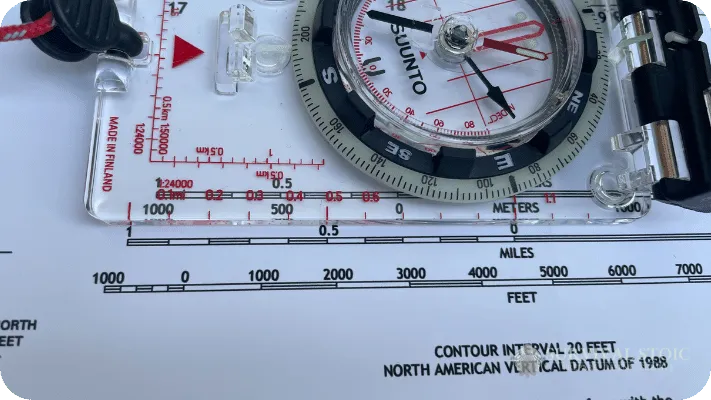
Scales
The scale printed on your baseplate or orienteering compass can be confusing. This is used for measuring the distance on a map.
Most compasses come with at least inches or centimeters printed on the baseplate. At a minimum, this, along with the scale printed on the map, can always be used to measure distance on a map. You could use a piece of string if you had to.
Most topographical maps today come with a standard scale. USGS maps are always 1:24,000 scale. Some compasses, like our top pick, come with a variety of scale options available.
If you know the type of map you have, try to match your compass with your map. For example, if you have a USGS map, get a USGS compass. This will just make it easier to take distance measurements. Otherwise, just use the typical inch or centimeter ruler that comes on all baseplate compasses.
Glow in the Dark Marks
A compass with luminescent or Tritium markings glows in the dark, making using your compass at night much easier. Tritium is the best and will usually last for at least ten years. Luminescent paint has to be “charged” by sunlight or a flashlight and will glow for a few hours afterward. Some glow better than others.
Either way, some glow-in-the-dark markings are nice but not essential.
Sighting Lens or Mirror
A Lensatic compass will have a sighting lens, while an Orienteering compass will have a mirror.
When using a Lensatic compass, you hold it close to your face. As you focus on an object in the distance through the sighting window, you can look down without moving and see the needle and the markings on the bezel through the lens. Since everyone’s eyesight is different, the position of the lens may have to be adjusted. You may also need to remove your glasses depending on your eyesight.
When using an orienteering compass, you hold it extended away from your face, much like a handgun. As you focus on a distant object through the sighting window, you can adjust the mirror to see the needle and bezel.
Essentially, the mirror and lens are accomplishing the same thing in different ways. In my experience, the mirror works best and is easier to use.
What Makes a Good Compass for Survival?
To find the best compass for survival, you must first determine what the compass will be used for.
The main items to focus on are:
- Assist with traveling in a straight line over a long distance.
- Be able to find a position and navigate with a map.
- Have multiple other uses like signaling and fire starting.
Lateral Drift
First and foremost, a survival compass must assist you with traveling in a straight line for a long distance. Everyone experiences what is called “lateral drift” while they are walking without a clear target in the distance.
When you are in the woods, and all the trees look the same, you tend to walk toward your dominant side without realizing it. This is why you hear of lost people walking in one big circle.
To walk in a straight line, we need a compass that allows us to sight targets in the distance to walk towards. This can only be accomplished with a Lensatic or orienteering compass.
Map Navigation
A survival compass should be able to be used with a map. Finding your way to safety or around hazardous locations is one of the main objectives in a survival situation.
Even while bushcraft camping, navigation is an essential bushcraft skill that could be used to find a body of water to fish or a location to hunt. It would then help you find your way back to camp.
To navigate with a map, a baseplate or orienteering compass is needed. Some Lensatic compasses can also be used with a map.
Multi-Use
For any piece of survival gear, it should have multiple uses to be considered. We are limited in how much gear we can carry in a survival kit, bug-out bag, or get-home bag, so each item must be valuable.
An Orienteering compass has a mirror. Mirrors can be a signaling device to others in the air or on the ground. They can also be used for hygiene or to see areas on your body that you can’t usually see for first aid.
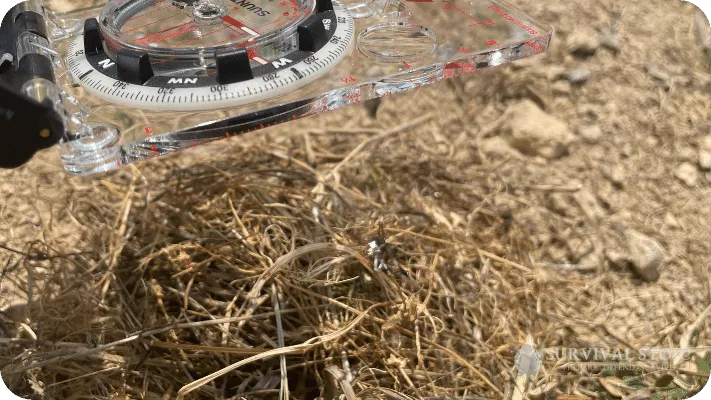
A baseplate compass and an orienteering compass also have a magnifying lens. A magnifying lens can be used to start a fire with the sun. This massive advantage over the other compasses should not be ignored. It is very easy to practice starting a fire with a magnifying lens before you need it. While you should have a fire starting kit, this is a resource that never runs out except on a cloudy day.
Best Survival Compass
Considering these factors, the best compass for survival is an orienteering compass like our top pick, the Suunto MC2. It has all the criteria needed in a survival compass.
Most people that are using a compass are doing it because they are traveling in a remote area. An argument could be made that all compasses are survival compasses. Before buying a cheap compass to take hiking, hunting, or camping, this should be considered. If you get lost, was saving a few dollars worth it?
A good survival compass is essential for any survival kit or as a backup to a GPS unit or survival watch. Learning how to use a compass to navigate is similarly just as important. There are many books, classes, and courses available on navigation. I recommend purchasing a map and practicing with your compass before venturing out on a long hike.
The best way to avoid a survival situation is to never get in one to start with.
Common Navigation Mistakes People Make with a Compass
Most people don’t get lost because they lack a compass. They get lost because they misuse it.
Here are the most common navigation mistakes we’ve seen over the years.
1. Not Adjusting for Declination
This is the most common and most costly error.
Magnetic north and true north are not the same. If you’re using a map and don’t adjust for declination, your bearings will be off, sometimes by several degrees. Over a long distance, that error compounds quickly.
A few degrees may not seem like much at first, but after a mile or two, you can be hundreds of yards off course.
2. Walking Without a Fixed Landmark
Trying to walk while staring at your compass is a mistake.
Instead, take your bearing, sight a clear object in the distance (a tree, rock, ridge, or terrain feature), and walk to that object. Once you reach it, repeat the process.
This reduces lateral drift and keeps you moving in a straight line.
3. Trusting Cheap or Unverified Gear
Many people assume all compasses are accurate.
They are not.
Cheap compasses can stick, drift, or give inconsistent readings. If you’ve never tested your compass against a known bearing, you are trusting it blindly.
Verify your gear before you rely on it.
4. Failing to Confirm Position on a Map
A compass only tells you direction, not location.
If you don’t periodically confirm your position using terrain features, elevation, or known landmarks, you can follow a perfectly accurate bearing in the wrong direction.
Navigation is direction plus confirmation.
5. Letting Terrain Override Direction
It’s natural to follow the easiest path: a valley, trail, or downhill slope.
But terrain often pulls you off bearing. If you consistently favor easier ground instead of maintaining your direction, you may gradually drift off course without realizing it.
Your compass should guide your movement, not the terrain alone.
6. Not Practicing
Navigation is a perishable skill.
If you only pull your compass out when something goes wrong, you’re already behind. Stress, fatigue, and poor weather make simple tasks harder. Practice in low-stakes conditions so the process feels automatic when it matters.
Video Guide to the Best Survival Compass
Frequently Asked Questions About Survival Compasses
What compass does the U.S. military use?
The U.S. military issues a lensatic compass, commonly the Cammenga M-1950 model. It is extremely durable and designed for military navigation systems. However, it does not include declination adjustment and is heavier than most mirror compasses, which makes it less practical for many civilian users.
Are cheap compasses accurate?
Most inexpensive compasses under $25 are not reliable enough for serious navigation. Poor-quality needles can stick or give inconsistent readings. Even small bearing errors can send you miles off course over long distances. A survival compass is not gear to cut corners on.
Is a mirror compass better than a lensatic compass?
For most civilians, yes.
A mirror (orienteering) compass allows accurate sighting while also functioning as a baseplate compass for map navigation. It is typically lighter, easier to use, and more versatile. Lensatic compasses are extremely durable but require more training and do not offer the same map usability.
Do compasses expire or stop working?
A quality compass can last decades if properly cared for. Over time, bubbles may form in the liquid-filled capsule. Small bubbles are usually harmless, but if a bubble fills more than about 25% of the chamber, the compass should be replaced. Magnets and needles can also weaken if exposed to strong magnetic fields.
Do I need declination adjustment?
Yes, if you plan to use your compass with a map.
Magnetic north and true north are not the same. Declination varies by location and changes over time. A compass with built-in declination adjustment makes map navigation much simpler and reduces the chance of error.
What compass should go in a bug out bag?
Your bug out bag should contain a full-featured primary compass, ideally a mirror sighting compass with declination adjustment. A small backup compass can also be included for redundancy, but it should not replace your primary navigation tool.
Can I rely on a GPS instead of a compass?
GPS devices are extremely useful but depend on batteries and electronics. A compass does not require power and will continue working regardless of battery life or signal issues. The most prepared approach is to carry both and know how to use them.
What is the Best Compass for You?
Not every compass on this list is meant for the same job, and that’s the point.
If you want one compass that can handle real survival navigation, including sighting long distances, working with maps, adjusting for declination, and providing secondary survival functions, a quality mirror compass like the Suunto MC2 is the most complete and practical choice. It balances accuracy, usability, and versatility better than anything else we tested.
If durability is your highest priority and you are already trained on a lensatic system, the Cammenga is proven and extremely tough, just understand the tradeoffs in weight and ease of use.
If you’re looking for a compact backup, the MCB Mini, MB-6, or Silva Mini can serve as insurance in a pack or vehicle, but they should not replace a full-featured primary compass.
At the end of the day, the best compass is the one you:
- Trust
- Train with
- Carry consistently
If you’re building your first kit, our How to Start Prepping guide walks you through the basics.
A compass is not just gear. It is a navigation system that only works as well as your ability to use it. Learn the fundamentals, practice with a map, and choose a tool that supports skill, not one that complicates it.
