

After testing dozens of pistol red dots, my top picks are the Holosun 507C ACSS for full-size pistols and the Holosun 507K ACSS for compact pistols. I explain what I like—and what annoys me—about each below.
If you’re shopping specifically for a Sig P365, also look at the Sig Romeo X Compact. It’s my P365-specific pick, and our separate P365 guide compares it with the other compact optics we’ve used.
We’ve spent the last 5+ years running pistol red dots on carry guns, competition pistols, and training setups, and then actually living with them: replacing batteries, re-zeroing after drops, dealing with rain, and figuring out which “features” matter and which are just marketing.
This guide is built around what holds up on real slides and what helps you get fast, confident hits, especially under pressure.
A pistol dot can make you faster and more precise, but the wrong one is an expensive headache: poor brightness, hard-to-find dot, tiny window, batteries you dread replacing, or a footprint that doesn’t actually fit your gun. If your dot is for carry, reliability and “find-the-dot speed” matter more than hype.

During testing, we tried Trijicon, Holosun, Sig Sauer, Burris, Vortex, Primary Arms, Viridian, Leupold, and Shield sights. We also spoke with others at defensive handgun training courses and competitions.
Keep reading to find out what we learned.
Our Favorite Full Size Pistol Red Dot Sights


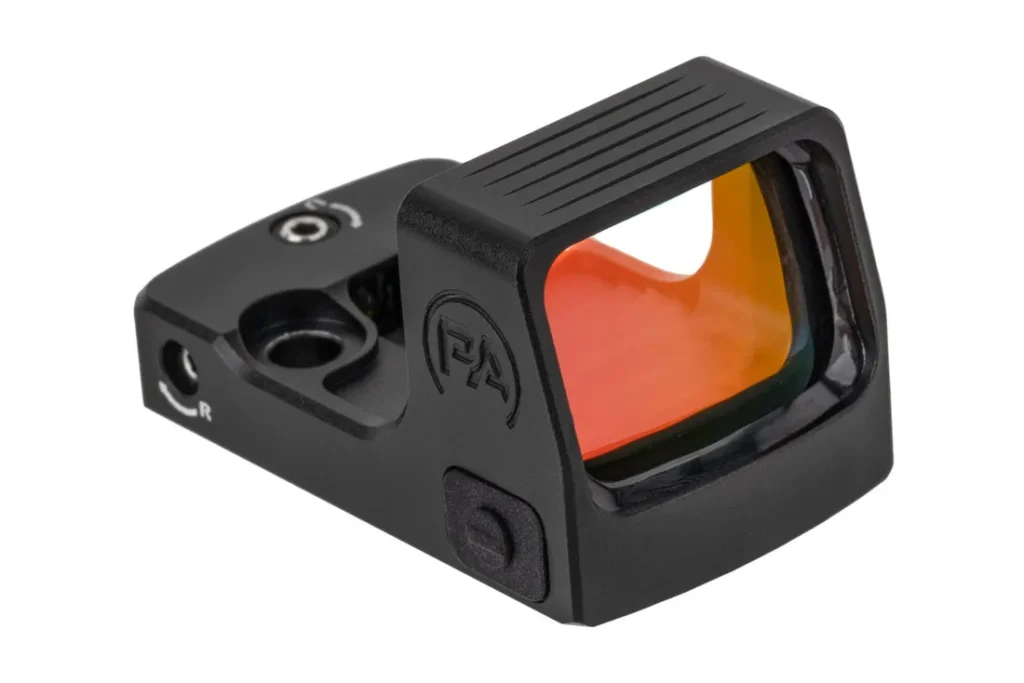
Primary Arms GLx RS-15 ACSS Vulcan Reticle
Unique Reticle
Good Window Size
Lifetime Warranty
MSRP: $359.99
Our Favorite Compact Pistol Red Dot Sights


Best Pistol Red Dot Sights
Since there are two distinct sizes of handguns, we have broken this down into “full size” and “compact” red dots. Full-size red dots fit on full-size slides like the Glock 19 and Walther PDP. Compact red dots fit on compact slides like the Glock 43X MOS and the Sig P365.
For a better understanding of the different sizes of red dots, see our red dot footprint guide.
The reviews below explain why I picked each optic and where I think it falls short. If you’re only comparing options for a Sig P365, start with our guide to the best red dots for the P365.
Best Full-Size Pistol Red Dot Sights
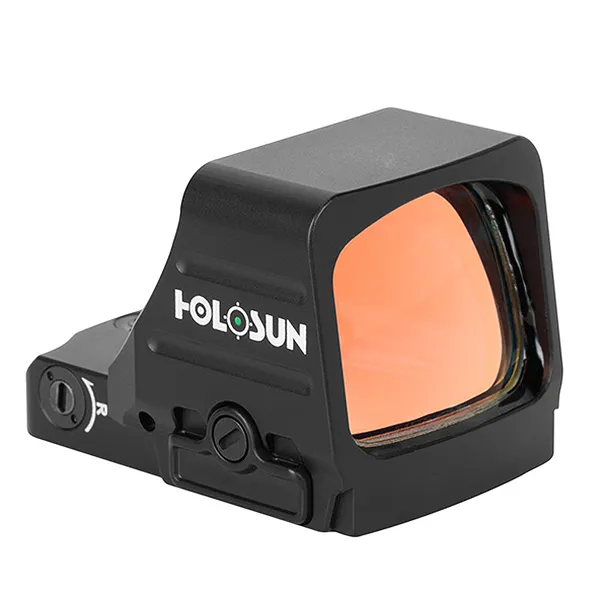
Holosun HS507C with ACSS Vulcan Reticle – Best Full-Size Red Dot for CCW
Verdict: If you carry a full-size handgun, this is the fastest “find the dot” optic we’ve tested, especially from awkward positions or under stress.
- Size: Full Size
- Footprint: RMR
- Window Size: 0.92″ X 0.65″
- Reticle: ACSS Vulcan (Selectable 10 MOA Chevron and 250 MOA Circle)
- Brightness: Auto or Manual, 10 Levels (2 for Night Vision)
- Emitter Type: Open
- Battery Life: 20,000 Hrs (with Chevron Only)
- MSRP: $319
The Holosun HS507C-X2-ACSS is the full size best red dot for concealed carry that we have tested.

This red dot is the same as the very popular 507C, but it adds a special reticle that we found is excellent for shooting from awkward positions or under duress.
The reticle has a large 250 MOA circle with a small chevron at the aim point. With the chevron on target, the circle disappears around the perimeter. When I move the point of aim off center, the circle starts to appear. The end effect of this is I can “find the dot,” or the point of aim, even when I am way off center.
That matters for a CCW since I could be in a position I am normally not in. While I try to train in various positions, I found it did help me aim quicker when I was lying on my side, for example. I can turn the outer circle on and off if I want, too, so there really isn’t any reason to get the standard 507C. The only reason I would want to turn it off is to save battery life.

In addition to the reticle, this red dot has all of the other features I look for, plus more. It has water drain holes around the emitter, a beefy housing with a rounded design that is easy to conceal in the appendix position, and a built-in solar panel as backup power. (Note that the solar panel does not charge the battery, but rather keeps the reticle on in sunlight if the battery dies.)

It also has a side-mount battery tray, which means that I do not have to remove the sight from my handgun to change the battery. Plus, it is waterproof.
One other feature that stands out to me over other red dots is the brightness modes. In Auto, the red dot will use the solar panel when light conditions are bright enough to conserve the battery. It will also automatically dim the reticle in dark conditions.

I find this very helpful for a CCW since I never know what conditions I will be in. With other red dots, if I set the brightness to where I can see it on a sunny day, it is much too bright in a dark room at night.
The base of this red dot is thin enough that I can lower co-witness my back up sights easily. Other red dots with thicker bases make this difficult.

The only real negative is the battery life. It is only around 5,000 hours when running the full reticle. But, it also has “shake awake” to conserve the battery when there is no movement. Even if I wear my CCW and move around for 12 hours every day, this is still over one year of battery life.
Recommended for:
The Holosun HS507C-X2-ACSS is for anyone who has a full-size handgun as their CCW and wants the best red dot. The reticle and brightness modes set this one apart.
PROS
ACSS Vulcan Reticle
Solar Backup
Auto Brightness
Waterproof
Water Drain Holes
CONS
Battery Life with Full Reticle
Holosun 507 Comp – Best Pistol Red Dot for Competition
Other Buying Options: Brownells – Optics Planet
Get 10% off at Optics Force with code “SURVIVAL”
Verdict: If you want a large view window and versatile reticle for competition or training, the 507 Comp delivers performance that rivals much more expensive optics.
- Size: Full Size
- Footprint: RMR
- Window Size: 1.1” x 0.87”
- Reticle: Multi-Selectable (2 MOA dot, 8 MOA circle, 20 MOA circle, 32 MOA circle) Red or Green
- Brightness: Manual, 10 Levels (2 for Night Vision)
- Emitter Type: Open
- Battery Life: 50,000 Hrs
- MSRP: $435
The Holosun HS507COMP is a new red dot from Holosun for full-size handguns where maximum window size and customizable reticles matter most.
Right away I was struck by how large the viewing window is. The only optic I’ve used with a comparable view is the Trijicon SRO, which is slightly taller and round. The 507 Comp, however, has a more square-like window with a domed top that lets you see more of your target and your dot during movement.

On matches and dynamic drills, that larger field of view made a noticeable difference. Instead of the dot moving out of view as my gun moved, I could keep it in view more consistently. That’s huge for tracking and follow-up shots, and it’s also a great training tool for learning how your pistol tracks through a stage.
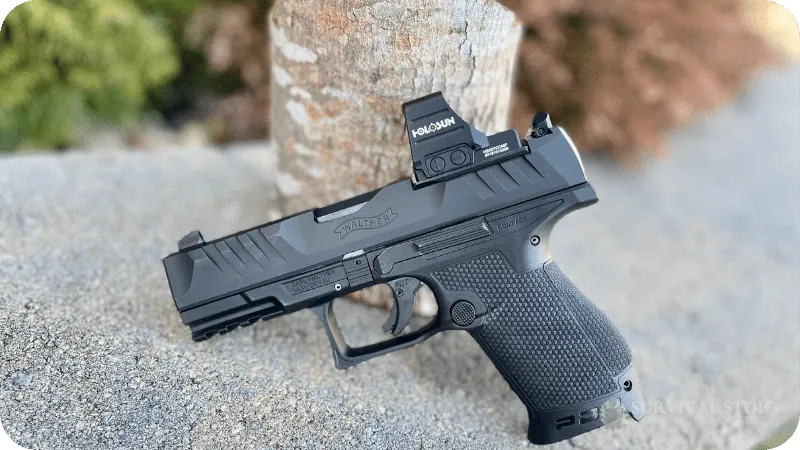
Another standout is the selectable reticle. You can pick between a simple 2 MOA dot or any of three circles, or dot + circle combinations. My favorite is the dot with the largest circle. The circle draws my eye in and helps me quickly center the dot when I’m off-center.

This red dot is IP67 rated, so it is waterproof, not just water resistant. The battery is in a side-mounted tray, so I can change it without removing it from the slide of my handgun.
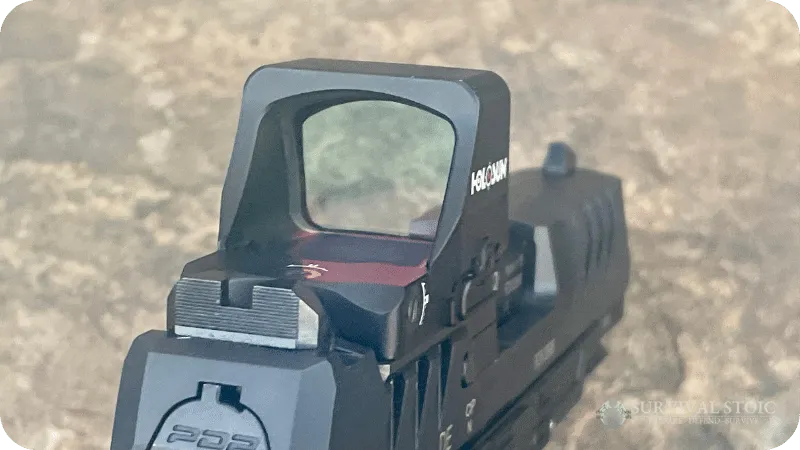
The housing is 7075-T6 aluminum, with thick, rounded top corners that give the lens solid protection. It feels durable, and I’m not worried about everyday knocks and drops.
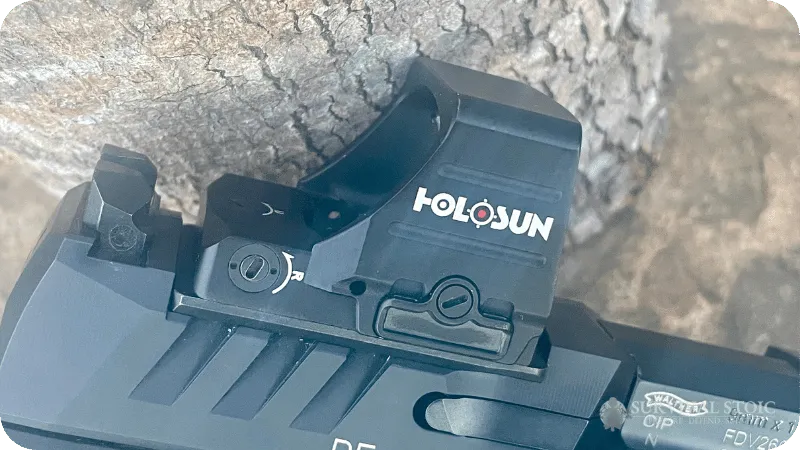
The only downside I found is size. It’s about 0.20″ taller than most full-size red dots, and with its square profile it protrudes more than other optics. For competition that’s no issue, but for concealed carry it can be noticeable depending on your holster and carry method. On my Walther PDP with a CYA Supply holster (one of the best appendix holsters), I didn’t have any serious printing issues, but it was more than with slimmer optics.
Recommended for:
The Holosun 507 Comp is ideal for anyone who wants a competition-ready red dot with a big viewing window, flexible reticle options, and solid durability without paying SRO prices.
PROS
Huge viewing window
User Selectable Reticle
Water Drain Holes
IP67 Rated
CONS
Large Size than Typical RMR
Protrudes More on Carry Guns
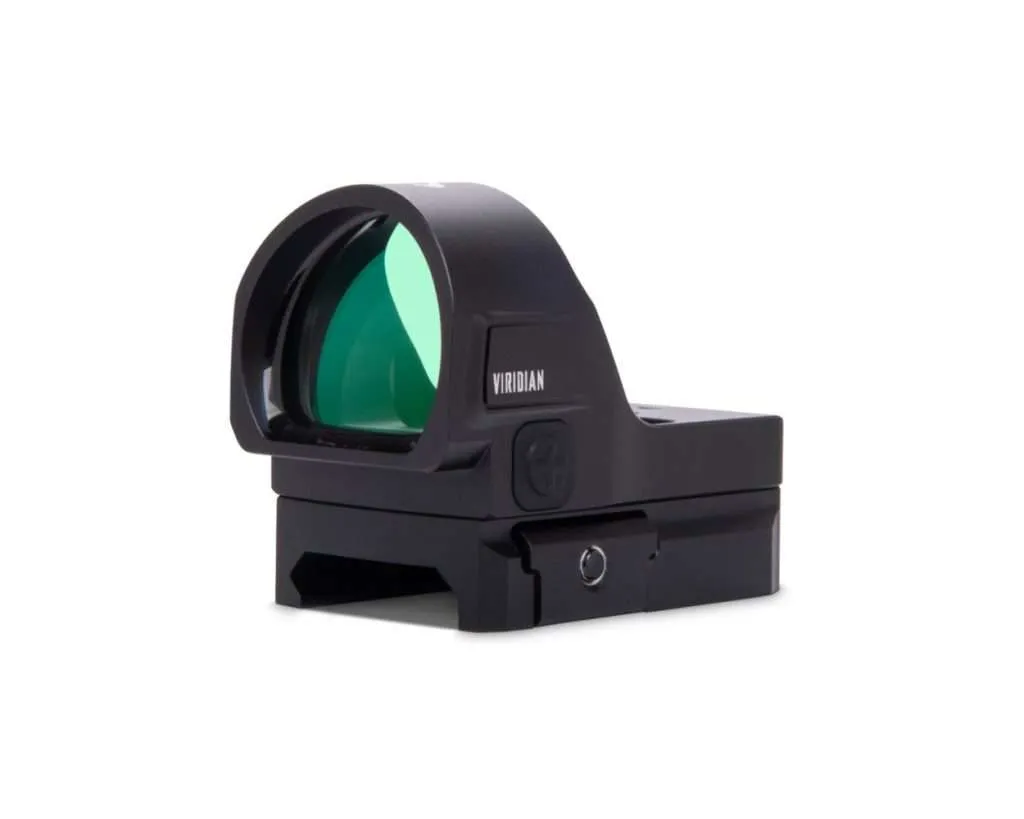
Viridian RFX35 – Best Value Full-Size Red Dot
Verdict: If you want a large viewing window and solid performance without breaking the bank, the RFX35 delivers one of the best value-for-money reflex sights on a full-size pistol.
- Size: Full Size
- Footprint: RMR
- Window Size: 0.86” x 1.03”
- Reticle: Green 3 MOA Dot
- Brightness: Manual, 10 Levels (2 for Night Vision)
- Emitter Type: Open
- Battery Life: 30,000 Hrs
- MSRP: $289
The Viridian RFX35 Green Dot Reflex Sight is a great full-size pistol reflex sight that stands out because of its size and price. While we use “red dot” as a generic term for mini reflex sights, this Viridian uses a green dot, and it works.

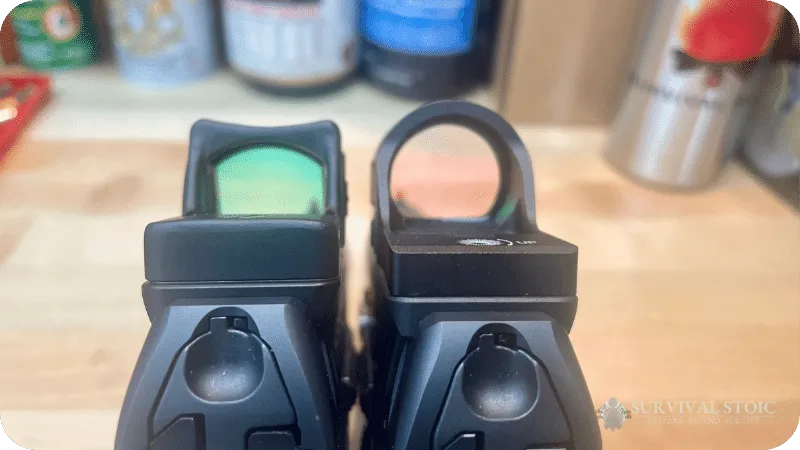
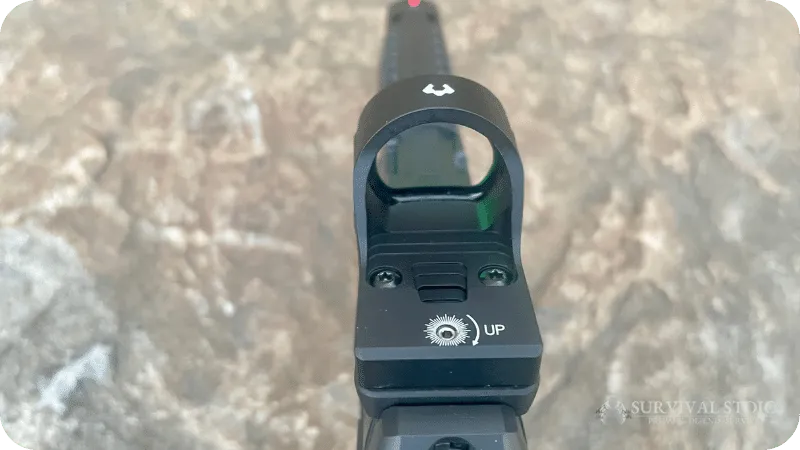
What I like most about this sight is the large viewing window. The shape is more rounded compared to square optics like many Holosun models, and that gives you a very open sight picture. In practice, this makes tracking your dot and target easier, especially on dynamic drills where movement matters.
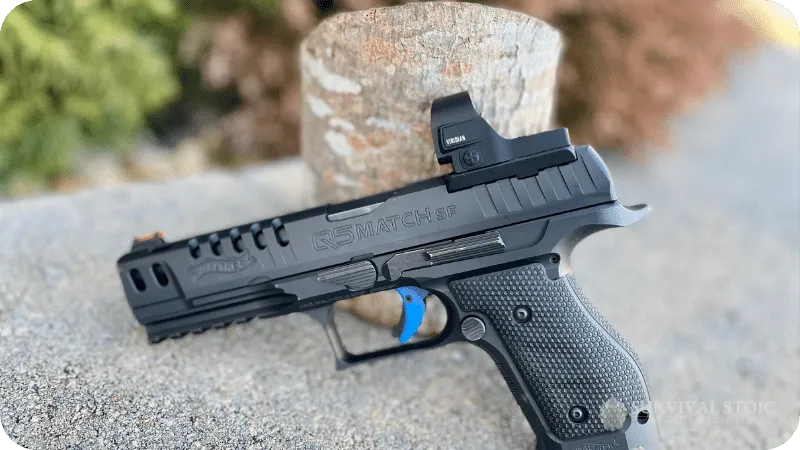
Mounted on my Walther Q5 SF, the RFX35 didn’t feel visually smaller than some optics that cost hundreds more. The low-profile base keeps the overall height down, so even with the wide window, you still get plenty of room for co-witnessing iron sights when you want them.
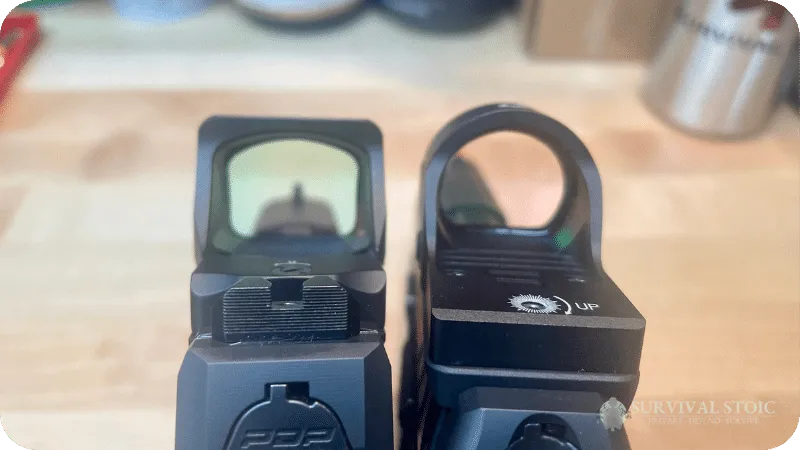
While the listed window dimensions suggest it’s slightly smaller than the Comp model above, the effective viewing area feels generous thanks to that rounded shape. The dot itself was crisp and clear throughout bright sunlight and nighttime. And while green may not be a magic bullet, it did seem easier to see outside than some red dots I’ve used.
The aluminum housing feels robust, and the rounded edges help deflect impacts if the sight gets knocked around. That said, zero adjustments require a hex key, and there are no tactile clicks, so dialing in your zero took a little trial and error.
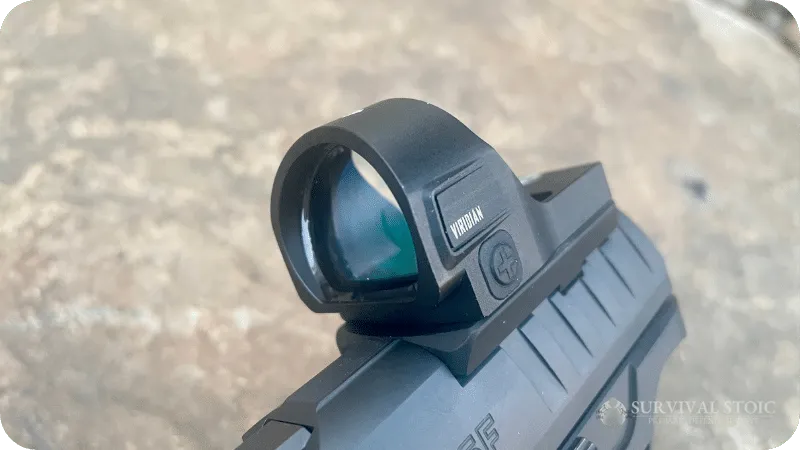
This sight does include a rubber cover and Picatinny rail mount in the box, perks many optics don’t include.
Recommended for:
The Viridian RFX35 Green Dot Reflex Sight is for shooters who want a large window and solid performance at a compelling price, whether for competition use or as a budget-minded alternative to pricier optics.
PROS
Large Window Size
Low Profile Base (Easy Co-witness)
Affordable
Lifetime Warranty
CONS
Buttons on Both Sides (Not Recessed)
No Tactile Clicks on Zero Adjustments
Primary Arms GLx RS-15 ACSS Vulcan Reticle– Best Red Dot for Glock MOS
Verdict: If you run a Glock MOS full-size pistol, this is one of the most shooter-friendly red dots we’ve tested: outstanding window size, a smart reticle, and a lifetime warranty.
- Size: Full Size
- Footprint: C-More (comes with Glock MOS Mount)
- Window Size: 1.04″ x 0.76″
- Reticle: ACSS Vulcan (Selectable 3 MOA dot and 250 MOA Circle)
- Brightness: Manual, 13 Levels (3 for Night Vision)
- Emitter Type: Open
- Battery Life: 25,000 Hrs (5,000 with full Reticle)
- MSRP: $359.99
The GLx RS-15 is the latest red dot from Primary Arms, and it stands out in the full-size class by combining a large sight window with one of my favorite reticles for rapid sight acquisition and stress shots.

This dot uses the ACSS Vulcan reticle, similar in concept to the Holosun models above, but with a 3 MOA dot instead of a chevron paired with the big 250 MOA circle.

What I found happens in real use is straightforward: when your dot is near the center of the window, the circle disappears, and you focus on the dot, but when your aim is off-center, that big circle starts to show, giving you intuitive feedback and helping you correct faster.

I installed this on a Glock 34 MOS and found the window is noticeably larger and the housing thinner than many red dots in this price range. That produces a clean sight picture and makes finding the dot easier in training and on the clock.


The battery design is unique too: instead of a side tray, it uses a top screw-cap lid for the standard CR2032. There are fewer moving parts than tray systems, and I’ve found this feels more solid and reliable over time.

Like many modern red dots, the GLx RS-15 is waterproof and has side drain holes so water doesn’t pool around the emitter and wash out your dot. For someone that runs drills in the rain or carries daily in unpredictable weather, that gives peace of mind.

The mounting footprint of this red dot is the C-More standard. This footprint is more common in larger 2011 style competition guns, and not so much in duty or concealed carry guns. However, it ships with a Glock MOS mounting plate, so it will mount up to any full-size Glock MOS, like the 17 or 19. (It will not mount up to a G43X MOS or G48 MOS, though; those need a compact red dot.)
I was unable to find an adapter plate for my Walther PDP at the time of this writing, though C-More says they are working on one. I did find one for my Walther Q5 match guns, though. If you have anything besides a Glock MOS, make sure you can adapt it to this mount before buying (see the Holosun 507C with a similar reticle instead.)
A few little things stand out as well: the buttons are recessed and protected, though a bit small to actuate, and the optic comes with a lifetime warranty through Primary Arms.

There are a few minor negatives worth pointing out. In certain indoor lighting (like bright LED strips), I saw slight ghost reflections around the reticle, not enough to ruin a drill, but noticeable. And while the battery life is solid with the dot only, it drops when the full reticle is engaged, something to keep in mind if you run the circle constantly.
Recommended for:
The Primary Arms GLx RS-15 red dot is ideal if you want a large window + adaptive reticle on a full-size Glock MOS handgun. It works equally well for competition and everyday practice.
PROS
ACSS Vulcan Reticle for intuitive target acquisition
Large Sight Window with thin housing
Waterproof with water drain holes
Lifetime Warranty
CONS
Ghost Reflections in Certain Indoor Lighting
Small Buttons
Reduced Battery Life with Full Reticle Engaged
Primary Arms Classic Series Mini Reflex Sight – Best Budget Full Size Red Dot
Verdict: If you want a capable full-size reflex sight under $150, this one punches well above its price and is our top budget pick.
- Size: Full Size
- Footprint: RMR
- Window Size: 0.94” x 0.69”
- Reticle: Red 3MOA Dot
- Brightness: Manual, 10 Levels (2 for Night Vision)
- Emitter Type: Open
- Battery Life: up to 50,000 hours
- MSRP: $149
The Primary Arms Classic Series Mini Reflex Sight is our pick for the best budget pistol red dot; a sight that proves you don’t have to spend a fortune to get a usable, durable optic on a full-size handgun.
At less than $150, you might expect something flimsy, but this Mini Reflex doesn’t feel cheap.
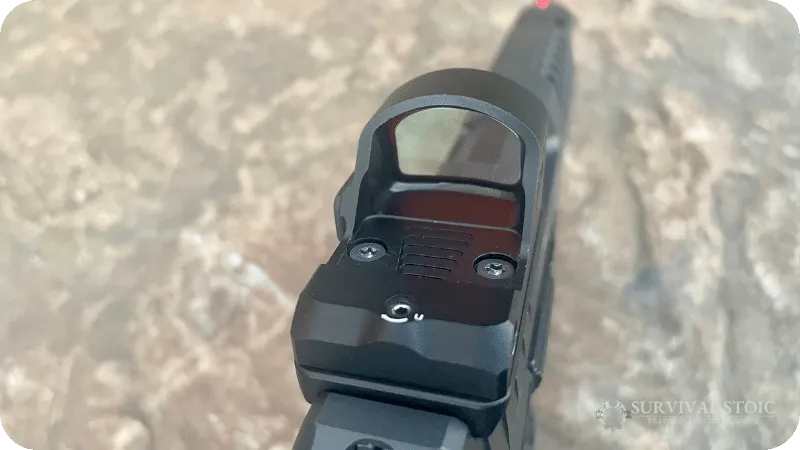
The housing is 6061-T6 aluminum, the dot is crisp, and the window size is respectable for the price. On the range, it behaved far better than many other budget reflex sights I’ve seen.
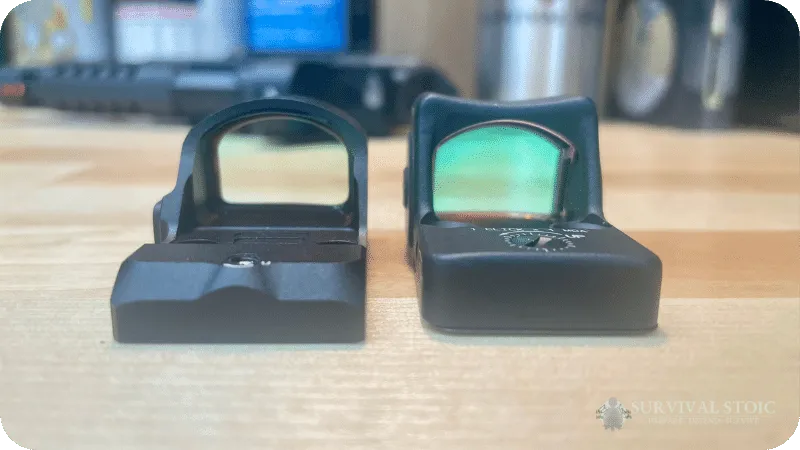
This sight’s low-profile base makes co-witnessing iron sights easy, the dot held steady through multiple sessions, and the lifetime warranty from Primary Arms adds another layer of confidence that most sub-$200 optics don’t offer.
One quirk worth noting was the power save feature on early units: after ~12 hours, the dot would shut off and require a button press to re-activate. That’s not ideal for carry setups where you want the optic on when you need it. Update: the Gen 2 now has auto-on, so you no longer have to press a button to wake it up — a nice improvement.
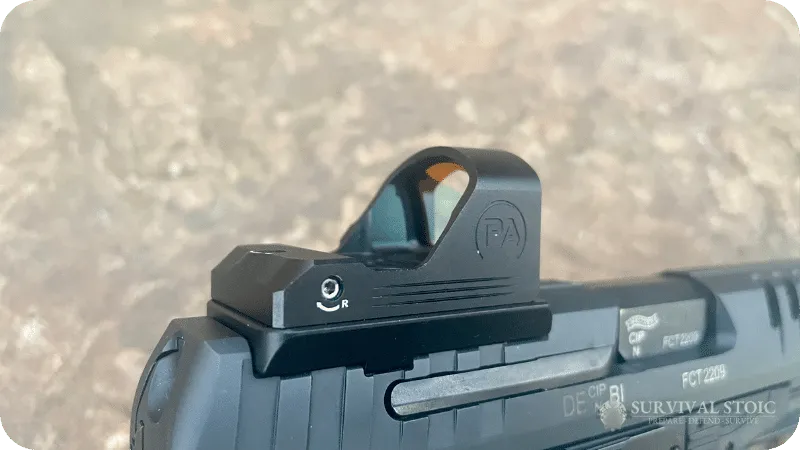
There are some limitations to be aware of: the buttons do stick out and aren’t as refined as higher-end models, though they’re covered by rubber for protection. Full brightness in direct sun isn’t quite as strong as more expensive units (it’s OK, not great), but still workable on most days.
Zeroing is straightforward, but this sight doesn’t have tactile clicks on the adjustments, so dialing in takes a bit of trial and error. Still, at this price with a lifetime warranty and a solid footprint, it’s a great entry point into pistol red dots.
Recommended for:
The Primary Arms Classic Series Mini Reflex Sight is for anyone who needs a functional, affordable red dot for a full-size handgun, especially training guns or budget builds where you don’t want to overspend.
PROS
Decent Window Size for Price
Affordable
Lifetime Warranty
Low-Profile Base (Easier Co-Witness)
CONS
Brightness Isn’t as Strong as Premium Optics
Buttons Stick Out
No Tactile Clicks on Adjustments
Best Compact Pistol Red Dot Sights

Holosun HS507K-X2-ACSS – Best Compact Red Dot
Verdict: If you carry a compact handgun like the P365 or 43X, this is the easiest pistol dot we’ve used for consistently finding the reticle under stress.
- Size: Compact
- Footprint: Holosun K
- Window Size: 0.58” x 0.77”
- Reticle: ACSS Vulcan (Selectable 3 MOA Dot and 230 MOA Circle)
- Brightness: Manual, 12 Levels (2 for Night Vision)
- Emitter Type: Open
- Battery Life: 40,000 Hrs (with Dot Only)
- MSRP: $329.99
The Holosun HS507K-X2-ACSS is our top pick for the best compact red dot for concealed carry.
We’ve been using variations of this red dot for years. What makes this one stand out is the ACSS Vulcan reticle.

This reticle is similar to our favorite full-size red dot above, but instead of a chevron it uses a 3 MOA dot. The outer circle is slightly smaller (230 MOA vs 250 MOA) and it’s a dashed line instead of solid, but functionally, it works the same.
When my presentation is good, and the dot is centered, I don’t see the circle at all. But when my aim is off, that big circle starts to appear and tells me exactly which direction I need to move the gun. At about 10 yards, I can be off target by roughly two feet and still see part of the circle in the window.
This is huge for me when I am aiming from an awkward position and under duress. And let’s face it, in a defensive situation, that is probably what I will be facing.

The housing is made from 7075-T6 aluminum, and it is noticeably beefy around the lens. The inside corners are rounded, which helps with stress relief under shock and makes it more durable without being intrusive in the sight picture.
I like that it is IP67 rated, which means it is guaranteed to be waterproof, not just water-resistant to a certain depth.
The battery tray is on the side, so I can easily change the battery without removing it from the slide. The buttons are small, but I like that they’re recessed and protected.

There is also a small rear sight notch built into the back of the optic. On my P365 XMacro and P365 XL, it does co-witness, although it’s a very low co-witness. I can’t see the full front sight post, but I can see the top of it, which means I still have a usable backup aiming method if the dot ever fails.

One important note: this uses the Holosun K footprint. It bolts directly to the Sig P365, but if you’re running a Glock or Hellcat, you’ll need an adapter plate (or slide modification).
This red dot is very similar to the Holosun 507K-X2 and the Holosun 407K-X2. The main differences are the reticle and price. The ACSS reticle is absolutely worth it in my experience, and you can always turn off the outer circle to conserve battery life if you want.

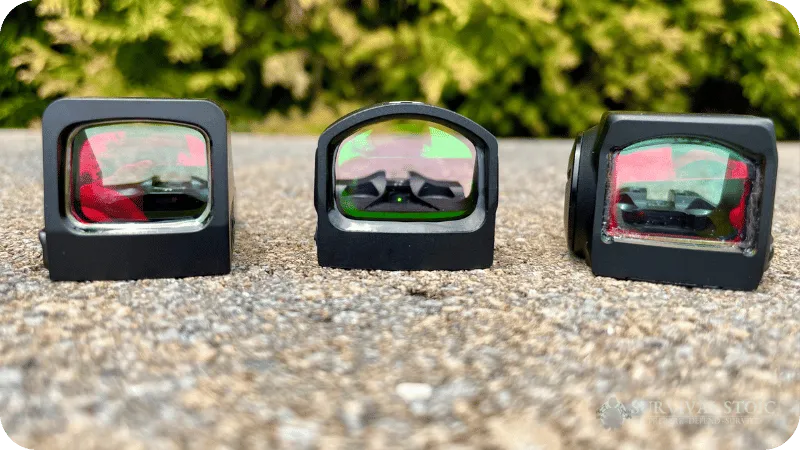
Recommended for:
The Holosun 507K-X2-ACSS red dot is for anyone who carries a compact pistol for concealed carry and wants the fastest, most forgiving red dot for real-world presentations.
PROS
ACSS Vulcan Reticle (very easy to find the dot)
Side Battery Tray
Durable 7075-T6 Housing
IP67 Waterproof
Rear Backup Sight Notch
CONS
K Footprint (Not RMSc)
Battery Life Drops with Full Reticle Enabled
Viridian RFX15 – Best Value Compact Red Dot
Verdict: If you want a big viewing window and easy aim on a compact handgun without spending a fortune, the RFX15 is one of the most user-friendly compact dots I’ve used.
- Size: Compact
- Footprint: Shield (RMSc)
- Window Size: 0.94” x 0.67”
- Reticle: 3 MOA Green Dot
- Brightness: Manual 8 Levels (2 for Night Vision)
- Emitter Type: Open
- Battery Life: 30,000 Hrs
- MSRP: $289.00
The Viridian RFX15 is one of my favorite compact red dot pistol sights, and not just because it’s affordable. What really sets it apart from a lot of other compact optics is the large viewing window, which in practice feels almost as big as some full-size red dots.

The window is almost 25% larger than the Sig Sauer Romeo X. When I used this red dot, I noticed how clear my sight picture was. The aluminum housing is low profile around the lens, so my field of view is better than the Holosun or Sig red dots.

When I mounted the RFX15 to my P365, the sight picture was noticeably clearer and more open compared to other compact dots. The aluminum housing has a low profile around the lens, which improves field of view even more and makes transitions feel smoother.
I tend to prefer rounded designs when carrying in the appendix position, because sharp corners can print more against your body. The RFX15’s rounded top helps it sit a little closer with less print: a subtle but real advantage on carry guns.
The green dot shows up well in both bright daylight and low light. Yes, science says green can be more visible to the eye than red, and while I haven’t found it to be a huge difference, on bright days it definitely felt easier to pick up at a glance.

One feature I really like is the built-in rear sight notch. On guns like my P365XL, mounting a red dot usually meant losing the iron rear sight, but with the RFX15, the built-in notch lined up perfectly with my front sight for a functional low co-witness. That’s a practical benefit you don’t get on most compact dots without installing aftermarket sights.
On the downside, the buttons are on both sides of the housing and not recessed, so they’re more exposed. Because this sight just barely hangs over the edge of my slide, those buttons sit in a place where they could get bumped.

The zero adjustments also require a hex key and lack tactile clicks, so tuning it in took a little trial and error.
Also, the bottom-mounted battery means you have to remove the sight from the slide to change it, which isn’t a big deal for range guns but is less convenient for carry setups.
But despite those quirks, the overall experience is very positive: a large window, solid dot visibility, and a very beginner-friendly sight picture.
Recommended for:
The Viridian RFX15 is for anyone who wants a large viewing window on a compact handgun at a fair price, especially shooters who value clarity and easy dot acquisition over bells and whistles.
PROS
Large Viewing Window (excellent field of view)
Low-Profile Housing
Easy to See Dot (green)
Built-in Rear Backup Sight
Affordable
CONS
Buttons Not Recessed
Zero Adjustments Require Hex Key (no clicks)
Bottom-Mounted Battery (less convenient)
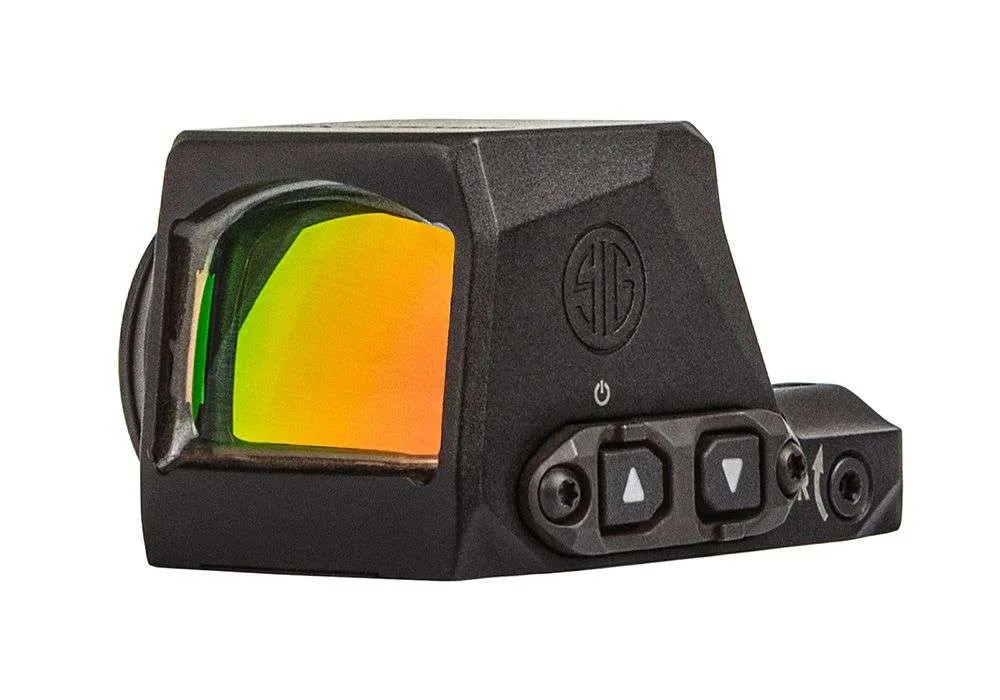
Sig Sauer Romeo X-Compact – Best Red Dot for the Sig P365
Other Buying Options: Brownells – Optics Planet – Palmetto State Armory
Get 10% off at Optics Force with code “SURVIVAL”
Verdict: If you run a Sig P365 or similar RMSc-ready compact pistol, the Romeo X-Compact combines a big window, selectable reticle, and practical built-in sights into one of the best all-around compact optics we’ve used.
- Size: Compact
- Footprint: Shield RMSc
- Window Size: 0.81” x 0.62”
- Reticle: Red 2 MOA dot and/or 32 MOA circle, selectable
- Brightness: Manual, 15 Levels (3 for Night Vision)
- Emitter Type: Open
- Battery Life: 20,000 Hrs
- MSRP: $399.99
The Sig Sauer Romeo X-Compact is the newest compact red dot from Sig and earns its place as the go-to choice for P365 shooters, especially those who want more than just a dot on a carry gun.
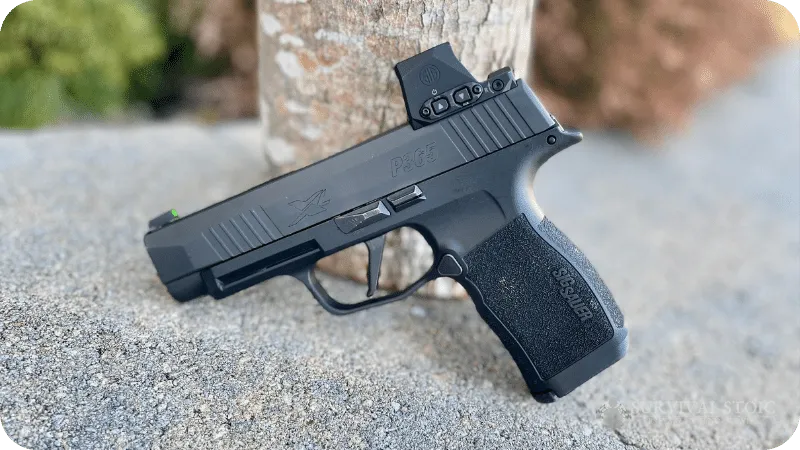
What immediately stands out is how surprisingly large the viewing window feels for a compact optic. Sig’s spec gives the lens size, but the effective window really matters when you’re drilling transitions and presenting quickly, and on that front, the Romeo X-Compact delivers.
The selectable reticle is another highlight. You can run just the small 2 MOA dot for precise aiming, the 32 MOA circle for rapid alignment, or both together for a hybrid that helps you find the center faster under stress. I’ve found the circle-plus-dot combo especially good for getting on target quickly in dynamic drills.
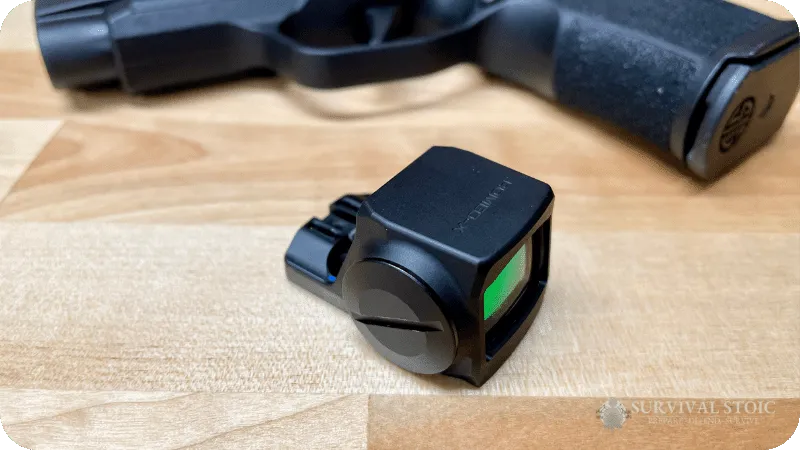
The housing is made from 7075 Aluminum and is extended to almost look like a closed emitter optic, but it is an open emitter. The box-shaped design with rounded corners inside gives it strength to protect the lens. It feels beefy but is not overly intrusive on my sight picture. I do find it makes it harder to clean the inside of the lens, though.
One practical advantage this optic has over many others in the compact class is the built-in rear backup sight. Since RMSc-footprint slides (like the P365 family) lose rear iron sight when the optic goes on, having this integrated low-co-witness sight is a real convenience. It works without swapping plates or aftermarket sights.
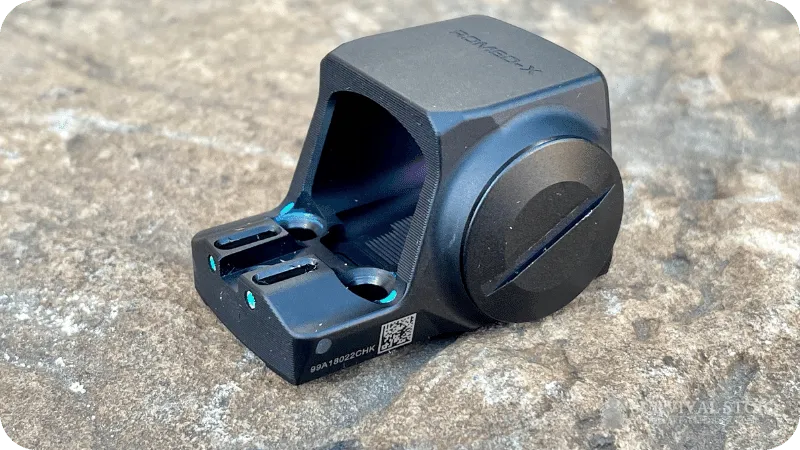
The rear sight even has fiber optic inserts. While I prefer just a black sight for backup, since these sit so low, they do not make my sight picture too busy.
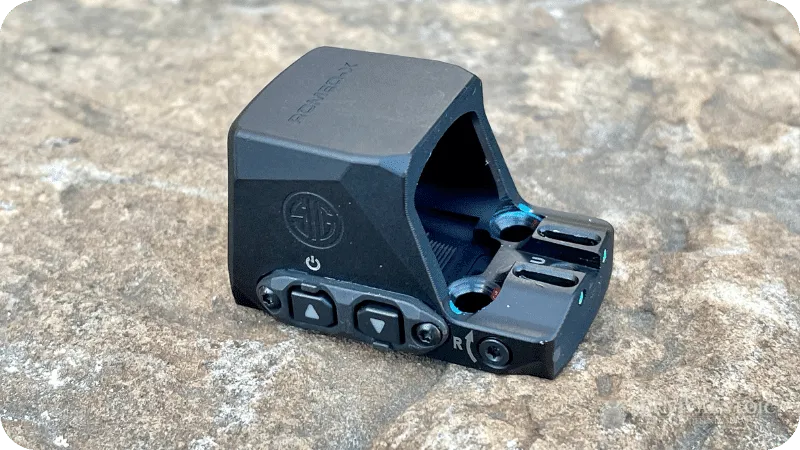
Buttons on the Romeo X are easy to reach but do stick out more than I’d like, and the battery cap on the side makes the right side of the sight thicker in the sight picture. Neither is a deal-breaker, but they’re worth noting for carry guns where snag and profile matter.
Otherwise, performance is very solid: reliable dot brightness across lighting conditions, excellent clarity, and an overall feel that’s confident and user-friendly out of the box.
We’ve also reviewed other red dots for the P365.
Recommended for:
The Sig Sauer Romeo X red dot is for anyone who wants a compact red dot that’s specifically tuned for RMSc-ready pistols like the P365 family. It’s great for carry and general use with built-in backup sights.
PROS
Large Window Size
User Selectable Reticle
Beefy Housing
Built-in Backup Sight
CONS
Battery Cap Adds Width to One Side
Buttons Stick Out More Than Ideal
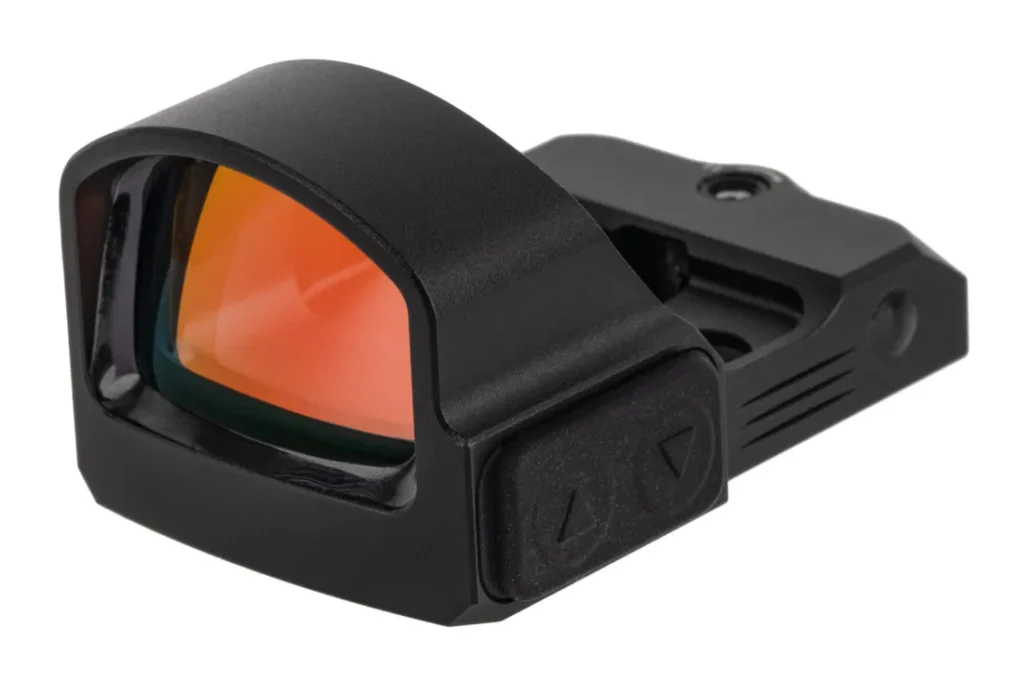
Primary Arms Classic Series Micro Gen 2 – Best Budget Compact Red Dot
Verdict: If you want the most affordable compact red dot that still works well as a carry optic or range companion, the Classic Series Micro Gen 2 is hard to beat under $150.
- Size: Compact
- Footprint: Shield RMSc
- Window Size: 0.83” x 0.59”
- Reticle: Red 3 MOA Dot
- Brightness: Manual, 10 Levels
- Emitter Type: Open
- Battery Life: Up to 50,000 Hrs
- MSRP: $149
The Primary Arms Classic Series Micro Reflex Sight is the compact counterpart to the full-size Mini, a true budget reflex sight that still gives you usable performance on compact pistols.
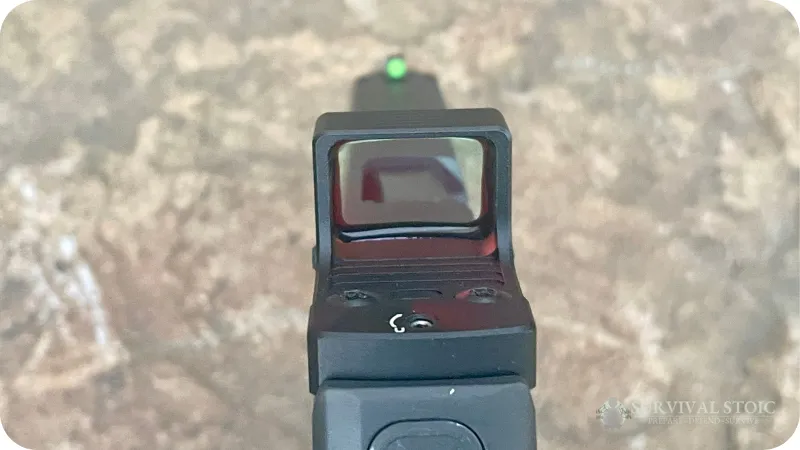
Just like its bigger sibling, this Micro sight uses a 6061 aluminum housing that feels solid, not flimsy. The square window maximizes sight area without making the optic wider, helping give a surprisingly usable field of view for the money.
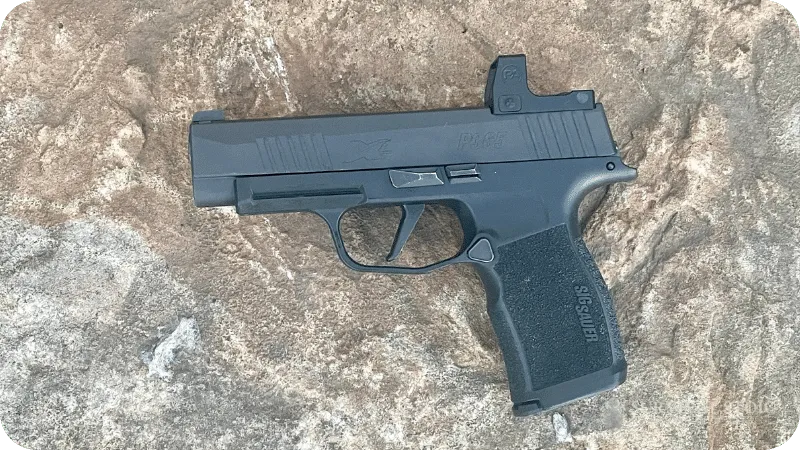
In real use I found the brightness at max was good enough for most daylight conditions, though it won’t blind you like premium optics. The dot itself was crisp and the sight performed fine in low-light situations once dialed in.
Buttons sit on both sides of the housing and are pretty small, so you’ll often use your fingernail to actuate them, not a big deal on the range, but something to remember if you’re trying to adjust on the fly.
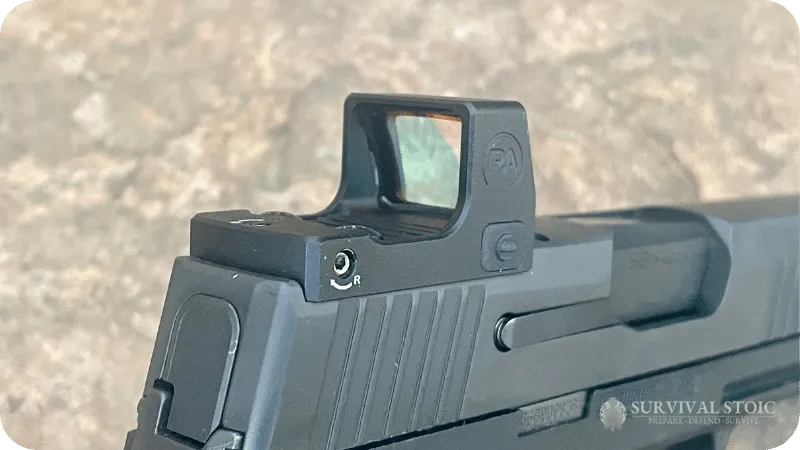
There’s no integrated rear backup sight, which means on many compact guns (like the Sig P365XL) you lose iron-sight fallback when the optic goes on; something to plan for if you care about having backups.
Like its full-size sibling, this Micro unit includes an auto-off feature: after about 12 hours it turns off and you have to press a button to wake it back up. The Gen 2 adds auto-on, so once it sleeps you don’t have to drag it awake every time, a nice quality-of-life improvement.
Zero adjustments require a hex key, and like many budget dots there aren’t tactile “clicks,” so dialing in zero takes some trial and error. That said, the lifetime warranty and price make this a great starter optic or backup dot if you’re on a tight budget.
Recommended for:
The Primary Arms Classic Series Micro Reflex Sight is ideal if you want a functional, affordable compact dot that’s especially good for range use, practice guns, or shooters new to reflex sights.
PROS
Affordable
Lifetime Warranty
Aluminum Housing
Decent Window for the Price
CONS
Brightness is Just “OK” in Bright Sunlight
No Integrated Backup Sight
Buttons are Small and Exposed
Which Pistol Red Dot Would I Buy?
For a full-size pistol, I’d buy the Holosun 507C ACSS. It’s the one I use on my daily carry gun, and the reasons I keep using it are covered in the review above.
The Holosun 507K ACSS is my general compact pick. For a Sig P365 specifically, I’d also consider the Romeo X Compact. That’s why I’ve given it a separate P365 recommendation rather than treating every compact pistol as the same choice.
The other optics here earned their places for different reasons. My favorite won’t necessarily be yours, but the drawbacks in each review should help you decide what you’re willing to live with.
Other Red Dots We Liked
Not every excellent red dot made our top tiers, but these stood out enough in real use that they deserve a mention, whether for durability or specific carry/competition roles.
Trijicon RMR Type 2
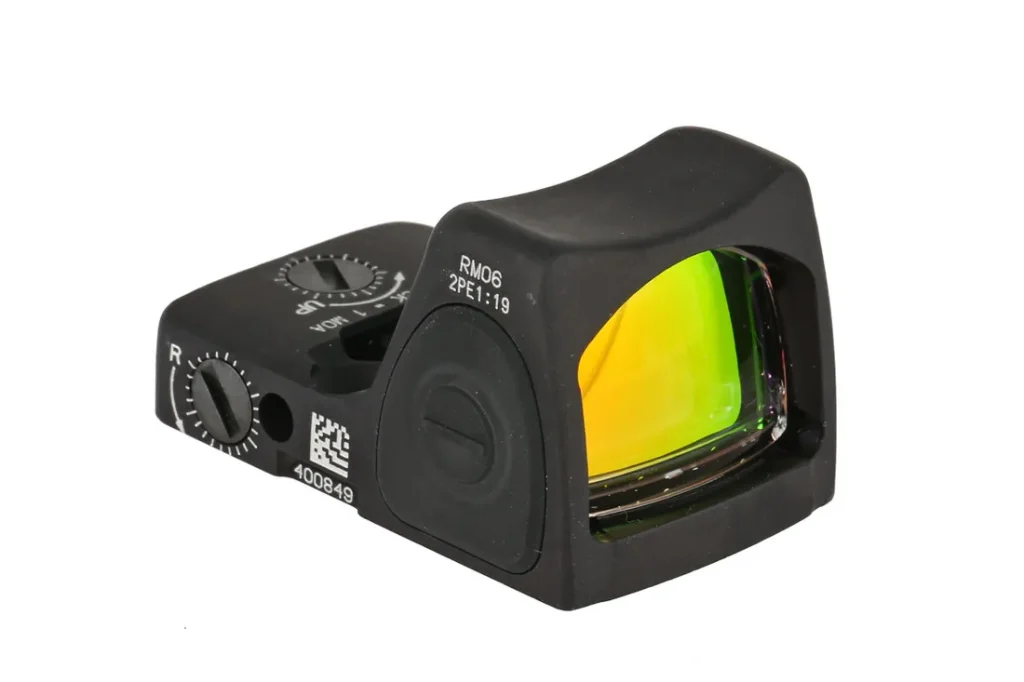
The Trijicon RMR Type 2 needs no introduction. It’s one of the original pistol red dots and still earns its reputation for sheer ruggedness. I’ve personally used an RMR on multiple duty and competition guns for years, and the durability is almost absurdly good. Drop it, beat on it, carry it hard, the Type 2 just keeps ticking.
But here’s where honesty matters: that durability comes with trade-offs that matter for non-duty use. The window feels smaller than many modern options, and on a Glock or PDP, it can actually seem more constrained than some compact reflex sights.
At twice the price of other reliable dots on this list, the cost/benefit leans toward “necessary only if durability is your #1 priority.”
PROS
Legendary toughness and field reliability
Trusted by military, LE, and high-volume shooters
Multiple reticle and battery variants
CONS
Small effective window size compared to competitors
High price for what most CCW/competition shooters actually need
C&H Precision EDC-XL

The C&H Precision EDC-XL is one of those optics that quietly punches above its price and utility. What makes it special is the combination of a selectable multi-reticle, solid build quality, and true direct-mount options for many popular pistol platforms, no adapter plate needed. That means a lower optic profile, fewer parts to check for torque, and a cleaner install overall.
In use, the large window and multi-reticle options (circle, dot, or both) make acquiring the dot intuitive once you’ve dialed it in. The built-in rear sight notch is a nice touch that most full-size reflex sights don’t offer, giving you some fallback if the dot ever fails.
That said, the base is a bit thicker than I prefer, and the thicker profile is noticeable in carry guns, so while I trust this one, it didn’t eclipse the Holosun or Viridian picks for everyday CCW.
PROS
True direct-mount options (MOS/DMO cuts)
Built-in rear backup sight
Selectable multi-reticle for versatility
CONS
Thicker base; not as sleek for carry
Battery not included in box
Viridian RFX11
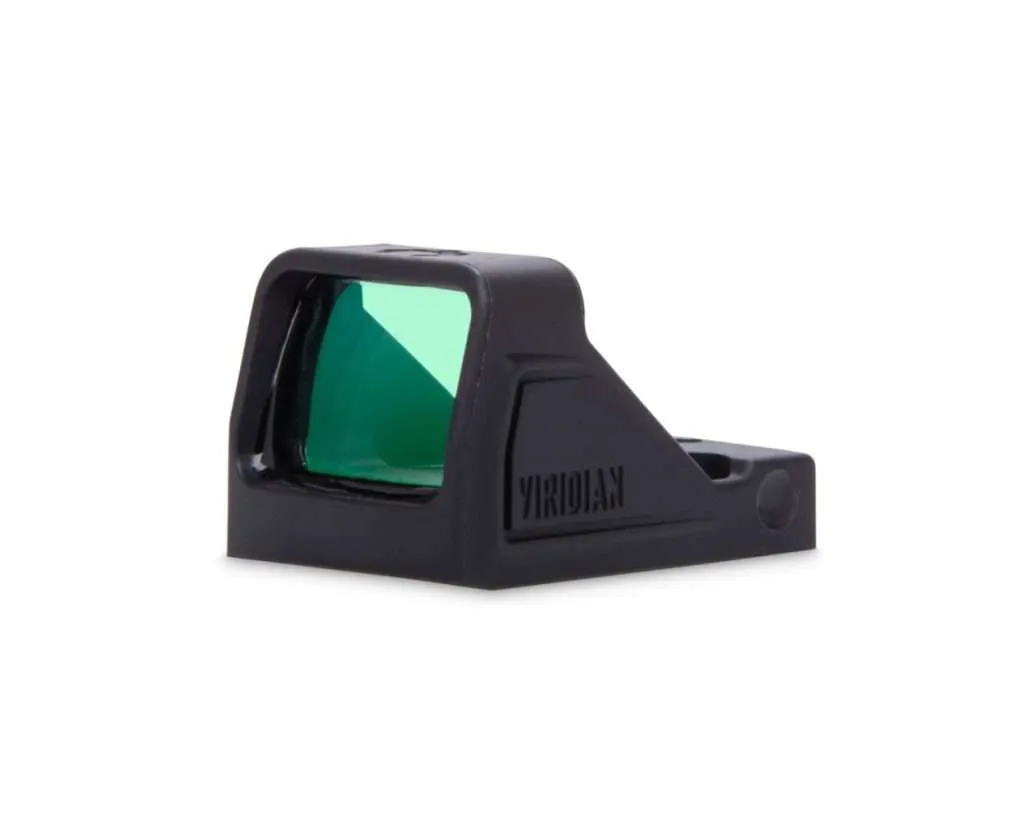
The Viridian RFX11 is a unique reflex sight that’s worth mentioning because it does a couple of things most other compact dots don’t, namely auto brightness adjustment and no buttons at all. It’s simple by design: the built-in light sensor automatically adjusts the dot’s brightness depending on ambient light, and because of that there’s nothing to bump or break.
On the range I found the green 3 MOA dot stayed visible in bright sunlight and didn’t go crazy in low light, which is exactly what a beginner or someone who doesn’t want to think about brightness settings is after. The lack of buttons also makes it less intimidating for shooters who’ve never used a red dot before.
That said, this simplicity comes with trade-offs. The housing is polymer, not aluminum, so it doesn’t feel as rugged as most of the other optics we tested, and I wouldn’t bank on it surviving a heavy drop on concrete.
There’s also no integrated backup sight, so on pistols that lose iron sights when you add a dot (like many RMSc slides), you’re left without any fallback if the dot fails.
In short: the RFX11 works and the auto brightness suits beginners or budget-focused shooters who don’t want to fuss with adjustments. It just doesn’t have the durability, refinement, or features we look for in the top picks.
PROS
Auto brightness works reliably
No buttons to break
Easy, straightforward dot visibility
CONS
Polymer housing feels less robust
No manual brightness control
No backup iron sight
Pistol Red Dots to Avoid
Not all pistol red dots are created equal. Some fail in obvious ways. Others fail in subtle ways that only show up after months of carry, recoil, weather, or battery changes. Here are the types of pistol red dots we actively avoid and why.
No-Name Budget Dots
If the company doesn’t have a real warranty or a real reputation, you’re gambling on a part that lives on a reciprocating slide.
What fails:
- Electronics die early or intermittently
- Brightness control glitches
- Dots flicker or shut off under recoil
If the brand disappears in a year, so does your “warranty.” On a carry gun, that’s unacceptable.
Auto-Brightness-Only Dots (For Carry Guns)
Auto brightness sounds great until the sensor guesses wrong, which happens more than people think in mixed lighting (dark shooting position; weapon light use).
What fails:
- Dot washes out in bright daylight
- Dot blooms too bright in dark rooms
- Dot becomes invisible when you need it most
Auto brightness is fine if the optic also has a manual mode. If it doesn’t, you’re trusting software to make a life-critical decision.
Ultra-Small Window Optics
Tiny windows dramatically increase the learning curve and make people think red dots “don’t work.”
What fails:
- Dot acquisition on draw
- Tracking during recoil
- Transitions between targets
Small windows aren’t “more tactical.” They’re just harder to use unless your presentation is already very consistent.
Optics With Fragile Battery Systems
Some dots use flimsy side trays or tiny caps that loosen over time.
What fails:
- Intermittent power
- Dot shuts off under recoil
A dot that turns off under recoil is worse than no dot at all.
Plate-Stacking Nightmares
The more adapter plates, spacers, and interfaces you stack, the more failure points you create. For information on what red dots fit what (and how to tell), read our guide on red dot footprints.
What fails:
- Screws loosen
- Plates shift
- Zero wanders
We’ve seen more than one red dot leave a slide at the range because of plate issues.
Spec Sheet Specials
Some optics look amazing on paper: huge battery life claims, exotic materials, celebrity reviews, impressive-sounding features, but no real track record.
What fails:
- Real-world durability
- Sealing against moisture
- Long-term electronics reliability
If nobody has run it hard for years, you’re the beta tester.
A pistol red dot lives on a violent, reciprocating, shock-heavy platform. This is one of the harshest environments in firearms. If an optic is cheap, over-complicated, poorly supported, or unproven, it will eventually fail.
For range toys, experimentation is fine. For carry or duty guns, boring and simple wins every time.
How We Tested Pistol Red Dots

We didn’t test these pistol red dots in a lab. We tested them the same way most people actually use them: on real carry guns, competition pistols, and training setups over several years.
This guide is the result of more than five years of combined use across multiple handguns, including Glock MOS pistols, Walther PDP and Q5 models, and several Sig P365 variants. Some of these optics have lived on guns that were carried daily, others have seen thousands of rounds in practice and matches, and a few have rotated between multiple slides during testing.
Here’s what our testing actually looked like:
- Timeframe: Tested over ~5 years, not a single weekend or short-term range trip
- Guns used: Glock 19/34 MOS, Walther PDP & Q5, Sig P365 XL & XMacro, and similar optics-ready pistols
- Use cases: Concealed carry, range training, and competition stages
- Round counts: Ranged from hundreds to several thousand rounds per optic over time, depending on the model and role
What We Evaluated
We focused on the things that actually matter on a pistol-mounted optic:
- Dot acquisition speed: How easy it is to find the dot on the draw, especially from imperfect presentations
- Window usefulness: Not just size on paper, but how usable the window is when shooting on the move or from awkward positions
- Brightness performance: Daylight visibility, low-light behavior, and whether auto modes make good decisions
- Reliability under recoil: Does the dot flicker, shut off, or lose zero over time?
- Battery system design: How easy it is to change, how secure it is, and whether it causes intermittent power issues
- Mounting security: Plate systems, screw retention, and whether anything loosens over time
- Carry practicality: Printing, snagging, and how the optic feels on a gun that’s actually worn all day
What We Did Not Do
- We did not perform artificial drop tests or lab-style torture tests.
- We did not rely on spec sheets or manufacturer claims to rank these optics.
- We did not include optics we only handled briefly or shot once.
If an optic is in this guide, it’s because we’ve actually lived with it on a gun.
Who Did the Testing
This guide reflects Jason’s and Blake’s personal testing and long-term use, along with feedback from other shooters we train and compete with. We also compare notes with other shooters at matches and defensive handgun courses to sanity-check our impressions against real-world use.
Our Philosophy
A pistol red dot lives on one of the most violent platforms in the firearms world — a reciprocating slide that slams back and forth thousands of times. So we care far less about marketing claims and far more about:
- Does it stay on?
- Does it hold zero?
- Is it easy to use under stress?
- Does it make shooting faster and more consistent?
That’s what this guide is built around.
Tips for Choosing the Best Pistol Red Dot
I have found that selecting the right red dot for my handgun is more complicated than any other aspect of my concealed carry or competition gear. Here are the tips we have learned over the years that will save you both time and money.
First, make sure you have read our iron sights vs red dot guide. There are some important tips in that guide that you need to understand before moving to this one.
Size and Footprint
Picking a red dot that will fit on a particular handgun is one of the most obvious and confusing steps at the same time.
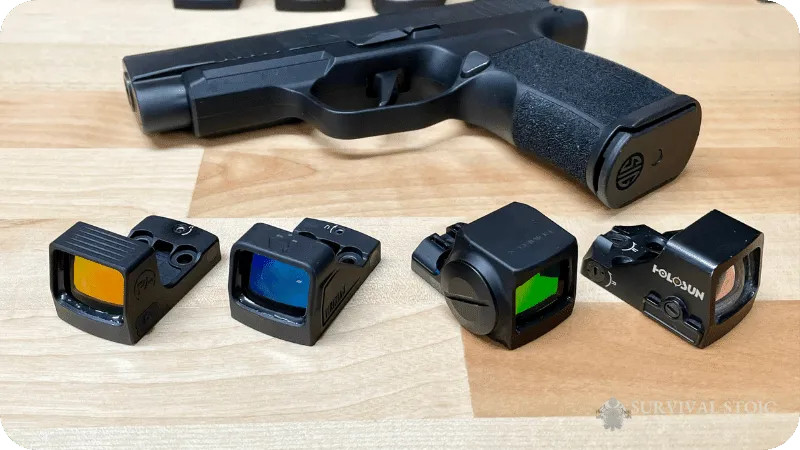
You must have an optics-ready handgun (outside of having your slide machined) and know the red dot size and footprint it will accept. Many handguns use adapter plates to make them flexible.
Window Size
The size of the sighting window dictates how close I have to be in presenting the handgun in front of my eyes in order to be able to see the dot. A larger window is easier and allows a larger margin of error.
At the same time, a larger window means the red dot is larger and may be harder to conceal depending on how what concealed carry position I use.
Full-size handguns will naturally be able to support a larger window versus a compact handgun.
I find a window of at least 0.6″ by 0.9″ is good for me.
Reticle Type, Size, and Color
Red dots today have various reticles available. Dots, circles, and a combination of the two are becoming more common.
My favorite is the selectable reticles, where I can choose between just a dot or a dot with a circle. I find the circle catches my eye better if my presentation is a little off. It helps me “find the dot.”
The reticle size is commonly shown as a MOA (Minute of Angle) size. We won’t get into everything about MOA here. Basically, a higher MOA is a larger dot or circle. A 1 MOA dot will be noticeably smaller than a 6 MOA dot.
I find a dot between 3-6 MOA to be the best for concealed carry. Smaller dots are harder to see, and larger dots cover too much of the target.
As for color, the standard used to be red. After all, we are calling it a red dot. But green has begun to be popular as well.
After using both for some time now, I can say that it doesn’t make a huge difference to me. The green seems to be brighter to me in full daylight, and red stands out better on darker colors outside. I imagine this is different depending on the person and their eyes.
Brightness Adjustment
Being able to manually adjust the brightness of the reticle is a feature I a look for. Some red dots will automatically adjust depending on the ambient light. This is nice, especially at night, but I still like to have a manual mode to be able to manually set the brightness where I want.
Sometimes, I find that the auto function on some red dots does not get the reticle bright enough in full daylight.
Battery Life
Battery life is something to pay attention to, but it is not the most important. As long as I set a schedule to change the battery regularly, it is not a huge issue. Batteries are not expensive, so changing one every six months or every year is easy. I recommend reducing the expected life that the manufacturer gives by 25%.
Some red dots have power-saving features like “shake awake” and solar backups. These are nice but not a requirement.
I also recommend using Lithium batteries instead of standard alkaline. The reason is lithium batteries last longer, and when they die, they die completely.
Alkaline batteries die slowly, and I find that I start to mess around with the brightness before realizing the battery is dying. I have had some blink on and off as well. Lithium batteries provide a steady stream of power that keeps the red dot brightness consistent.
Battery Location
Most red dots either have the battery on the bottom of the sight, on the side, or on the top.
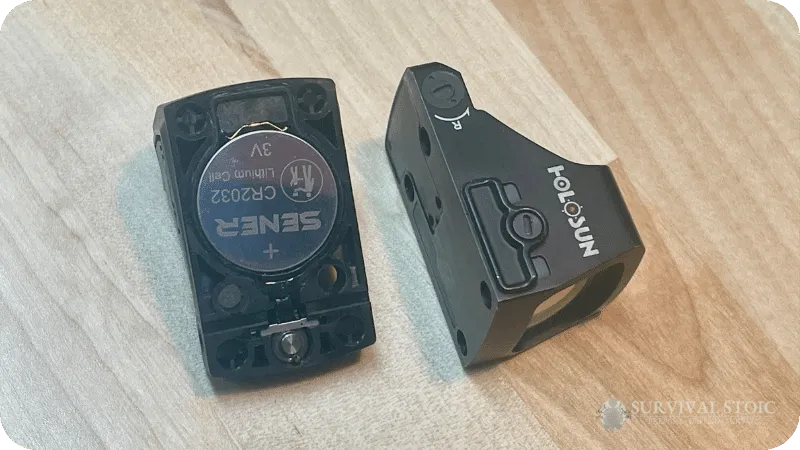
The most robust location is on the bottom. There are fewer springs and moving parts like trays or caps. However, to change the battery I have to remove the red dot from my handgun totally. This means I have to re-torque and possibly re-zero my dot (usually I find the zero is still good depending on the footprint of the dot.)
The most convenient location is on the side or top. With these, I do not have to remove the red dot to change the battery.
Most people make the assumption that being able to change the battery without removing the red dot is superior. This could be a bad assumption.
For red dots that have an adapter plate to mount to the handgun, there is a set of screws under the red dot holding the adapter plate to the slide. These screws should be checked periodically. I have seen more than one red dot fly off a handgun at the range, and loose adapter plate screws is the main culprit. Don’t assume they stay tight. I have seen them shear in two as well.
Also, remember that batteries on the side or top make the housing bigger. I feel that having a thin housing around the sight window is best.
Open or Closed Emitter
Open emitters are the most common red dot sight today. They have one piece of glass that the reticle is projected on. Debris or water can fall on the emitter, causing the dot not to be visible any longer.
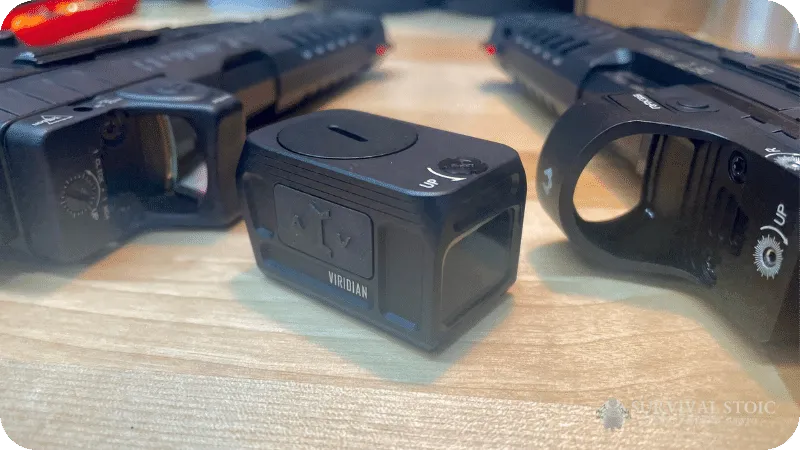
Closed emitters have two pieces of glass, and the emitter is protected between them. These red dots are usually bulkier and more expensive than open emitter sights.
I tend to prefer open emitter sights in general. If I were planning to be in a harsh environment with my handgun exposed, then a closed emitter would be preferred.
Durability
Durability is important for almost everything, but I would caution against making it the most important. I do not need the most durable red dot in the world on my concealed carry or competition gun. Other things like window size and reticle type are more important.
Water resistance and drain holes for water to drain away from the emitter are important though. I have shot plenty of matches in the rain and had trouble aiming with my dots without them.
Price
Of course, price is important with anything. For red dots, understand that buying an expensive red dot will not make you a better shooter. Only training will do that.
Red dots with selectable reticles will be more expensive than red dots without. Spending extra on them as a training tool is worth it. I find I can train through various conditions, and it helps me improve my speed and the presentation of my handgun.
Co-witness Iron sights
For my CCW, backup iron sights are a must. I prefer lower 1/3 co-witness over full co-witness. I find my sight picture is cleaner and has fewer distractions. Full co-witness defeats the advantages of the red dot I discussed in the iron sights vs red dot guide.
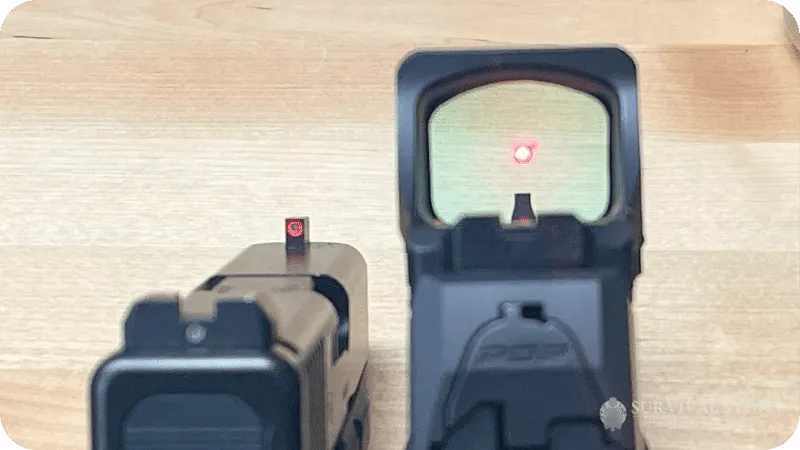
On some handguns, I lose the rear sight when I put on a red dot. In this case, it is important to choose a red dot that has either a built-in rear sight or at least a notch so I can still aim accurately if the dot fails. This is one of our tips for choosing the best red dot ready pistol.
This is usually not thought of until after the fact, so be sure to check before you buy.
Frequently Asked Questions About Pistol Red Dots
What is the best pistol red dot for concealed carry?
For most people carrying a full-size pistol, the Holosun 507C ACSS is our top pick because the ACSS Vulcan reticle makes it much easier to find the dot from imperfect presentations. For compact carry guns like the Sig P365 or Glock 43X MOS, the Holosun 507K ACSS does the same thing in a smaller package.
What is the best pistol red dot for a Glock 19?
If you’re running a Glock 19 MOS or optics-ready slide, the Holosun 507C ACSS is the best all-around choice we’ve tested. It uses the RMR footprint and the ACSS reticle dramatically improves speed and consistency on the draw.
Is an enclosed emitter pistol red dot worth it?
For most concealed carry and range use, no, an open emitter red dot is usually the better balance of size and usability. Closed emitters make more sense if your pistol will be exposed to heavy rain, mud, snow, or duty use in harsh environments, but they’re bigger, heavier, and more expensive.
What size dot is best for a pistol: 2 MOA, 3 MOA, or 6 MOA?
For carry and general use, we’ve found 3–6 MOA to be the sweet spot. Smaller dots (like 2 MOA) are precise but harder to pick up quickly. Larger dots are faster to see but can cover too much of the target at distance. Reticles that include a circle or ACSS-style guide often matter more than raw dot size.
How often should I change the battery in my pistol red dot?
We recommend once per year, regardless of the manufacturer’s battery life claim, and more often if you run the circle reticle or higher brightness. Batteries are cheap. A dead dot at the wrong time is not.
Do I need backup iron sights with a pistol red dot?
For a carry gun, yes, absolutely. Either your pistol needs to retain its rear sight, or your optic should have a built-in rear sight or notch. Electronics can fail. Backup sights are cheap insurance.
Why do I lose the dot on the draw?
Because your presentation isn’t consistent yet, not because the dot is bad. Smaller windows make this harder. Reticles like the ACSS Vulcan or circle-dot systems help guide your eye back to center and dramatically shorten the learning curve.
Will a red dot make me a better shooter?
Not automatically. A red dot shows you what your hands are doing, which is incredibly valuable for training. With practice, most shooters become faster and more consistent, especially at distance. But you still have to put in the reps.
Do I need a mounting plate or can I direct mount?
That depends on your gun and optic. Some pistols (like many Sig P365 variants) allow direct mounting with RMSc footprint optics. Others (like Glock MOS) use plates. Fewer plates = fewer failure points, so direct mount is always preferable when possible.
What is the Best Pistol Red Dot for Concealed Carry for You?
Overall, for full-size handguns, the Holosun 507C ACSS is the best we have found. The ACSS adjustable reticle and decent sight window are great for training, allowing us to get our handgun on target quickly.
For compact slide handguns, the Holosun 507K ACSS is the best. It also has the ACSS adjustable reticle just in a smaller version for a compact handgun. The built-in rear backup sight is a plus and saves money as well.
Now that you have selected your red dot, be sure to read our guide on how to mount a pistol red dot. You don’t want it flying off and there are some critical steps to follow. Also check out our guide on how to zero a pistol red dot for an easy method to get your red dot zeroed quickly.
Also check out our Best Pistol Light Guide for our favorite lights for our handguns.
Also be sure to check out our full concealed carry guide for guides you won’t find anywhere else! From mindset to holsters, we have it covered.
Go Back: Concealed Carry Guide
