

In this hands-on Rhino Rescue IFAK review, we’ll evaluate two kits and examine their individual components.
The general advice seems to be to avoid Rhine Rescue’s Chinese-made kits. But this isn’t the whole truth.
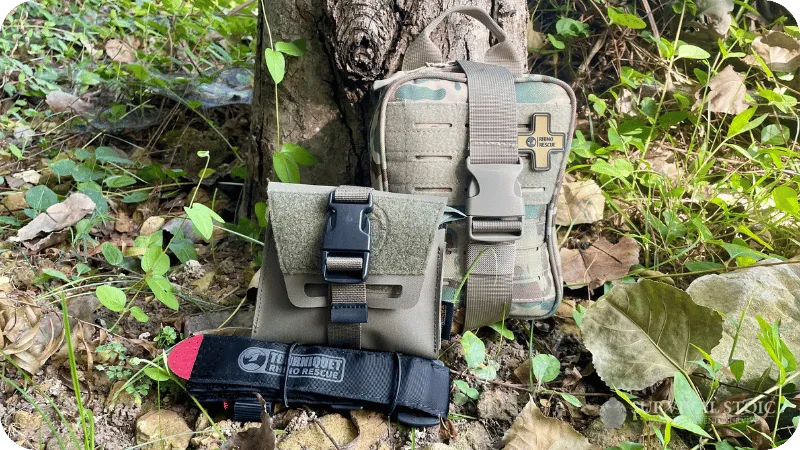
We consulted a whole slew of experts for this review, including Teri, an ER nurse, Stan, a retired Navy Corpsman (military medic), and Blake, a veteran. They helped us evaluate these kits for completeness and effectiveness.
We’ve also included a 10% discount code below. Here’s what we discovered:
Rhino Rescue SE IFAK Trauma Kit Review
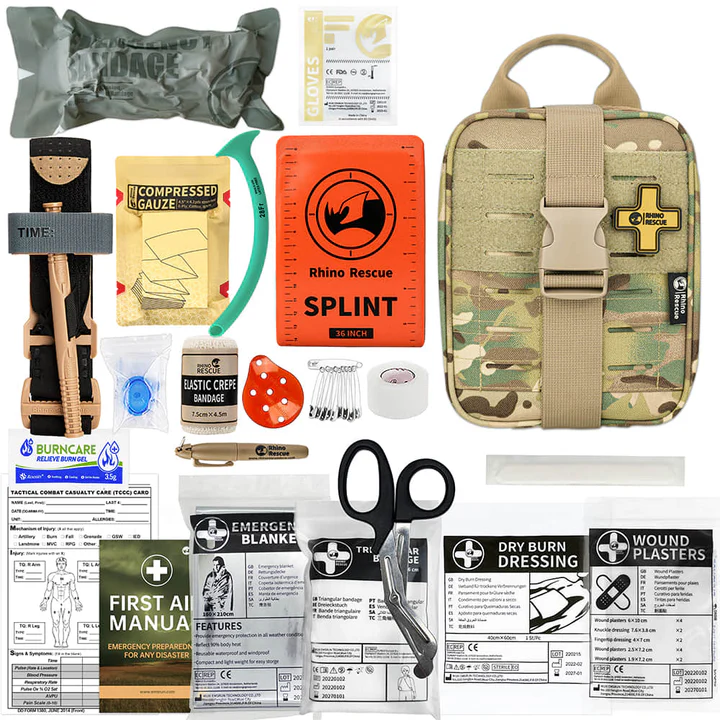
We selected this kit to provide us with the most comprehensive comparison against other IFAKs. We opted for the Pro version, which includes everything we seek in an IFAK and more.
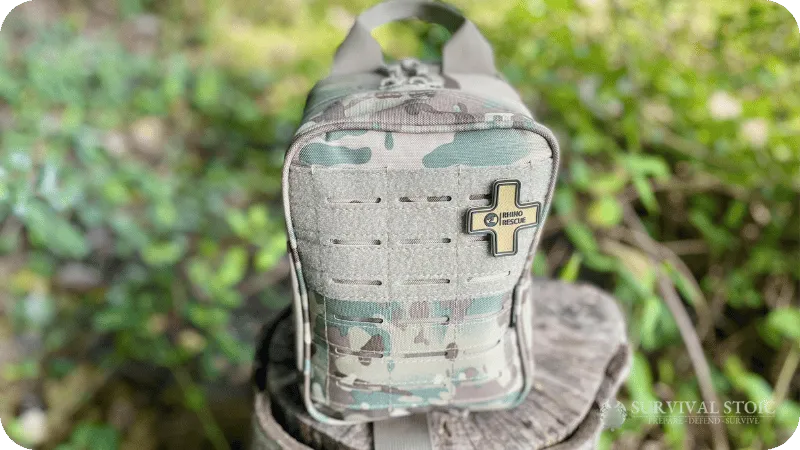
It is similar to the Mountain Man Medical Basecamp kit or the My Medic MyFAK mini-Pro (which we featured in our Best First Aid Kit for Camping review and our My Medic First Aid Kit review).
Firstly, the pouch is very similar to the My Medic kit. It has a strap that attaches the kit to a Velcro panel with MOLLE straps. I can easily attach it to a backpack or another panel with MOLLE webbing. It’s quickly removable by unbuckling the strap and pulling the top handle.
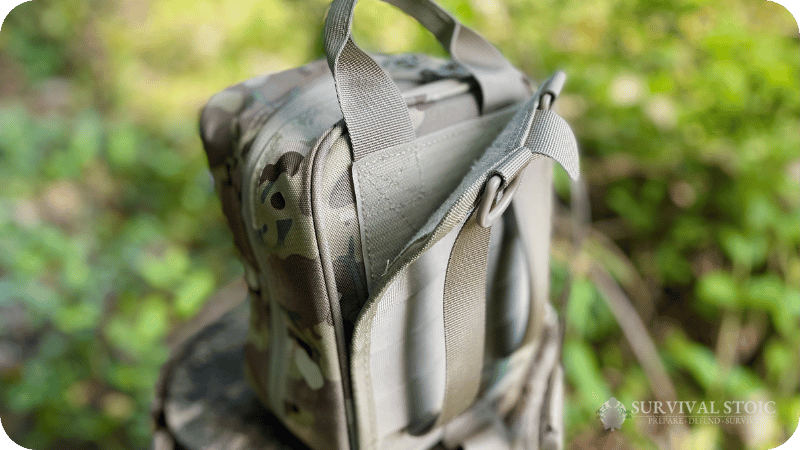
Inside, there are elastic loops to hold everything in place. A center panel has a pocket held in by a Velcro strap. This pocket contains smaller items like gloves, eye shields, and band-aids.
This kit contains everything I look for in an IFAK, including Rhino’s Tactical CAT-type tourniquet, compressed gauze, pressure bandage, and chest seals. It also has a few other bandages, a nice pair of shears, an emergency blanket, a nasal airway, and a large splint.

There are also a few extras like burn cream, CPR face shield, and sterile eye pads.
I like the pouch and layout; the contents are comparable to most of my other kits.
The only downside? It doesn’t include any type of medicine like most other kits do.
Of course, the big question is the quality of the components. But before we jump into that, let’s review the smaller kit.
PROS
Nice Pouch
Good Shears
CAT Tourniquet
Large Splint
CONS
No Medicine Included
Rhine Rescue Cordura Mini IFAk Review

This kit is a smaller, more portable IFAK that fits nicely on my belt or on my pack.
The pouch is made from heavy-denier CORDURA fabric, designed to withstand a beating. It even comes with a lifetime warranty.

On the back are belt loops made from heavy nylon webbing, and around the pouch is a nylon strap with a heavy Duraflex buckle. On the bottom of the pouch are two elastic bands that hold the CAT tourniquet.
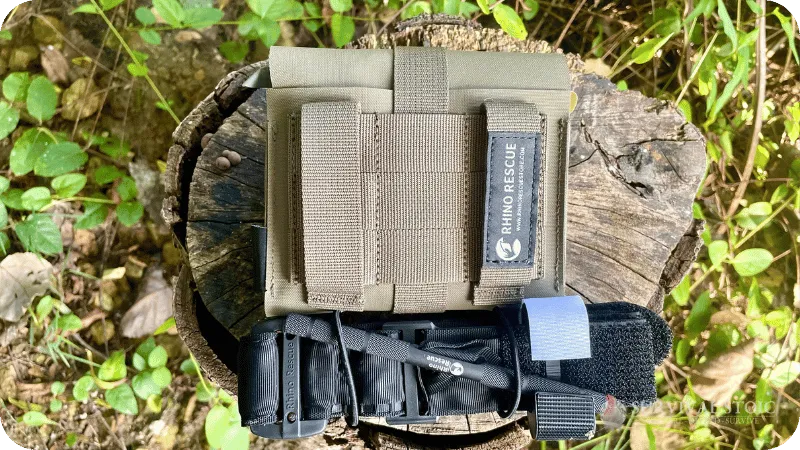
While these seem strong, I am a little worried I could lose my tourniquet, depending on where I carry the pouch. I could see if I was moving quickly through heavy brush that it could be pushed out.
The pouch has compressed gauze, a small amount of Hemostatic gauze, and a compression bandage. As I mentioned, on the bottom of the pouch is Rhino’s metal CAT type tourniquet.

This kit has the basics that I need to control severe bleeding in an extremity. It is a durable, minimal kit that I can keep on my body and quickly access. It is also a good size for a range bag or hiking backpack when weight is a concern.
PROS
Cordura Pouch
Metal CAT Tourniquet
Compact
Durable Material
CONS
Tourniquet Holder
Rhino Rescue Component Quality
You might be wondering:
Is the gear included in the kits actually life-saving?
Unlike most other IFAKs, which use standard, name-brand components, Rhino Rescue makes all of its own.
Rhino Rescue is a Chinese company, and the components are made in China. This, plus the fact that their products are cheaper than most others, makes many concerned that they are just cheap copies and poor quality. But is that really the case?
Let’s look at the components:
Rhino Rescue Tourniquets
Rhino Rescue has two types of tourniquets: a tactical and a metal version. They are both very similar of the popular CAT (Combat Application Tourniquet). The only difference is the metal version has a metal windlass, while the tactical version has a plastic one.
I compared these to one of my North American Rescue Gen 7 CATs, arguably the standard tourniquet that is recommended by the Committee of Tactical Combat Casualty Care (CoTCCC).
My first impression is that the Rhino tactical tourniquet looks the same as the NAR Gen 7 CAT. The design is nearly identical. The strap looks and feels very similar, the windlass and buckle are very similar, and the outer strap is welded near the windlass strap similarly on both.

The Rhino Metal tourniquet is very similar to the CAT, except it has a metal windlass with a small built-in pen in the end. This windlass feels much stronger than either of the plastic ones and has a nice, knurled finish.
Mine also came with an authenticity sticker, and I was able to verify that it was authentic online.

The paperwork that comes with the Rhino tourniquets is marked with both “EC/REP” and “FDA” certifications. They are also marked with lot numbers and other codes for traceability. So, it would seem as though at least the European Union has tested and approved them for use.
Now:
I have read some comments here and there on reports of the Rhino CAT failing but have been unable to find any substantiated evidence.
Most seem to say that they work fine in general, but there are one or two in a lot that don’t. Again, I have not been able to find any evidence.
After my inspection and researching other testing, I feel that it is very comparable.
Rhino Rescue Gauze and Bandages
Gauze is typically used to stuff a severe bleeding injury in an extremity, and bandages are used to apply pressure to that wound and keep the gauze in place.
Almost any sterile material will do, and even a T-shirt in extreme circumstances will work. So, to me the quality is not so much a concern as it is with the tourniquet.
I noticed that my Rhino Rescue gauze and compression bandages were marked with “EC/REP,” “CE,” and “FDA” certifications. Similarly, the items I have that are made in the US are marked with similar certifications.

The biggest difference I see is in the Hemostatic Gauze. The Hemostatic Gauze that we like to use is “Chitogauze,” which contains Chitosan, a substance derived from shellfish that helps form clots and is also antimicrobial (see our guide on the Best IFAK for more on this).
Tip: Even if you have a shellfish allergy, you won’t react to Chitosan, as it doesn’t contain the shellfish allergen.
The Rhino Rescue hemostatic gauze contains sodium carboxymethyl cellulose, which absorbs water and turns into a gel. However, the experts we spoke to preferred the Chitogauze, which has superior properties.
Rhino Rescue Chest Seals
Chest seals are a critical piece of first aid gear for injuries to the chest cavity, such as gunshot wounds. They prevent air from entering the chest cavity through the injury as the patient breathes. Excess air inside the chest cavity can lead to suffocation since the pressure limits how much the lungs can expand.
My Rhino chest seals are marked with similar certifications as the other items I mentioned above. A scratch-off sticker reveals a certification code so I can verify the authenticity. They are also latex-free, just like my NAR chest seals.

But here’s the kicker:
I noticed that the vents on the Rhino chest seals are different from those on the NAR chest seals. On the Rhino, there are three smaller vents, all facing to one side of the seal. On the NAR, there are also three vents, but they are 120 degrees apart.
Our experts like the NAR design betternce there is less chance of all three vents getting blocked by an external object.
I have seen reports that some soldiers in Ukraine have seen inconsistent adhesive on their Rhino chest seals, and some of them do not stick to the patient properly.
I have not been able to find sufficient direct evidence of this, though, and who knows if they were applied properly.
Is Rhino Rescue Gear Worth It?
The common recommendation in the tactical medicine industry in the US is to only use first aid gear that has been tested and proven. We know that Rhino Rescue gear has been used by the Ukrainian military in the conflict with Russia that started in 2022.
We also know that Rhino Rescue gear carries many of the same certifications that the US-made counterpart carries.
The decision of whether it is worth it is a personal decision.
If I were going into a known armed conflict where there was a high chance of injury and a low chance of available medical help, I would want the best IFAK I could get, and price would not be a consideration.
If I wanted an IFAK to be prepared in a normal environment where first responders were available and I had a very strict budget, I would consider Rhino Rescue. But only if my budget did not allow me to purchase an IFAK from a US-based company with US-made components.
Our experts saw no issues with Rhino Rescue’s gear on the surface. We have a very small sample size and do not have extensive experience using their products in the field. From what we can tell, everything we have seen is high quality, has certifications, and authenticity verification.
If you are uneasy, we recommend considering adding a NAR CAT7 tourniquet to their IFAKs. They only cost around $20-$30 and will give you a second tourniquet. Then, you can use the Rhino Rescue tourniquet to practice with or as a backup.
Be sure to check out all of our other IFAK and first aid kit reviews in our Preparedness Guides and Gear section of our website. We have covered many other kits and have firsthand experience with them. Also, be sure to read our guide on How to Choose the Best First Aid Kit.
