

A few years ago, I was in a car accident that left my car totaled. My back axle was completely bent, and my phone battery was at 4%. The worst part? The other guy’s phone was nowhere to be found.
I had no flashlight, first aid kit, and worst of all, no way to get help. Luckily, a good Samaritan rolled by after about twenty minutes. But, I hate to think about what would have happened if someone had been seriously injured!
After that, I start researching the best car emergency kits. The problem? Most “best car emergency kit” guides online were packed with expensive gear I didn’t need and definitely couldn’t afford as a broke college student.
Back then, there was very little guidance on how to piece together a car emergency kit on a budget. I had to make due with the little advice I could find online.

That’s why with the help from our team of experienced preppers and survivalists, I’ve put together this no-nonsense list of 16 must-have items to keep in your car.
It’s everything you need to stay safe without wasting money on things you don’t need.
Here’s what we recommend:
Budget Car Emergency Kit List
1. Jumper Cables
One of the most common car emergencies is a dead battery. Keeping a pair of jumper cables in your car is an easy way to overcome this straightforward problem.
Disabled vehicles are a huge source of fatalities, so being able to get your car moving right away is essential. The IIHS reports that:
“Around 800 pedestrians a year are killed on U.S. interstates and other freeways — about 18 percent of them due to a disabled vehicle.”
Of course, jumper cables require another car, which you won’t always have. Which brings us to the next essential item:
2. Portable Jump Starter
A portable jumper starter allows you to jumpstart your car without having someone there to help you.

We particularly recommend the Fanttik T8 2000 Amp Jump Starter. It’s the one we’ve tested and used many times.
It also has a built in flashlight and a USB charger. The price may seem a little high, but consider there are two less things you have to purchase. It also takes up less room than typical jumper cables (although it is a little more expensive).

3. Spare Tire, Jack, and Lug Wrench
Everyone should have basic tire-changing gear on hand in case you get a flat tire. Most vehicles come with these, but some do not.
My recommendation?
Don’t just get any set; get a good set like this one. When it’s pouring rain and you’re trying to change your tire, you’ll be happy you spent the extra $10!
4. First Aid Kit
First aid kits are essential for all vehicles. According to the Australian College of Road Safety:
“At least 7% of road fatalities could be saved as a result of basic first
aid measures taken at the scene.”
I’ve tested a lot of first aid kits in my lifetime. I’ve even written a whole guide on how to choose the best first aid kit.
First aid kits are one of my things.
So, what is the best first aid kit for your car?
Well, it isn’t actually any of the kits in the reviews above. After all, driving your car and hiking are very different things.
Instead, the very best kit I recommend the Redi Roadie+ – one of the few first aid kits actually designed for your car. I recommend getting the plus version because it has a trauma kit for severe bleeding (just the injuries you’re looking to treat).
I love this first aid kit because everything is compartmentalized and labeled. It attaches directly to your car, so you don’t have to worry about it tossing around in a wreck. Plus, it comes with literally everything you need and then some.
You can read more about it in my Redi Roadie review, which includes hands-on testing insights.

The only negative with the Redi kit? It is a little pricy. Since this guide is more for the budget minded, I recommend the My Medic MyFak mini Pro. It has the basics (although I don’t like the tourniquet) that you can read about in my MyMedic Review. Plus you can save 15% with our discount code “Survivalstoic15”.
5. Flashlight and/or Headlamp
You don’t need a $100 tactical flashlight for your car kit. A reliable $40 EDC flashlight with a few extra batteries will cover 99% of situations.
We’ve tested a lot of tactical EDC flashlights and Survival Flashlights. We keep several in our vehicles.
In an emergency, you won’t want to keep your car lights on for hours on end, or you’ll run down your battery. A flashlight can help you stay aware of your surroundings without relying on your car lights.
Make sure you store extra batteries, too. Alternatively, you could get a solar flashlight that recharges.
I also like headlamps, especially since they free up my hands. This budget LED headlamp is affordable and works great.
6. Water
Water is one of the first things you need, according to the survival rule of three. So, you should keep water in your car, ready to go.
You can only survive three days without water, but you’ll become delirious before that. So, water should be one of your main priorities. If you only store one thing in your car, choose water!
How much water should you store?
Not too much. I recommend around 40 ounces. Instead of expensive survival water pouches, grab a durable stainless steel bottle like the Kleen Kanteen that you can refill at home for free. It’s cheaper and works just as well.
As long as it is clean when you fill it, tap water will stay fresh for at least 6 months in this bottle.

7. Water Filter
You never know when you’ll need more than the amount of water you’ve stored. Keep a simple water filter, like the Sawyer mini water filter, just in case.
If you live somewhere dry and hot, consider storing extra water instead of a water filter. (Buy two Kleen Kanteens instead of one.) A water filter is only helpful if you can find water, after all.
I live in TN, so finding water is never a huge deal, even if I’m stuck on the side of the road.
As a backup to my filter I keep water purification tablets as well. See why in our Best Water Purification Tablets Guide.
8. Survival Blanket
The cold can kill very fast, especially if you’re stuck in a damaged car in the middle of winter. I recommend the Arcturus Heavy Duty Survival Blanket, which is lightweight and doesn’t take up much room.

I have also used it as a ground cover many times. The shiny backing not only insulates well, but also reflects heat. It can be used in a windshield to reflect the suns heat during hot weather. If you get stuck in the snow, it can even be used under your tires for traction.
You can also consider a survival wool blanket. However, they can be a bit bulky, though they are very warm.
Make sure to keep multiple blankets, especially if you have children. In the case of an emergency, you don’t want to try and shove everyone under one blanket.
Check out our full guide to the Best Emergency Blankets for more.
9. Emergency Sleeping Bag
An emergency sleeping bag is another nice-to-have item, especially if you live somewhere cold. The Survival Frog Tact Bivy is our recommended option. It’s affordable, small and very warm.
I’ve used it several times when camping during the winter, and I have no doubt that it would keep me warm in a car, too.
I recommend most people purchase a quality blanket and sleeping bag to stay plenty warm. You might want even heavier duty gear if you live somewhere with a particularly cold climate.
If you live somewhere like Florida, you might need only a blanket, though! Use your judgment.
Don’t forget to pack one for each passenger, too.
10. Emergency Food for Your Car
The best emergency food for your car is small, filling, and resistant to heat and cold. Emergency food bars, like Millennium Bars or Grizzly Gear Bars, are cost-effective because they last for years and don’t need rotation.
Grizzly Gear Bars are extremely tasty. During testing, I had a whole pack in my house (which is equivalent of about 3,600 calories), and I was worried that my children would eat them all before I had a chance to put them in my car!
I had to hide them.
I’ve only tried the vanilla poundcake flavor, but there are several other flavors, too, like blueberry. I’m confident they’re all yummy.
These bars are nutritionally dense, too. Each pack comes with nine bars, which are 400 calories each.
Skip expensive freeze-dried meals — they require hot water, which isn’t practical in a car emergency. Plus, they’re much more expensive.
Make sure you pack enough for several people, just in case others are traveling with you. One pack of Grizzly Gear bars could easily keep several people going for a day, but you might want to consider getting two packs if you have a large family.
See our Emergency Food Bar Review for more including one bar I kept in my car for over 4 years.
11. Extra Prescription Medication
Always keep extra prescription medication in your car, just in case you get stuck!
You don’t want to be stuck without any medication that you literally rely on to live. Sometimes, skipping your medication once or twice won’t have any adverse effects. Other times, it might send you to the hospital.
If you’re in this later category, be sure to keep some extra in your car! (Or on your person at all times.)
Of course, be aware that the medicine will be exposed to extreme conditions, so it might not last as long as it would in your house. Ask your doctor about how long your medication would last in the car.
Consider practicing FIFO, which involves switching out your stored medication regularly with a new dose (and taking the old dose as normal). You might decide to do this once a week, for instance, to make sure you have a fresh dose in the car at all times.
Exactly how you go about this will depend on your medication, but don’t skip this step!
12. Self-Defense Tools
Most car-related emergencies won’t require you to defend yourself, but some will, and it’s important to be prepared. There are several options here, like a concealable handgun or pepper spray.
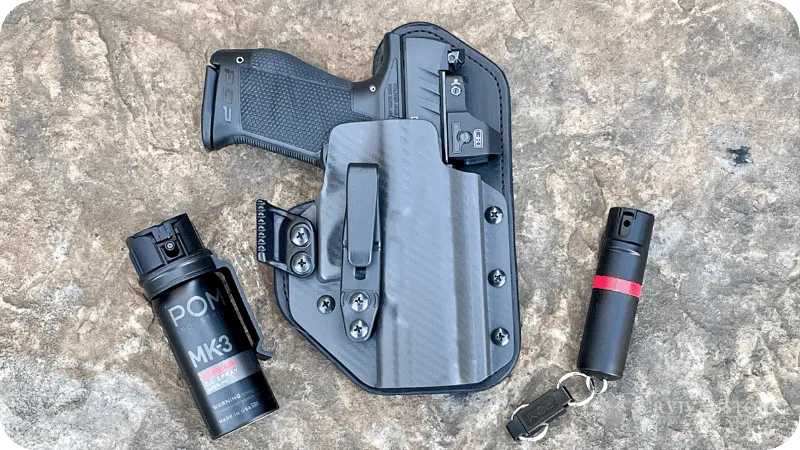
Check out our full concealed carry guide for everything from our favorite concealed carry guns to our favorite concealed carry holsters as well.
I’ve also tested and reviewed pepper spray. Long story short, POM pepper spray is one of my favorites to keep in my car.
Honestly, most people on our team carry both. Pepper spray can be a usually-not-lethal deterrent for your average carjacker. But I also recommend having something a bit tougher to back you up, too.
If you decide to get a handgun, don’t forget about safe gun storage. In most cases, this means getting a security cable if you plan to leave your gun unattended in your car permanently.
In most cases, it makes sense to carry the firearm on your person. Then, if you do get stuck in your car, you’ll have it.
But, you don’t have to worry about leaving it in your car.
Pepper spray can be kept in your car without any extra safety measures. But it is something you might want to consider keeping on you, too.
13. Phone Charger
In a car emergency, your phone is your lifeline. So, make sure you have a way to charge it if your car isn’t working.

The Battarix SOS Charge Card is a great option because it’s extremely small and works with most devices. Plus, it’s affordable, too.
This charger is single-use, so it’s something you should keep for emergencies – not use the first time your phone dies.
I also like the Flextail Zero Power Bank. This little guy is rechargeable and has 10,000 mah capacity. I can recharge my phone nearly 3 times with it. Plus it is tough as nails, waterproof, and the smallest and thinnest power bank with this much capacity that I have found. To top that, it is less than $60.
You may think you can just charge your phone with your car, but a simple electrical problem can cause the USB ports in your car to stop working.
14. Wet Wipes
I’m a strong believer in wet wipes, even outside of emergencies. A pack of wet wipes can avert a huge list of minor crises, especially if you have kids!
The brand doesn’t particularly matter much. We’ve tested both Combat Wipes Active wipes and Klean Freak Flushable Wipes and both earned high reviews.
In an emergency, wet wipes become even more important. If you don’t have access to clean water (and won’t for a while), being able to stay clean becomes increasingly difficult.
15. Tow Strap
Sometimes, a good Samaritan will be able to pull you out of a stick situation. But, you’ll need some tow straps to make this possible!
We recommend the Rhino USA Recovery Tow Strap, simply because that’s what we’ve used! You don’t have to get this exact brand, but do make sure to get something that’s rated for your car’s weight.
16. Tire Repair Kit and Pump
Some flats can quickly be repaired with a tire repair kit. It’s always a good idea to have one of these stocked in your car in case you get a small leak.
I also like to carry a portable tire pump. The Flextail EVO Tire Pump 200 works great. It is compact and also has a built in flashlight. Plus, I can charge my phone with it if I need to.

Just remember that a tire repair kit and a pump is not a replacement for a spare tire and everything you need to change it.
Not all flats can be patched, after all.
17. Poncho or Rain Jacket
Getting stranded in the rain is no fun, and can lead to Hypothermia even in warm weather.
I like to keep a military style poncho in my car for emergencies. It is large enough to keep me dry (my pants too) and can be used as a shelter if I really needed it.
Even if I just have a flat tire, I like knowing that I have rain gear.
18. Cash
I like to keep at least $60 of extra cash in my emergency kit. In the event I am far from home and need gas, this is my backup.
I had a friend recently that was driving to TN from Ohio. About halfway here he stopped to get gas and then realized he didn’t have his wallet. What a sinking feeling that must have been!
Luckily, he had some cash in his emergency kit and was able to buy enough gas to get home.
Extra cash is also handy incase of a power outage. Some gas stations may accept cash but can’t accept credit or debit cards when the power is out!
The Most Important Part
We get it, 16 items is a lot to buy all at once. So, where should you start?

If your budget only allows a few items, here’s what I’d recommend:
- Portable Jump Starter: A dead battery is the most common emergency, and this will take care of it quickly.
- Spare Tire, Jack, and Lug Wrench: Get everything you need to change a flat if your car doesn’t already have it.
- Survival Blanket: Get the Arcturus Heavy Duty Survival Blanket. It can be used for so many things and is affordable.
- First Aid Kit: Invest in a My Medic MyFak mini Pro to treat life-threatening injuries and small bumps alike (don’t forget our discount code above!)
- Water: Store at least 40 ounces of water in a durable, leakproof container. I recommend the Kleen Kanteen 40 oz Stainless Bottle.
- Cash: Keep a few extra $60 in you car just in case.
After you have these basic items, consider investing in a well-stocked get home bag, too. You never know when you’ll need to abandon your car in an emergency, and a get home bag can make your life much easier.
The items on this list are designed to keep you alive should you get stuck while traveling in your car. For emergencies when you need to leave quickly in your car (like an evacuation), I recommend a bug out bag for everyone in your family. This bag will keep you alive longer than a basic car emergency kit will.
Stay Updated and Learn More
After you build your emergency car kit, be sure to stay up to date on all of our content by joining our Newsletter. Each week, we include tips on how to stay mentally prepared with actionable ideas and strategies. We also include any good deals we have found, plus updates to our content.
