

A 30-day emergency food supply list is the most practical preparedness target for a normal household. It is long enough to outlast most short-term disruptions and widespread supply issues, and short enough to build using standard grocery store food.
This is not a bunker plan. It is a continuity plan. The goal is simple: keep your household fed and functional when normal systems are under stress.
Stoicism teaches us to focus on what we can control. You cannot control supply chains, weather events, or panic buying. You can control what sits in your pantry. A well-built food supply turns uncertainty into something manageable.

In this guide, we are going to walk through a complete, realistic system. You will learn how much food you actually need, what to buy, and how to build a 30-day emergency food supply using foods your family will actually eat.
If you are building beyond 30 days, start with our full system in our best survival food guide, which expands this into a long-term plan.
Why Trust This Guide
We did not build this list from theory. We built it by using it.
We ran planned pantry-only periods where we relied entirely on shelf-stable food. During those tests, we tracked calorie intake, prep time, and how often meals were skipped or modified. We paid close attention to what actually got eaten versus what sounded good on paper.
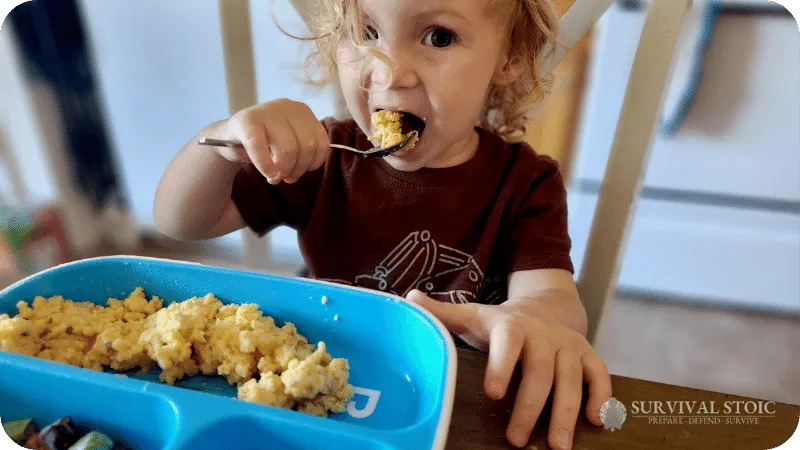
We also tested this as a household, not as individuals. That matters. Adults will tolerate repetitive meals. Kids will not. Fatigue shows up quickly when food is boring, difficult to prepare, or unfamiliar.
Some foods that seemed like smart additions were ignored completely. Others became staples we relied on daily. We adjusted the system based on those outcomes.
This guide reflects that process. It is built around food that is easy to store, simple to prepare, and realistic to eat for an extended period.
Who This Guide Is For
This guide is built for normal households that want a reliable buffer, not a theoretical survival plan.
If you are starting from zero, this will give you a clear path. If you already keep some extra food on hand, this will help you turn that into a complete, structured system. The focus is on feeding a family through a disruption without needing specialty gear, complicated cooking, or hard-to-find ingredients.
It is also designed for people who want something they can maintain. A 30-day supply only works if you can store it, rotate it, and actually use it. Everything here is based on food you can buy at a regular grocery store and incorporate into your normal routine.
This is not a long-term off-grid plan. It does not rely on freeze-dried meals or bulk storage systems meant to last decades. Those have their place, and we will touch on them later, but they are not the foundation here.
It is also not a “perfect nutrition” plan. The goal is stability, adequate calories, and meals your household will consistently eat under stress. That matters more than optimizing every nutrient.
This list isn’t just for disasters; it’s a hedge against supply chain “thinning” and grocery inflation. By purchasing these 30-day staples in bulk now, you are essentially “locking in” today’s food prices. We focus on White Rice, Oats, and Canned Meats because they are the most resilient against the price spikes we’ve seen in fresh produce and dairy.
If your goal is simple, practical preparedness that holds up in real life, you are in the right place.
The Framework: How a 30-Day Emergency Food Supply List Actually Works
Before you buy anything, you need a simple mental model. Most food storage plans fail because they start with a list instead of a system.
A 30-day supply is not a collection of items. It is a set of constraints you are solving for: calories, preparation, storage, and repeatability.
1. Calories Come First
If your plan does not meet calorie needs, nothing else matters.
Most people underestimate how much food they actually need. A typical adult requires roughly 2,000 calories per day, often more under stress or physical activity. Over 30 days, that adds up quickly.

Low-calorie foods create the illusion of preparedness. You can fill a pantry with canned vegetables and still fall short where it counts. Your foundation has to be calorie-dense staples.
2. Cookability Under Stress
Food that requires time, precision, or multiple steps becomes a problem when conditions are not ideal.
You may be dealing with limited power, limited fuel, or just mental fatigue. Meals need to be simple, repeatable, and forgiving. If something takes too long or feels like a chore, it will get skipped.
A good rule is this: if you would not want to cook it after a long, exhausting day, it does not belong at the center of your plan.
3. Fatigue Is a Real Constraint
Food fatigue shows up faster than most people expect.
Eating the same meals over and over reduces appetite. When appetite drops, calorie intake drops with it. This is especially noticeable with children, who are far less tolerant of repetitive or unfamiliar food.
A workable system includes enough variety to keep meals acceptable, even if they are simple.
4. Rotation Over Perfection
You do not need perfect long-term storage to build a strong 30-day supply.
Grocery store foods work well if you rotate them. That means using what you store and replacing it as part of your normal routine. This keeps food fresh and prevents waste. A system you maintain is more valuable than one that looks good on paper but sits untouched.
5. Water Is Part of the System
Food does not exist on its own.
Many staples require water to prepare, and all of them require water to consume safely. Any food plan needs to account for how meals will actually be cooked and eaten if normal utilities are disrupted.

Rule of thumb: Budget 1 gallon per person per day for drinking and sanitation, but add an extra 2 cups per person for every rice or pasta-heavy meal you plan to cook.
We will focus on food in this guide, but your plan should always include a clear approach to water as well. If you do not already have a water plan, read our full guide on the best water storage containers to get started.
6. “No Power” Contingency
A 30-day supply is useless if you can’t heat it. If the grid goes down, your strategy must shift from “pantry staples” to “zero-barrier calories.” We recommend:
- Primary Fuel: Make sure you have an emergency stove. Store at least two 20lb propane tanks for a standard grill or four 8oz butane canisters for a portable camp stove.
- Thermal Retention: Use a “retained heat” method: boil your rice for 2 minutes, then place the pot in a Wonder Oven or wrap it in heavy towels to finish cooking without using more fuel.
- The 72-Hour “Blackout” Stash: Keep a separate bin of food that requires zero water and zero heat (crackers, peanut butter, canned fruit, and tuna pouches) for the initial phase of a disruption.
Once you understand these constraints, the grocery list starts to make sense. Without them, it is easy to build something that looks complete but fails under real conditions.

How Much Food You Actually Need
Once you understand the framework, the next step is sizing the system correctly. This is where most plans quietly fall apart.
A 30-day supply sounds manageable until you run the numbers.
Start with a simple baseline. A typical adult needs about 2,000 calories per day. Some people will need more, especially in stressful or physically demanding situations, but this is a solid working number. Here are some quick guidelines for special circumstances:
| Person Type | Daily Calorie Target | 30-Day Total | Key Focus |
| Active Adult | 2,500 – 2,800 | 75k – 84k | Fats & Complex Carbs |
| Sedentary Adult | 1,800 – 2,000 | 54k – 60k | Fiber & Lean Protein |
| Growing Child | 1,400 – 1,800 | 42k – 54k | Familiar Comfort & Sugars |
| Nursing Mother | 2,500+ | 75k+ | Hydration & Calorie Density |
Over 30 days, 2,000 calories a day comes out to:
- 60,000 calories per adult
- 30,000 to 45,000 calories per child, depending on age
That adds up quickly for a household.
A family of four can easily require 180,000 to 240,000 total calories for a full 30-day supply. That is the number your food plan needs to support. Everything else is secondary.
This is why staple foods matter so much. Rice, pasta, oats, oils, and other calorie-dense items carry most of the load. Lower-calorie foods like canned vegetables and soups still have a place, but they cannot be the foundation.
It also helps to think in terms of daily structure instead of total numbers.
Most households do better with a simple rhythm:
- One or two larger, calorie-dense meals
- One lighter meal or snack-based period
Trying to recreate three full, traditional meals every day often adds unnecessary complexity. Simpler patterns are easier to maintain, especially when energy and time are limited.
One more practical note. Build a small buffer into your plan.
People eat more when they are stressed, bored, or physically active. You may also be feeding an extra person, stretching meals longer than expected, or dealing with some waste. A margin of safety keeps small problems from becoming real ones.
Once you have your calorie target in mind, the grocery list becomes much easier to build with purpose instead of guesswork.
30-Day Emergency Food Supply Calculator
Use this tool to size your system. It does not need to be perfect. It needs to be sufficient.
If you want to extend this system beyond pantry rotation, see our guide to Best Mylar Bags and How to Use Them for long-term storage.
The 30-Day Grocery List (Overview)
Now we move from theory to structure.
Before breaking this into categories, it helps to see the system at a high level. A good 30-day food supply is not random. It is built in layers, with each category serving a specific role.
At a glance, your food supply should include:
- Staple calories that carry most of your energy needs
- Protein sources that are easy to prepare and repeat
- Fats that increase calories and improve satiety
- Ready-to-eat foods that reduce effort on hard days
- Comfort foods that stabilize morale
- Basic flavor additions that keep meals from becoming monotonous
If one of these layers is missing, the system starts to break down. You may have enough food on paper, but not enough usable food in practice.
Below is a simplified reference table to show how this comes together.
| Category | Example Foods | Approx. Quantity | Role |
|---|---|---|---|
| Staple Calories | Rice, pasta, oats | 25–35 lbs total | Core calorie base |
| Protein | Beans, canned meat, peanut butter | 15–25 lbs total | Sustained energy, satiety |
| Fats | Oil, butter alternatives | 2–4 quarts | Calorie density, cooking |
| Canned / Ready Foods | Soups, pasta meals | 15–25 cans | Low-effort meals |
| Comfort Foods | Coffee, sugar, snacks | Variable | Morale, routine |
| Flavor Additions | Salt, spices, bouillon | Small amounts | Prevent fatigue |
This is not a rigid checklist. It is a framework you can adjust based on your household.
Some families will lean more heavily on rice and beans. Others will use more ready-made foods to reduce prep time. The exact mix matters less than making sure every category is covered.
Once you understand these roles, the actual grocery list becomes straightforward. You are no longer guessing what to buy. You are filling specific needs in a system that is designed to hold up under real conditions.
In the next section, we will break this down into a practical, store-by-store grocery list you can follow.
The Realistic Grocery List (By Category)
This is where the plan becomes actionable.
Everything below is based on food you can find in a normal grocery store. No specialty suppliers, no bulk ordering required. You can build this gradually over a few trips or all at once if needed.
The goal is not variety for its own sake. The goal is repeatable, reliable meals that hold up over 30 days.
1. Staple Calories (Your Foundation)

These carry most of your calories. If this section is weak, the entire plan is weak.
- White rice
- Pasta
- Rolled oats
- Flour or baking mix
- Potatoes or instant potatoes
These foods are inexpensive, calorie-dense, and flexible. You can build dozens of simple meals from them with minimal effort.
Field note: People tend to overestimate how much variety they need and underestimate how much they will rely on these staples. In practice, these show up in some form almost every meal.
Rice and beans are the backbone of most 30-day plans, but they only work if you store them correctly. Here’s a practical guide on how to store rice and beans so they actually last.
2. Protein (Where Most Plans Break)

Protein is where many grocery-based plans fall apart. It is either too complicated, too repetitive, or not something people actually want to eat.
- Canned chicken, tuna, or beef
- Dry or canned beans
- Peanut butter
- Shelf-stable dairy or powdered eggs, if available
These need to be simple to prepare and easy to combine with your staple foods.
Real-world constraint: Appetite drops faster than expected when meals are repetitive. This is even more pronounced with kids. If the protein options are unappealing or require too much effort, they will be skipped.
That creates a second problem. Skipped protein often means skipped calories.
If you want to add shelf-stable options beyond canned goods, see our breakdown of Best Powdered Eggs and Best Powdered Milk.
3. Fats (Small Section, Big Impact)
Fats do more work than most people realize.
- Cooking oil
- Butter alternatives or shelf-stable spreads
They increase total calories, improve satiety, and make basic meals more satisfying. Without enough fat, food feels incomplete and less filling, even if the calorie count looks adequate on paper.
4. Canned & Ready Foods (Friction Reduction)
These are your low-effort meals. You will rely on them more than you think.
- Canned soups
- Pasta meals
- Chili or stew
- Jarred sauces
These reduce prep time and decision fatigue. On days when energy is low, these keep you from skipping meals or defaulting to snacks.
This is not cutting corners. It is removing friction from the system.
5. Comfort & Morale Foods
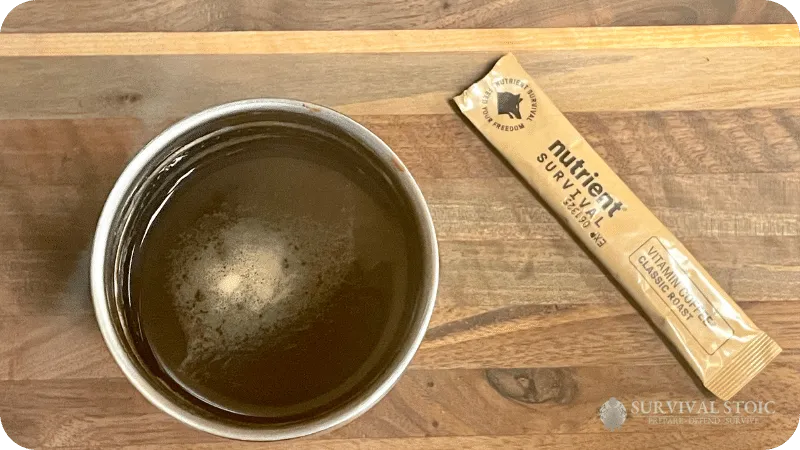
This section matters more than it seems.
- Coffee or tea
- Sugar or sweeteners
- Chocolate or simple snacks
Food is not just fuel. It is routine. It is something familiar when everything else feels off.
A small amount of comfort food can stabilize mood and make repetitive meals easier to tolerate, especially over multiple weeks.
6. Flavor Fatigue Killers
This is one of the smallest sections, but one of the most important.
- Salt
- Basic spices
- Hot sauce
- Bouillon cubes
These take up almost no space, but they dramatically change how meals feel day after day.
Field note: A simple bowl of rice and beans is very different on day ten than it is on day one. Small flavor changes can make the difference between eating a full meal and pushing food around a plate.
7. No-Cook and Low-Prep Foods

You will not always want to cook. Plan for that.
- Crackers
- Shelf-stable milk
- Ready-to-eat items like canned soup
These give you options when time, energy, or utilities are limited. They also help fill gaps between larger meals.
At this point, you have all the pieces. What matters now is how they come together in practice. These same foods form the foundation of a mobile kit. For a portable version of this system, see our guide to Bug Out Bag Food List.
What Most 30-Day Food Plans Get Wrong
Most plans look complete on paper. In practice, they break down within a few days.
These are the patterns we saw repeatedly when testing and adjusting this system.
1. Not Enough Calories
This is the most common problem.
People build lists around variety or “healthy-looking” foods and end up short on actual energy. A shelf full of canned vegetables and soups can look reassuring, but it does not carry enough calories to sustain a household for 30 days.
When calorie intake drops, everything else follows. Energy declines, mood shifts, and meals start getting skipped.
2. Too Little Fat
Fat is easy to overlook because it takes up so little space.
Without it, meals feel incomplete and less satisfying. You may technically hit your calorie targets, but food will not keep you full for long. That leads to constant snacking and faster depletion of your supply.
A small amount of oil or fat goes a long way toward making basic meals work.
3. Overcomplicated Meals
Plans that rely on complex recipes do not hold up under stress. If a meal requires multiple steps or too many ingredients, it becomes a barrier. On low-energy days, those meals get skipped or replaced with something easier, which throws off the system.
Simple meals are not a compromise. They are a requirement.
Yes, pre-made meals can be expensive. However, there are budget emergency food options that are ready-to-eat, too.
4. No Plan for Food Fatigue
Repetition wears people down faster than expected.
What sounds acceptable in theory can become unappealing after a week. Appetite drops, portions shrink, and calorie intake follows. This is where small variations, sauces, and flavor additions matter. Without them, even a well-stocked pantry can feel limited.
Field Note: Plain rice provides calories, but rice cooked in chicken bouillon provides a ‘mental win.’ It smells like a kitchen, not a survival situation.
5. Ignoring Kids and Household Preferences
Adults will push through meals they do not enjoy. Kids usually will not.
If your plan does not include foods your household already eats, you are setting yourself up for friction. That friction turns into skipped meals, wasted food, and unnecessary stress.
A realistic plan reflects what your household will actually accept, not what looks ideal on paper.
6. Too Much Reliance on One Food
It is easy to overbuild around a single staple.
Rice-heavy plans are common. So are plans built almost entirely on beans or pasta. While these are excellent foundations, over-reliance creates fatigue and limits flexibility. Balance matters. You want enough overlap between categories to build simple variations without adding complexity.
7. No Low-Effort Options
Every plan looks good when you imagine having time and energy.
Reality is different. Some days will be busy, stressful, or simply exhausting. If every meal requires effort, you will start skipping them or defaulting to snacks. Ready-to-eat and low-prep foods are what keep the system working on those days.
A good 30-day supply is not about perfection. It is about removing failure points. If you solve for calories, simplicity, and repeatability, the rest becomes much easier to manage.
If you want to understand how these failures show up during real disruptions, read our guide on How to Prepare for a Food Shortage.
Sample 3-Day Rotation
A list is useful. A system is better.
This is what the 30-day supply looks like in practice. Not perfect meals. Not Instagram-ready. Just simple, repeatable combinations that deliver enough calories without requiring much effort.
The goal is a small set of meals you can cycle through without thinking. You can find many of these recipes on our survival recipe list.
Day 1
Breakfast:
Overnight oats with a little sugar or honey
Coffee
Lunch:
Rice and beans with canned meat and seasoning
Dinner:
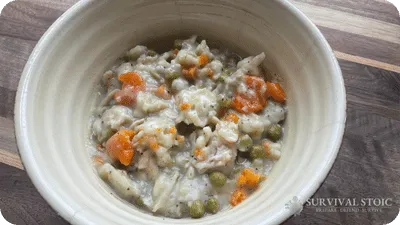
Chicken and dumplings (using canned chicken, broth, and baking mix)
Notes:
This is a strong “baseline” day. It uses simple ingredients but feels like real food. Meals like chicken and dumplings go a long way toward keeping morale steady when everything else feels off.
Day 2
Breakfast:
Oatmeal or no-bake peanut butter oat bites
Lunch:
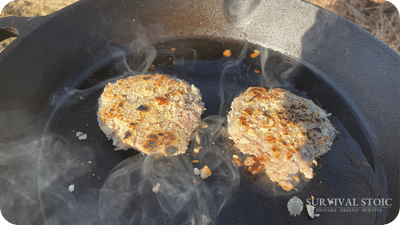
Tuna cakes with crackers
Dinner:
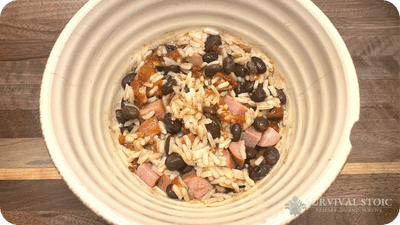
Rice and beans again, with different seasoning or hot sauce
Notes:
This is where variation matters. The base ingredients are the same, but changing the preparation makes it feel like a different meal. Tuna cakes are a good example of turning something basic into something people will actually want to eat.
Day 3
Breakfast:
Oatmeal or crackers with peanut butter
Lunch:
Leftovers or simple soup
Dinner:
Brunswick-style stew or lentil soup using canned ingredients
Notes:
This day leans more on one-pot meals. These are efficient, filling, and easy to scale for a family.
How This Scales to 30 Days
You are not building 30 different days.
You are building a small rotation like this and repeating it:
- Rice and beans become multiple meals depending on the seasoning
- Canned meat shifts between dishes
- Oats show up in different forms
- Simple recipes rotate in and out
Field note: This is where most plans fail. People store ingredients but never connect them into actual meals. When the time comes, they end up eating everything separately.
If you can look at your pantry and immediately see meals like rice and beans, tuna cakes, or simple dumplings, the system works. If you cannot, it will break down under stress.
How to Store This Without Wasting It
A 30-day food supply only works if you can maintain it.
Most people do not fail at buying food. They fail at managing it. Food gets pushed to the back of the pantry, forgotten, and eventually thrown away. That turns a good plan into an expensive mistake.
The goal here is simple. Your emergency food should be part of your normal food system, not separate from it. These food storage mistakes are more common than you think.
Use What You Store
This is the core rule. If you store something, you should already be eating it in your regular routine. That way, nothing sits untouched long enough to expire.
Rice, pasta, canned goods, peanut butter, oats. These should already be part of your weekly meals. Your 30-day supply is just a deeper version of what you already use.
Build a Simple Rotation System

Once your pantry is stocked, the next step is learning how to rotate emergency food so nothing gets pushed to the back and forgotten. You do not need anything complicated.
- New items go to the back
- Older items move to the front
- Use from the front first
That is enough for most households.
If you want to take it one step further, mark the month and year on cans and boxes when you bring them home. It takes a few seconds and removes any guesswork later.
Keep It Accessible
If your food supply is difficult to reach, you will not use it.
Avoid storing everything in hard-to-access areas like attics or deep storage bins. At least part of your supply should live in your everyday pantry space. Convenience is what makes rotation happen without effort.
Separate a Small “Do Not Touch” Buffer
If you have the space, keep a small portion of your supply set aside.
This acts as a true emergency reserve while the rest rotates normally. It prevents your system from being completely depleted during busy weeks or unexpected situations.
Watch for the Quiet Failures
These are the things that usually go wrong:
- Buying food you do not normally eat
- Letting items expire in the back of shelves
- Storing too much of one item and ignoring others
- Forgetting to replace what you use
None of these are dramatic mistakes, but they add up over time.
A good storage system is not about organization for its own sake. It is about making sure your food is always ready to use.
For a deeper system that covers shelf life, containers, and long-term rotation, see our full guide on How to Store Food Long-Term.
How We Tested This System
This system was not built from a spreadsheet. It was built by using it.
We ran planned pantry-only periods where we relied entirely on shelf-stable food. No grocery runs, no fresh ingredients, no shortcuts. The goal was to see what actually holds up when your options are limited.
We treated it like a real constraint, not a thought experiment.
The Constraints We Worked Under
- No reliance on fresh food
- Limited prep time and energy
- Simple cooking methods only
- Feeding a full household, not just one person
Meals had to be repeatable, fast, and forgiving. If something required too much effort or attention, it was removed or adjusted.
What Broke First
A few patterns showed up quickly.
Meals that looked good on paper but required multiple steps were skipped. Ingredients that were unfamiliar or unappealing sat untouched (especially by the kids). Repetitive meals reduced appetite faster than expected, especially for kids.
We also saw how easy it was to drift toward low-effort, low-calorie eating. Snacking replaced real meals if the plan was not simple enough.
What Actually Worked
Simple combinations carried the system.
Rice and beans showed up constantly, but only when paired with seasoning or added protein. One-pot meals like soups and stews were reliable because they required less effort and cleanup.
Ready-to-eat foods fill in the gaps on low-energy days. Oats, peanut butter, and canned meals were used far more often than expected. Meals that felt familiar were used more consistently. That mattered more than variety.
What We Changed After Testing
We adjusted the plan in a few key ways:
- Added more fat to improve satiety
- Increased ready-to-eat options
- Reduced reliance on complex meals
- Built in more flavor options to prevent fatigue
We also made sure every core ingredient could be used in multiple ways. That flexibility made the system easier to maintain.
The takeaway is simple: A food supply is only as good as your ability to use it under pressure. Testing reveals what works. More importantly, it shows you what does not.
In the next section, we will break down what this actually costs and how to build it without overspending.
Budget Breakdown: What This Actually Costs
A 30-day food supply does not have to be expensive. It only gets expensive when it is built inefficiently.
If you focus on staple foods and build this through normal grocery trips, the cost stays manageable. Most of the calories in this system come from inexpensive items like rice, oats, pasta, and beans.
Estimated Cost Per Person (30 Days)
A realistic range for a grocery-based 30-day supply is:
- Budget approach: $120 to $180 per person
- Mid-range (more convenience foods): $180 to $300 per person
For a family of four, that puts you roughly between:
- $480 to $1,200 total
The wide range comes down to choices. You can build this almost entirely from bulk staples, or you can include more canned meals, ready-to-eat options, and comfort foods.
Both approaches work. One just trades cost for convenience.
Where to Save
Some categories offer easy savings without hurting the system:
- Staple calories like rice, oats, and pasta
- Dry beans instead of all canned options
- Store brands instead of name brands
These items make up the bulk of your calories. Keeping them inexpensive has the biggest impact on total cost.
Where Not to Cut Corners
Other areas are worth spending a little more on:
- Protein variety, so meals stay usable over time
- Ready-to-eat foods for low-energy days
- Comfort items that help maintain routine
Cutting these too aggressively makes the system harder to stick with. That usually leads to wasted food or skipped meals, which defeats the purpose.
Build It Gradually
You do not need to buy everything at once.
A simple approach is to add a few extra items to each grocery trip:
- One staple
- One protein source
- One convenience or comfort item
Over a few weeks, this builds into a full system without a high upfront cost.
A Practical Way to Think About Cost
This is not extra food. It is stored time. You are buying the ability to avoid crowded stores, empty shelves, and rushed decisions. That has value beyond the price of the food itself.
In the next section, we will look at when it makes sense to supplement this system with emergency food kits and ready-to-eat options.
When to Supplement With Emergency Food Kits
A grocery-based 30-day supply should be your foundation. It is flexible, affordable, and easy to rotate.
That said, it is not perfect.
There are situations where having a second layer of food makes sense. This is where emergency food kits and ready-to-eat meals come in.
The First 72 Hours Problem
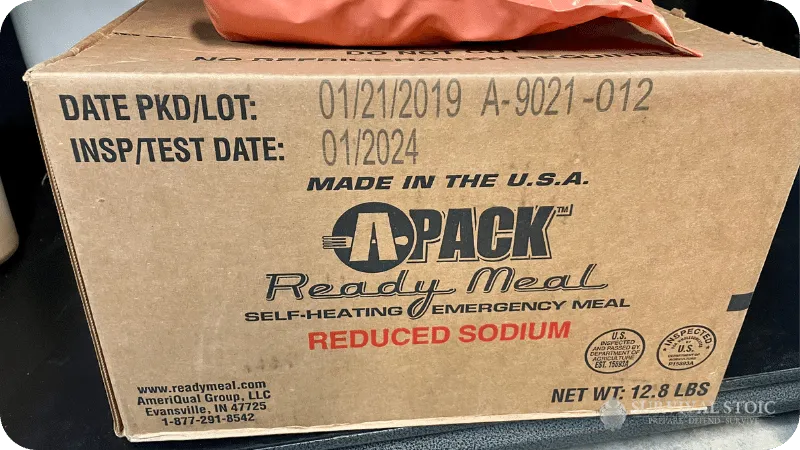
The beginning of a disruption is often the most chaotic.
You may not have time, energy, or even the ability to cook. Utilities may be unreliable. Your focus is on stabilizing the situation, not preparing meals from scratch.
This is where ready-to-eat options shine.
Meals that require little or no preparation allow you to eat without adding more work. They buy you time to settle into a routine before relying on your full pantry system.
Fuel and Cooking Constraints
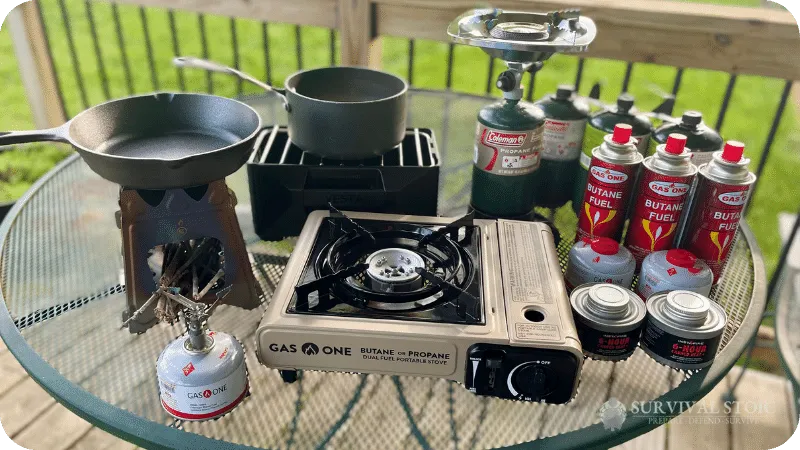
Even a simple plan assumes you can heat water or cook basic meals.
If fuel is limited or if your cooking setup is unreliable, your grocery-based system becomes harder to use. Staples like rice and beans require time and energy to prepare. Emergency food kits, especially freeze-dried meals, reduce that burden. Many only require hot water, and some can be eaten with minimal preparation.
Consider investing in one of the best emergency stoves so you can at least boil water after the power goes out.
Longer Shelf Life and Backup Storage
Grocery store food works well for rotation, but it still requires maintenance. Emergency food kits offer long shelf life with very little oversight. They can sit in storage for years and still be ready when needed.
This makes them useful as a secondary layer. Your everyday pantry handles short-term use. Your kits act as a backup if something disrupts your normal rotation.
Where They Fit in Your System
Think of it in layers:
- Primary layer: Grocery-based 30-day supply
- Secondary layer: Emergency food kits for backup and low-effort meals
- Short-term layer: Ready-to-eat foods for immediate use
Each layer solves a different problem. Together, they create a more resilient system.
Common Questions
These are the questions that usually come up once people start building a real 30-day supply.
How long will this actually last?
Thirty days is a target, not a guarantee.
If calorie needs increase, portions get larger, or you are feeding extra people, your supply will shrink faster. On the other hand, careful portioning and simple meals can stretch it beyond 30 days.
This is why building in a small buffer matters. It gives you room to adjust without running short.
Can you live on this long-term?
You can live on it for a while. That is the point.
This system is designed for stability, not optimization. It provides enough calories and variety to get through a disruption without major issues. For long-term use, you would want to expand it with more variety, fresh food sources, and additional storage methods. But for 30 days, this is more than sufficient.
What about special diets?
The framework stays the same. You still need calories, protein, fat, and simple meals. The difference is in the specific foods you choose. Gluten-free, low-sodium, or other dietary needs can be worked into the system by swapping ingredients, not redesigning the entire plan.
The key is to build around foods you already eat, not introduce completely new ones.
How do you cook if the power is out?
You need a basic alternative cooking method.
A simple camp stove, grill, or other off-grid option is enough for most of these meals. Many recipes only require boiling water or heating a single pot. We even have an entire article on ways to boil water without electricity for this purpose.
You should also include some no-cook foods in your plan. That gives you flexibility if cooking is not possible for a period of time.
Do I need to store water too?
Yes. Food without water is not a complete system. Many staple foods require water to prepare, and your body needs water to process calories properly.
At a minimum, you should have a plan for both drinking water and cooking water alongside your food supply.
Is this better than buying emergency food kits?
It serves a different purpose.
A grocery-based system is easier to build, cheaper, and more flexible. Emergency food kits are useful as a supplement, especially for long shelf life and low-prep situations. Most people benefit from having both, with grocery food as the foundation.
Bottom Line
A 30-day food supply does not eliminate risk. It removes urgency.
When the basics are handled, you are no longer reacting to empty shelves or crowded stores. You are operating from a position of stability. That changes how you think and how you act.
Stoicism is not about preparing for dramatic scenarios. It is about reducing the number of things that can disrupt your judgment. Food is one of the simplest places to start.
A full pantry is not impressive. It is quiet. It does its job in the background. And when something does go wrong, it turns a problem into something manageable.
If you are building this out further, the next step is expanding from 30 days to a full system using our Survival Food Guide.
To stay updated on our newest guides, subscribe to our newsletter.
